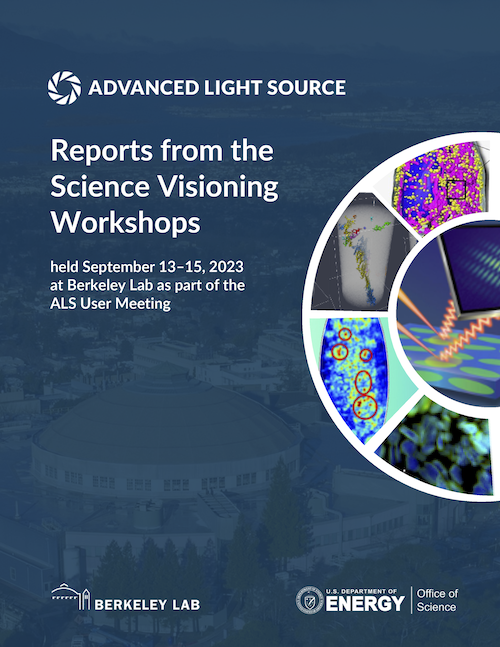
October 2023 marked the 30th anniversary of first light at the ALS. With new opportunities on the horizon prompted by the ALS Upgrade (ALS-U), in summer 2023 the ALS embarked on a strategic visioning exercise to define the evolution of its science portfolio into the 2030s and where investments will be needed to realize the vision.
The output from four science visioning workshops, in the fields of Condensed Matter and Quantum Materials, Energy Sciences, Earth and Environmental Sciences, and Biosciences, formed a critical part of the visioning exercise, helping to identify priority science areas for the ALS and emerging research goals and are informing the next iteration of the ALS’s five-year strategic plan. These workshops were held at the 2023 ALS User Meeting at Lawrence Berkeley National Laboratory (Berkeley Lab) September 13–15, 2023.
Each workshop was planned and executed by a separate workshop organizing team, consisting of members internal to the ALS and from the broader external user community. Those teams planned a program with invited participants, comprising a diverse group from a range of career stages and backgrounds, and the workshops were also open to anyone from the scientific community to participate.
Each workshop was charged, within its area of science, to:
- Identify key scientific challenges and priority long-term research opportunities that the ALS’s capabilities could evolve to address 10 years from today.
- Delineate key enabling synchrotron or related capabilities needed to realize these research opportunities.
- Articulate the most critical partnerships and which new partnerships or collaboration modalities would have the most potential for impact.
The reports compiled in the document shown above reflect the user and broader scientific communities’ viewpoints as presented and discussed in these workshops.
Details and descriptions of those workshops are archived below.
Biosciences
Organizing Committee: Greg Hura, co-chair (MBIB, LBNL), Andrej Sali, co-chair (UCSF), Marc Allaire (MBIB, LBNL), Diane Bryant (ALS, LBNL), Scott Fraser (Univ. Southern Calif.), Lisa Miller (NSLS-II, Brookhaven), Ritimukta Sarangi (SSRL, SLAC)
Location: 33-106
Zoom link – Updated 9:20 am on September 14
View the: Agenda | Workshop Page
[su_spoiler title=”Description” icon=”chevron” class=”header6″]
The Biosciences Visioning Workshop seeks to generate ideas, guidance, and inspiration for the ALS and its user community on how light sources can best contribute to bioscience breakthroughs over the next decade. The ALS synchrotron has contributed significantly to and has been a special place for research in the biosciences. Of particular note has been its contributions to structural biology. The successes in structural biology have warranted tremendous investments both at the ALS and in other techniques like electron microscopy and computational modeling. For structural biology, the ALS has been more than a light source, and has also served as a hub for a vibrant user community that extended results in many other ways. The ALS has broadened its biological technique portfolio beyond structural biology and has beamlines that can probe inter-organelle spaces, cells, biofilms, and biological tissues. As a unifying theme for biological programs, our workshop will have a focus on the ALS as a unique place to integrate information from multiple scales and multiple dimensions including temporal and chemical. We will identify ways to strengthen existing user programs and identify gaps where new capabilities could be developed. In this workshop we will look forward to the ways the ALS can retain its role in optimally serving the biosciences post-pandemic and post-ALS upgrade.
[/su_spoiler]
Condensed Matter & Quantum Materials
Organizing Committee: Aaron Bostwick, co-chair (ALS, LBNL), Ming Yi, co-chair (Rice), Alex Frañó (UC San Diego), Mingda Li (MIT), Hendrik Ohldag (ALS, LBNL), Chris Palmstrøm (UC Santa Barbara), Sujoy Roy (ALS, LBNL), Feng Wang (UC Berkeley/LBNL)
Location: 59-3101
Zoom link
View the: Agenda | Workshop Page
[su_spoiler title=”Description” icon=”chevron” class=”header6″]
The Condensed Matter & Quantum Materials Visioning Workshop will explore how the ALS can advance the design and understanding of new synthetic materials and their electronic, spin, chemical, and physical properties. We solicit ideas from visionaries and experts in quantum materials to discuss challenges and opportunities for the future of the ALS, taking advantage of the upcoming upgrade to coherent light to address both fundamental physics and applications of condensed matter physics related to spin and quantum properties of materials, including but not limited to material engineering and discovery (e.g., atomically engineered multilayers, 2D materials, and materials that exhibit unusual topological and correlated electronic phases), multimodal characterization, application of machine learning and artificial intelligence to enable new acquisition methodology, sample environment control for in situ electronic phase tuning and operando characterization, and advanced instrumentation to extract novel response functions.
[/su_spoiler]
Earth & Environmental Sciences
Organizing Committee: Martin Kunz, co-chair (ALS, LBNL), Tamas Varga, co-chair (Pacific Northwest National Laboratory), Harold Barnard (ALS, LBNL), Michelle Devoe (UC Berkeley), Hoi-Ying Holman (MBIB, LBNL), Harry Lisabeth (LBNL), Matthew Marcus (ALS, LBNL), Hope Michelsen (CU-Boulder), Brandy Toner (Univ. Minnesota)
Location: 15-253
Zoom link
View the Agenda | Workshop Page
[su_spoiler title=”Description” icon=”chevron” class=”header6″]
The Earth and Environmental Science Visioning Workshop will focus on the structure and function of natural systems across spatial scales (from the atomic scale to the macroscale) as well as temporal scales. The high brightness, coherence, and broad spectral range of the ALS’s synchrotron light source allows in situ and operando direct probes of the chemistry and structure of earth and environmental systems to better understand complex processes occurring in natural environments. Our workshop’s goal is to identify key scientific challenges and research opportunities, and envision how ALS’s instrumental capabilities and collaborative partnerships should evolve to address those 10 years from today. Special emphasis will be placed on problems with high societal impact within research focused on the water cycle, carbon cycle, changing climate, environmental stressors, critical zone, geo/mineral physics, planetology, volcanism, bio/geochemistry and geomicrobiology. We solicit new ideas for how the ALS’s multimodal, in situ, high-resolution 2D and 3D imaging, spectromicroscopy, scattering, and diffraction techniques can be used in tandem with traditional laboratory and other techniques to improve our molecular level understanding of earth and environmental phenomena. We will discuss current science drivers, existing and future beamline capabilities as well as computational, modeling, and data science tools that will be able to support future science needs as well as drive the science of the next decade.
[/su_spoiler]
Energy Sciences
Moni Blum, co-chair (ALS, LBNL), Will Chueh, co-chair (Stanford), Greg Su, co-chair (ALS, LBNL), Dean DeLongchamp (NIST), Alex Hexemer (ALS, LBNL), Whitney Loo (Univ. Wisconsin), Karthish Manthiram (Caltech), Wanli Yang (ALS, LBNL), Iryna Zenyuk (UC Irvine)
Location: 91-310
Zoom link
View the: Agenda | Workshop Page
[su_spoiler title=”Description” icon=”chevron” class=”header6″]
The Energy Sciences Visioning Workshop will address critical research directions that crosscut renewable energy disciplines. Moreover, this workshop seeks to determine how the high flux, coherence, and spectral range of the future ALS are uniquely positioned to advance priority research directions in energy science. Transformative progress in fundamental energy science requires probing transport, structure, and function in complex systems across different length and time scales and under realistic conditions. This workshop will bring together scientists to discuss opportunities in various areas, including chemical manufacturing and catalysis, separations, energy storage and conversion, carbon dioxide capture, conversion, and storage, and new experimental probes. These topics will connect ALS capabilities that span high resolution imaging, scattering, and spectroscopy to advances in materials synthesis, multimodal characterization, and theory and simulations.
[/su_spoiler]