New information regarding proposal calls is now available below. Last page update: August 4, 2026
The ALS Upgrade (ALS-U) project is in its construction phase. As of fall 2025, all of the accumulator ring magnet rafts have been mechanically installed. Still to come is the storage ring, which will be installed during the dark time period, projected to start no sooner than October 2027 and last 22 months. This page outlines the upcoming steps and anticipated impacts on the user community.
- Before the Dark Time
- During the Dark Time
- Transition to Operations
- Ramp-Up to Full Performance
- Feedback and Questions
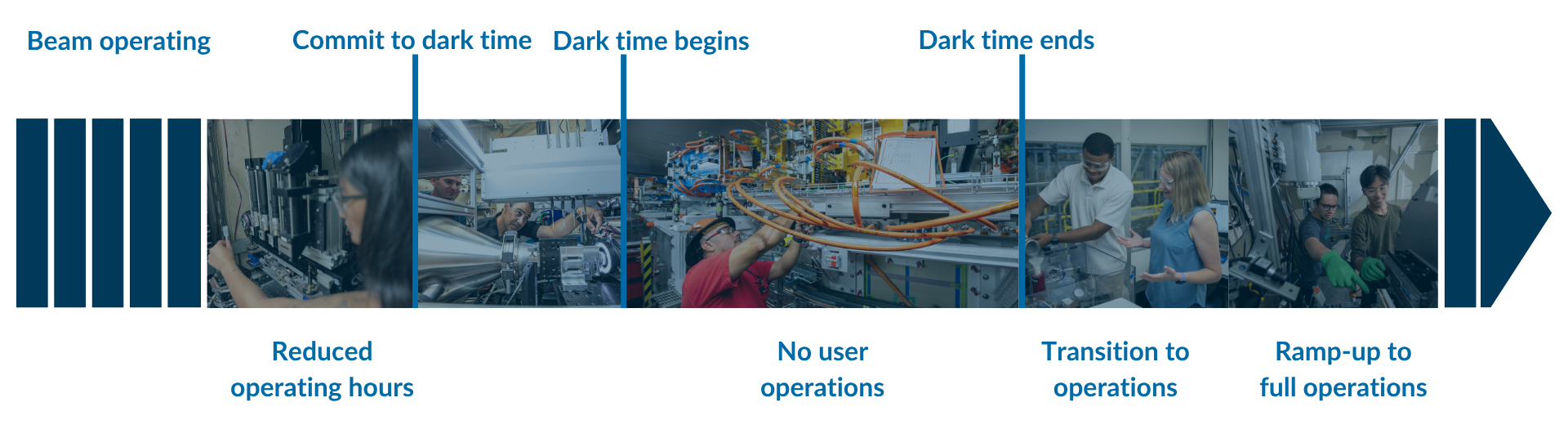
Before the Dark Time
The ALS will continue to provide as much beam as possible to users until the dark time begins. We understand the importance of planning your projects and research, and we are developing resources to help you explore potential facilities and capabilities to access during the ALS dark time. We will keep you apprised of our timeline and ways we can support your work. We are also continuing to develop beamline-specific operational plans and will communicate these details as they become available.
What to Expect
Operating Schedule
View: ALS Operating Schedule
- 2026-2 Cycle (July–December): No beam in the second half of 2026. The ALS will shut down in early July through the end of the calendar year for the replacement of the switch station through which all power for the ALS accelerator comes.
Upcoming Building Closures Safety barriers and exclusion zones will be strictly enforced during crane work. UPDATE: N2 Parking Lot will be closed July 24 until further notice. Daily Timeframe: 6:00 AM – 6:00 PM (06:00–18:00) Interior and Exterior Areas Closure Date(s): September 28 Resources and Maps
- 2027-1 Cycle (January–June): Several months of beam, anticipated to begin in late January. Accumulator ring commissioning will require a month-long period in the spring without user operations. Following this, continued accumulator commissioning will require approximately six weeks of reduced user operations. During that time, the ALS will be shut down for approximately four days per week. The detailed cycle schedule will be announced this fall.
- 2027-2 Cycle (July–December): At least three months of beam, depending on the final dark time start date. We don’t plan to have an extended shutdown in summer 2027. Detailed schedule anticipated in spring 2027.
Regular shorter maintenance shutdowns and accelerator physics shifts will continue as usual, but additional time will be needed each week to support the accumulator ring commissioning. This schedule is critical to maintain the reliable operation of the current ALS, and accelerator physics time helps minimize the ALS-U commissioning risk. See the Operating Schedule for the latest information.
The ALS-U Project schedule has been updated. The start of dark time is planned to start no earlier than October 2027 and will last at least two years.
Proposal call plans
- UPDATED: General user proposals: We will issue a call for new General User proposals (GUPs) and beamtime requests (BTRs) on existing GUPs this summer, with a September 2, 2026, deadline.
- RAPIDD: The RAPIDD access path will be open for urgent access requests and for experiments that can be finished within a single cycle. Contact the beamline scientist(s) to see if a RAPIDD proposal is appropriate for your experiment.
- Existing Approved Programs will pause when the ALS goes dark and then will resume afterwards. We do not plan to issue calls for new APs before the dark time.
Beamlines
- Most beamlines will operate until the dark time begins.
- See the Post-ALS-U Beamline Status Table on this page for more information.
During the Dark Time
The facility’s dark time, the timeframe without any user operations, is when the present-day ALS storage ring will be removed and a new ring built and commissioned in its place. This period is currently expected to last at least two years. Storage-ring removal and installation will be longer than originally expected due to preparation of the site and storage-ring commissioning. Bend-magnet beamlines will be moved, some beamline upgrades will be performed, and beamline commissioning will begin. Please check back for more details on this as we continue to work on the schedule.
What to Expect
- The accelerator will be turned off until storage-ring commissioning begins; there will be no user operations on the experimental floor.
- The experimental floor will be a construction zone with limited access.
- Possible intermittent multiday closures of portions of Building 6 due to crane work.
- Additional construction impacts include changes to pedestrian and vehicular traffic routes, some additional noise and vibration, and power and cooling-water outages of a few days each at the beginning and end of the dark time.
Transition to Operations
The dark time will be followed by a transition period to operations, when beamlines will be brought back online and accelerator commissioning will continue. The ALS-U project team is currently working to determine the order in which beamlines will be turned on.
What to Expect
- Beamlines will be in commissioning. There will be no general user operations, but collaborative access may be possible.
- Operations during this period will likely be characterized by low current, beam instabilities, and beam interruptions. Beamlines that have returned to operation may require further commissioning past the transition to operations period or may need to wait for the storage-ring current to reach a certain value at which experiments become feasible for full user operations to resume on that particular beamline.
- Additional time past the transition-to-operations period will be needed to return all beamlines to operation.
The ALS-U project will end when CD-4 is approved upon demonstration of the project’s threshold key performance parameters (KPPs).
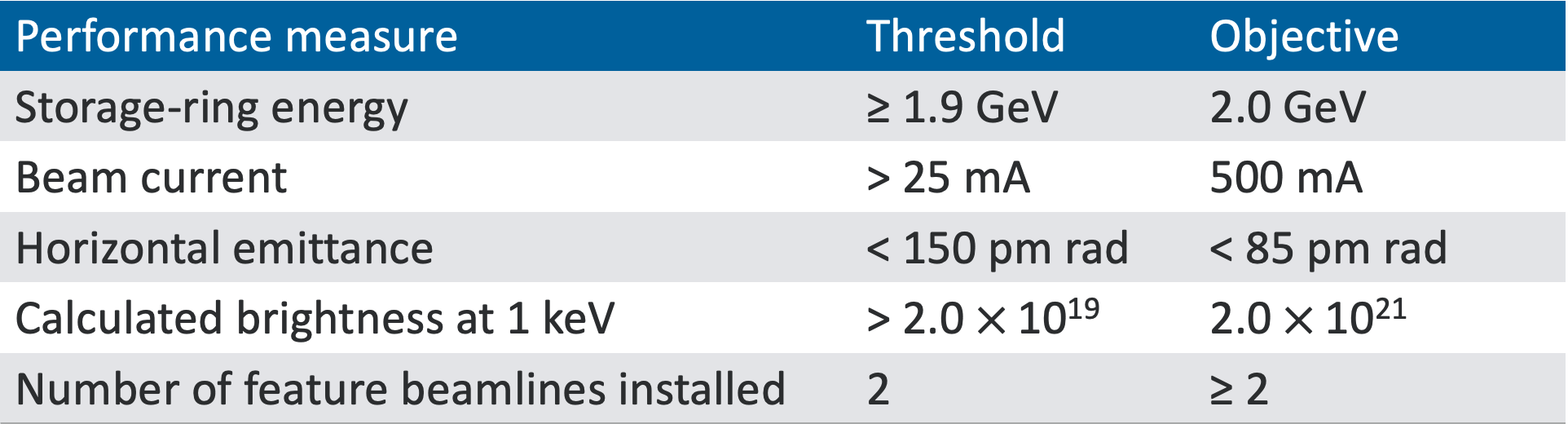
ALS-U project key performance parameters (KPPs). Threshold KPPs must be achieved before the project can end. Objective KPPs are the desired operational goal.
Ramp-Up to Full Operations
Accelerator development and beamline commissioning will continue. Any beamlines not yet returned to operations will be brought online.
What to Expect
- Available beamtime will increase as the accelerator current ramps up and beam instabilities are mitigated and interruptions decrease.
- Another six months (one year past the end of the dark time) or more may be needed to get to a full steady state of user operations. It could take longer to reach the target current of 500 mA.
- RAPIDD proposals will be phased in as beamlines become available. Formal proposal calls will resume when beamlines are fully operational.
Feedback and Questions
Feedback and questions are welcomed.
- Email a member of ALS leadership (see staff directory)
- Contact the Users’ Executive Committee at alsuec@lbl.gov
- For specific questions about beamline capabilities, you may also contact the beamline scientist
Last page update: September 23, 2026