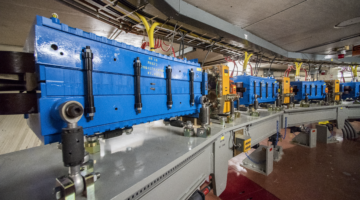
DOE’s Genesis Mission awarded Phase II funding to Berkeley Lab’s Multi-Office Accelerator Team (MOAT) to expand its Super Intelligence assistant, first launched at the ALS, helping optimize our facility during ALS-U for thousands of researchers. Read more »
All News & Updates
How the Advanced Light Source Is Accelerating Our Quantum Future
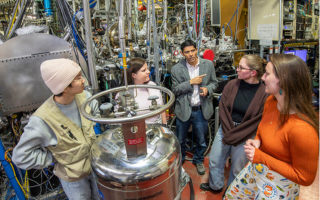
The Advanced Light Source Upgrade project will generate brighter beams of X-ray light, allowing researchers to push the boundaries of quantum materials research further by collecting data with far greater detail than has been possible before. Read more »
Planning a New Era of Discovery with ALS-U
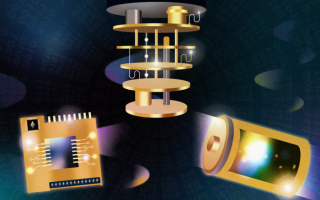
The ALS is undergoing an ongoing upgrade that will increase our brightness by at least 100 times compared with the current accelerator and improve X-ray coherence. Read about how this leap in brightness will enable groundbreaking sensitivity and precision, empowering researchers to see our world like never before. Read more »
Researchers Confirm Low-Nickel Cathode Resists Degradation
Researchers confirmed that a radially graded, low-nickel cathode sustains reversible oxygen redox across repeated cycling, enabling high capacity with minimal degradation. This cathode could cut nickel usage in electric vehicle batteries, lowering supply risk and financial and environmental costs, while preserving energy density and lifespan. Read more »
Hidden State Precedes Superconductivity in Kagome Metal
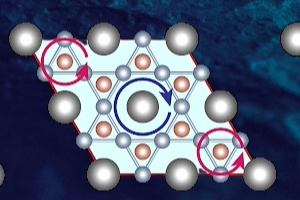
Experiments at the ALS revealed a hidden electronic phase that breaks time-reversal symmetry before a charge-density wave forms in a kagome metal. Because hidden electronic order can compete with or shape superconductivity, this finding helps guide the search for high-temperature, unconventional superconducting materials. Read more »
Scientists Uncover How Calcite Repairs Cracks in Its Structure
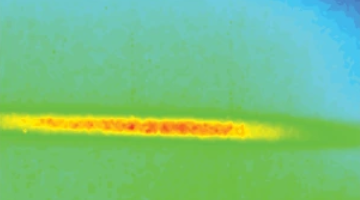
Researchers uncovered how calcite repairs cracks in its structure over time. These findings could improve reservoir management for extracting resources such as geothermal energy from the Earth. Read more »
ALS-United: Elmie Peoples-Evans and Fernando Sannibale
ALS-United is an opportunity to meet the people collaborating at the Advanced Light Source and the ALS Upgrade project. Hear firsthand how team science enables the cutting-edge research of today and builds the facility of the future. This month, we spoke with Elmie People-Evans, project manager for the ALS Upgrade, and Fernando Sannibale division deputyRead More Read more »
Microscopy Reveals How Early Human Diets Led to Tougher Teeth
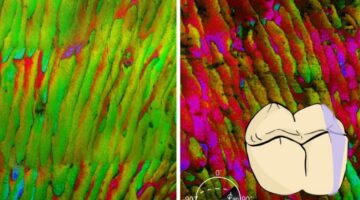
Microscopy at the ALS revealed that nanocrystal misorientation in tooth enamel tracked major dietary shifts in primates, contributing to enamel’s resilience. These structural details provide a blueprint for developing tougher, crack-resistant bioinspired materials, next-generation structural ceramics, and coatings. Read more »
Deadline for General User Proposals is September 2

The User Office is accepting new General User Proposals (GUPs) and beamtime requests (BTRs) on existing GUPs. The deadline for submissions is September 2, 2026. Please read the upcoming schedule information closely and contact alsproposals.lbl.gov with any questions.
Read more »
In Memoriam: Jim Underwood, Retired Berkeley Lab Physicist
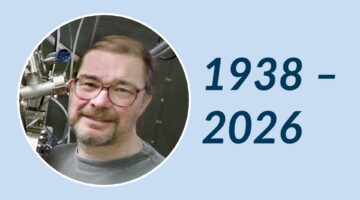
We are saddened to report the passing of Jim Underwood, who made many significant contributions to the early days of the Advanced Light Source and the Center for X-ray Optics. Read more »
- 1
- 2
- 3
- …
- 145
- Next Page »