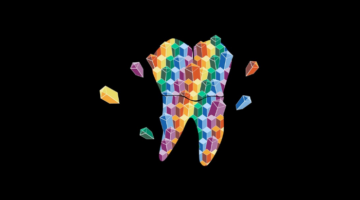
Researchers use the Advanced Light Source to better understand how misorientation at the nanoscale makes for tougher teeth. Read more »
Science News
Raising the Floor for X-Ray Grating Precision
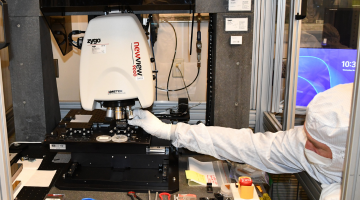
A collaboration between DOE user facilities and industry is redefining the precision with which synchrotron gratings can be fabricated and measured, advancing the optics that power X-ray science worldwide. Read more »
Accelerator Team Receives DOE Genesis Mission Phase II Funding
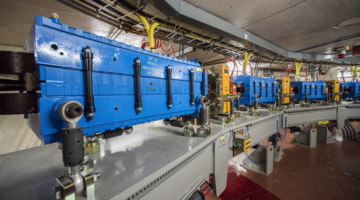
DOE’s Genesis Mission awarded Phase II funding to Berkeley Lab’s Multi-Office Accelerator Team (MOAT) to expand its Super Intelligence assistant, first launched at the ALS, helping optimize our facility during ALS-U for thousands of researchers. Read more »
Seeing Double: Dual Measurements of Ceria Provide Insights for Catalysis
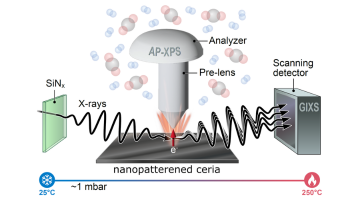
In a recent study at the ALS, researchers employed an approach that combines two techniques and uses a single X-ray beam to capture both chemical and structural changes in nanopatterned ceria during catalytic reactions. Read more »
Strength in Numbers: Nanopatterns Amplify X-Ray Signals from Buried Interfaces
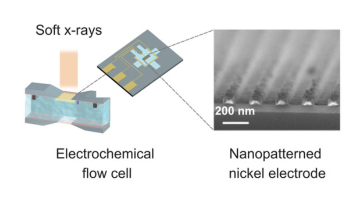
Berkeley Lab researchers developed a new x-ray technique that uses nanoscale patterns to amplify weak signals, allowing scientists to observe chemical reactions at buried solid–liquid interfaces that were previously challenging to study. Read more »
Aerosol Chemistry Offers Clues to the Arctic’s Future

Researchers used scanning transmission x-ray microscopy to analyze Arctic aerosols, which strongly influence cloud formation and overall climate. Understanding what these particles are and how they change as they travel could help improve climate models and yield more accurate predictions of the changing Arctic environment’s global impact. Read more »
How Zinc Alters Mineral Structure in Early Arthritis
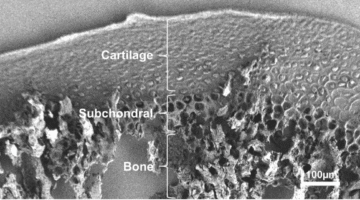
Using high-resolution x-ray techniques, researchers from UCSF, the ALS, and SSRL uncovered structural evidence that zinc subtly alters bone mineral in vulnerable joint regions, revealing early changes that may explain how arthritis begins and progresses. Read more »
The Goldilocks of Ethylene Purification
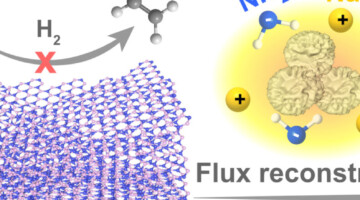
Researchers engineered defects in boron nitride to develop a metal-free route for purifying ethylene to remove acetylene. The ALS shed light on how the engineered defects were responsible for exceptional selectivity. Read more »
Altermagnetism All the Way Down
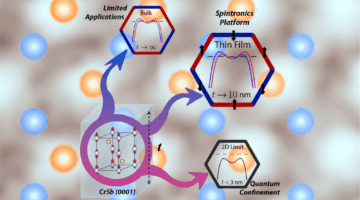
Altermagnets are an emerging class of magnetic materials that offer the potential for energy-efficient, high-density memory chips. Researchers at Penn State, UC Santa Barbara, and the ALS demonstrated that characteristic altermagnetic band splitting in chromium antimonide is evident in thin films relevant for real-world device application. Read more »
To Study Alien Atmospheres, ALS Fractures Nitrogen Gas
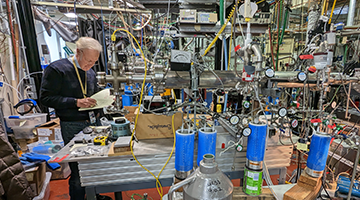
A research team used the ALS to recreate how the Sun breaks apart nitrogen to inform a new model that can be used to understand the fate of a variety of elemental isotopes to explain atmospheric evolution on planets across the solar system. Read more »
- 1
- 2
- 3
- …
- 24
- Next Page »