by Ina Reichel
The 2026 winter shutdown started on January 2, and the ALS returned to user operations on Tuesday, February 3. It was the shortest shutdown the ALS has had since 2018; as a result, the current user run will be the longest one since 2018. One big accomplishment of the recent shutdown was the installation of the “golden bellows” connecting the accumulator ring vacuum with the rest of the ALS vacuum system.
Golden bellows

What exactly are bellows, and why do we need them?
The electrons (and photons) in the accelerator travel in an ultra-high vacuum that is comparable to the surface of the Moon. In most places, solid vacuum chambers made from aluminum, stainless steel, or copper are used to keep the air out. Most vacuum chambers in the storage ring are made from aluminum, but in the transfer lines between accelerator rings, the majority are made from stainless steel. Of course, they are all rigid structures. If they were all connected directly, the whole vacuum system from the linac through the booster to the storage ring and beamlines would be a very large, rigid structure. Any temperature change would result in the chamber changing dimensions. Any magnet settling down over time would put pressure on the chamber. These changes would increase the engineering demands on the whole accelerator complex to an unworkable level. So, instead of having one big rigid structure, the accelerator comprises many smaller ones linked by flexible “connectors” that can compress, expand, and allow for some transverse movement. This is called a bellows, and it looks a bit like an accordion. Many of them are used around the ALS.
What makes one of these connectors the “golden bellows?”
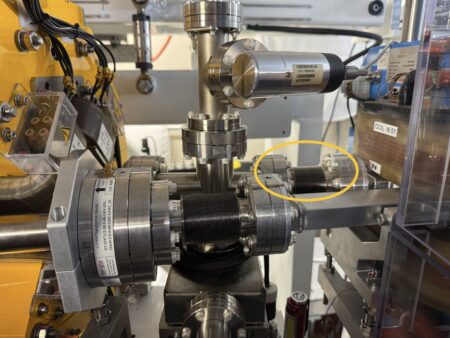
It’s not the material or even the color. Like the other bellows in the ALS, it’s made from stainless steel. But until the winter 2026 shutdown, the ALS had two completely separate vacuum systems. The “old” ALS included the linear accelerator (linac), booster ring, storage ring, assorted transfer lines, and the beamlines, with the accumulator ring (AR) having its own vacuum. During this shutdown, the team installed some of the vacuum chambers in the transfer line that will “feed” the AR and that branches off from the booster-to-storage-ring transfer line (BTS). The final bellows that actually connected the two vacuum systems with each other was dubbed the “golden bellows,” a name borrowed from the “golden spike” that connected the first transcontinental railroad in the United States (that was indeed made from gold and can be seen at the Cantor Arts Center at Stanford University).
Accumulator ring
The magnets and vacuum chambers for the AR were installed in previous shutdowns, enabling the team to start to connect the AR to the rest of the facility. This shutdown focused on cabling to connect magnets to power supplies for three of the twelve AR sectors.
Work was also done on the RF system for the AR, getting the two cavities that were installed in the ring last summer ready for conditioning, which needs to be done before they can operate with beam. In addition, the personnel protection system (PPS) for the AR RF system was completed.
Although all vacuum chambers in the AR had been installed previously, NEG activation remained incomplete. The inside of many of the vacuum chambers are coated “with non-evaporable getters” (NEGs). It’s kind of a sticky surface for air molecules that helps achieve and maintain the ultra-high vacuum needed since, at those low pressures with small tubes, there is not really a pressure gradient helping to get air molecules out. The NEG surfaces need to be heated to be activated. With the activation of Sector 12, this milestone now has also been reached.
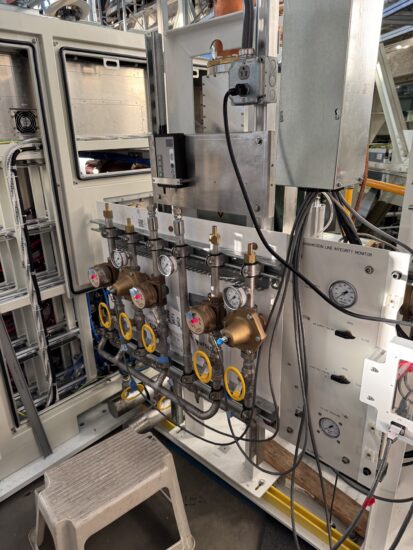
The magnets in the ALS are all cooled using low-conductivity water (LCW), a special form of demineralized water that contains very few ions. The coils that power the magnets are actually hollow, which allows LCW to flow through and cool the magnets. It’s important that the cooling water not have ions so it is not conducting. During the shutdown, a full flow test of the entire facility, including the AR, was performed to make sure that the LCW plant could supply the total required capacity given all the new flow paths added to the system. The ALS will require more LCW than previously during AR commissioning, while the AR and the old SR operate in parallel. Once the new SR is in place, the LCW flow in the ALS will be less than pre-ALS-U flow levels. To meet this peak demand, ALS-U upgraded the LCW system flow pump impellers during the 2025 summer shutdown.
Beamlines
Photon masks prevent x-rays from hitting any part of a beamline they are not supposed to hit. During the recent shutdown several new photon masks were installed in Beamline 6.0.1 (AMBER): two before and two behind the monochromator, and in addition at least two in each branchline. An additional one will be installed in the storage ring tunnel during the next shutdown.
All beamlines at the ALS are equipped with personnel safety shutters (PSSs). When the PSSs are closed, they prevent x-rays from entering the beamline. During this shutdown, the PSS shutters for Beamline 12.3.x were replaced, and the emergency switch for the Beamline 8.3.1 PSS was relocated.
Other work
A new integrating current transformer, which measures the current flowing through the transfer line (i.e., the number of electrons), was installed in the booster-to-storage-ring transfer line (BTS). In preparation for the installation of the new storage ring, a range of related activities were undertaken: additional electronics racks and their baseplates were installed; as noted in the previous shutdown article, a cable inventory was underway to ensure adequate space in the cable trays for all cables required by the new storage ring, and this work continued during the shutdown; many of the older bus-assembly electrical panels were replaced with power distribution units; and the power supplies of the horizontal corrector magnets in Sectors 4, 8, and 12 were replaced.