by Brooke Kuei
Scientific Achievement
Researchers combined in situ X-ray microcomputed tomography at the Advanced Light Source (ALS) with super-resolution techniques to characterize the microstructural evolution of superlight ablators during heating.
Significance and Impact
This work provides a detailed understanding of the evolution of materials that protect spacecraft from extreme heat during atmospheric reentry.
Protecting spacecraft at extreme temperatures
Spacecraft entering planetary atmospheres at hypersonic speeds, such as during the recent return of NASA’s Artemis II mission, are subjected to extreme heat. To protect the spacecraft and its crew, ablative thermal protection systems are designed to char, melt, and vaporize in a controlled way that dissipates the extreme heat of reentry.
Superlight ablators (SLAs) are lightweight thermal protection materials used in the backshells of spacecraft due to their low density and low thermal conductivity. Despite their mission relevance, the real-time microstructural evolution of SLAs during high-temperature chemical degradation is not well understood, such as how different fillers affect phase decomposition and porosity. In a study published in npj Materials Degradation, researchers used in situ X-ray microcomputed tomography (micro-CT) at ALS beamline 8.3.2 to track the real-time multiphase decomposition of SLAs in high-temperature environments that mimic atmospheric entry.
High-resolution, large-volume imaging during degradation
The researchers studied two commercial SLAs, SLA-220 and SLA-561V, chosen for their different filler compositions and complementary functional roles in separate parts of spacecraft backshells, including NASA’s upcoming mission to Saturn’s moon. To characterize these materials, the team drew on a decade-long partnership with the ALS and extended research residencies through the Department of Energy’s Office of Science Graduate Student Research (SCGSR) fellowship program, which were instrumental in developing the experimental and computational methodology used in this work.
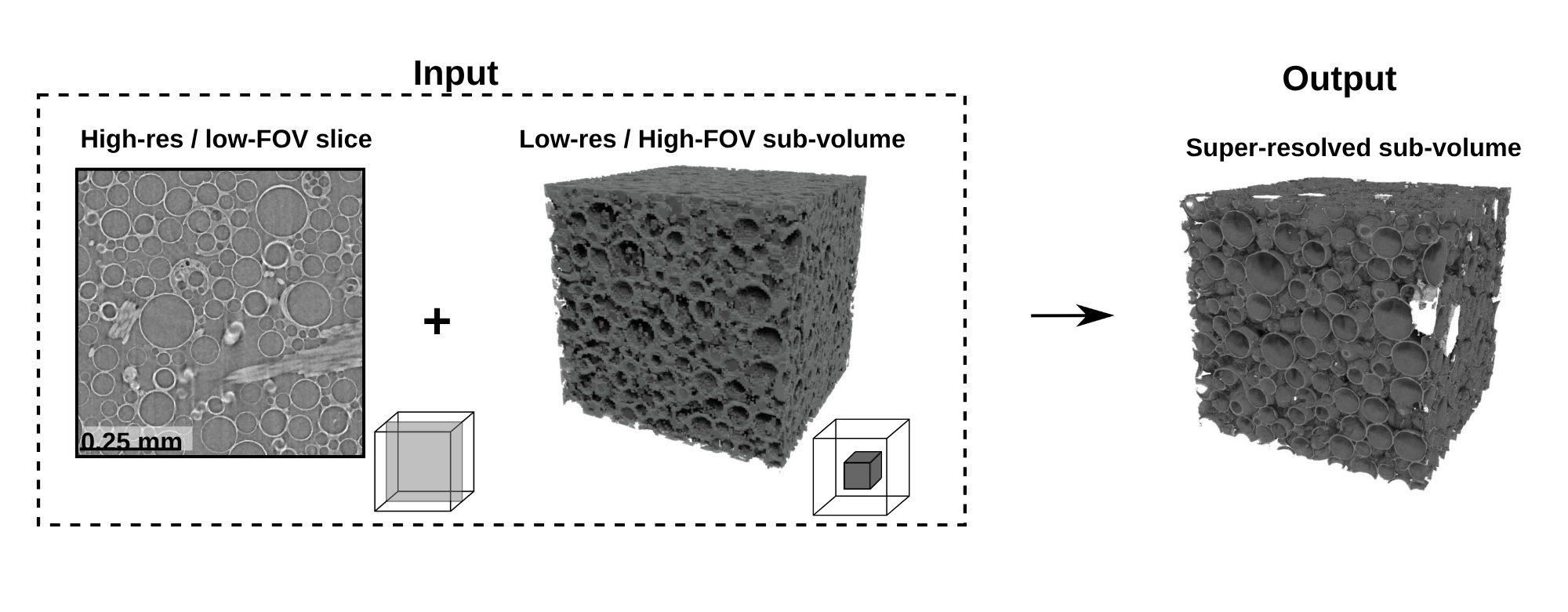
To balance the trade-off between rapidly collecting images of large, representative areas and capturing structural details at high resolution, the researchers used an AI-based super-resolution technique leveraging generative adversarial networks (GANs). The high flux of white light X-rays at beamline 8.3.2 enabled large-volume, lower-resolution micro-CT data to be collected at short intervals to track quickly changing features, while the ability to switch to a monochromatic beam allowed the collection of high-resolution images of the samples before and after heating. By using the high-resolution scans for GAN training, the team was able to super-resolve the full sequence of lower-resolution in situ scans, resulting in a complete, time-resolved 3D rendering of structural evolution throughout heating at a previously unachievable level of detail.

The role of filler composition in degradation behavior
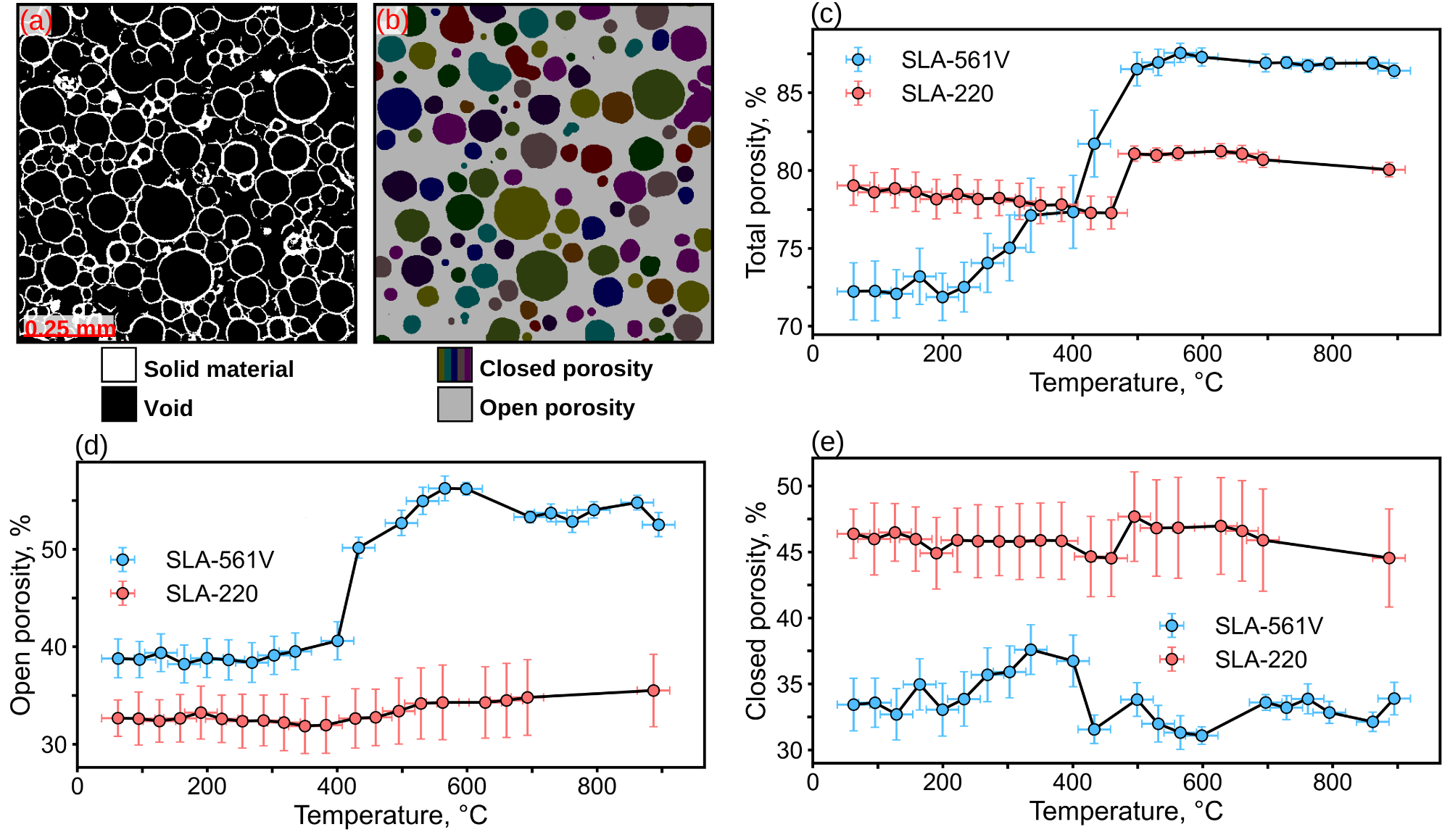
Despite belonging to the same class of materials, the researchers found that SLA-220 and SLA-561V undergo fundamentally different changes during degradation. SLA-561V contains cork, a natural, cellulose-based filler, which chemically decomposes as temperatures increase and leaves behind open voids. On the other hand, SLA-220 does not contain decomposing fillers, and its silicone elastomer matrix produced a complex pore network as it was heated.
These differences in porosity have direct implications on properties such as thermal conductivity and gas permeability, both critical to how thermal protection materials perform during atmospheric entry. The high-resolution, time-resolved microstructural data generated in this work provide a foundation for improving and validating the computational models that engineers rely on to design thermal protection systems for future space missions.
Contacts: Francesco Panerai
Researchers: C.W. Foster, S. Oruganti, and F. Panerai (University of Illinois at Urbana-Champaign).
Funding: National Aeronautics and Space Administration (NASA). DOE Office of Workforce Development for Teachers and Scientists, Office of Science Graduate Student Research (SCGSR) program. This work was also supported by the Laboratory Directed Research and Development program of Sandia National Laboratories. Operation of the ALS is supported by DOE BES.
Publication: C.W. Foster, S. Oruganti, and F. Panerai, “Super-resolved microstructure of pyrolyzing superlight ablators,” npj Mater. Degrad. 9, 9 (2025), doi:10.1038/s41529-025-00556-z.
ALS SCIENCE HIGHLIGHT #543