Dear users, staff, and friends of the ALS,
Looking back at an eventful 2025, the ALS and the ALS-U made exceptional progress in many areas. We continued to support impactful science across our research portfolio while preparing our now 32-year old facility, located under the iconic 80-year old dome, for the upgrade to a fourth-generation light source.
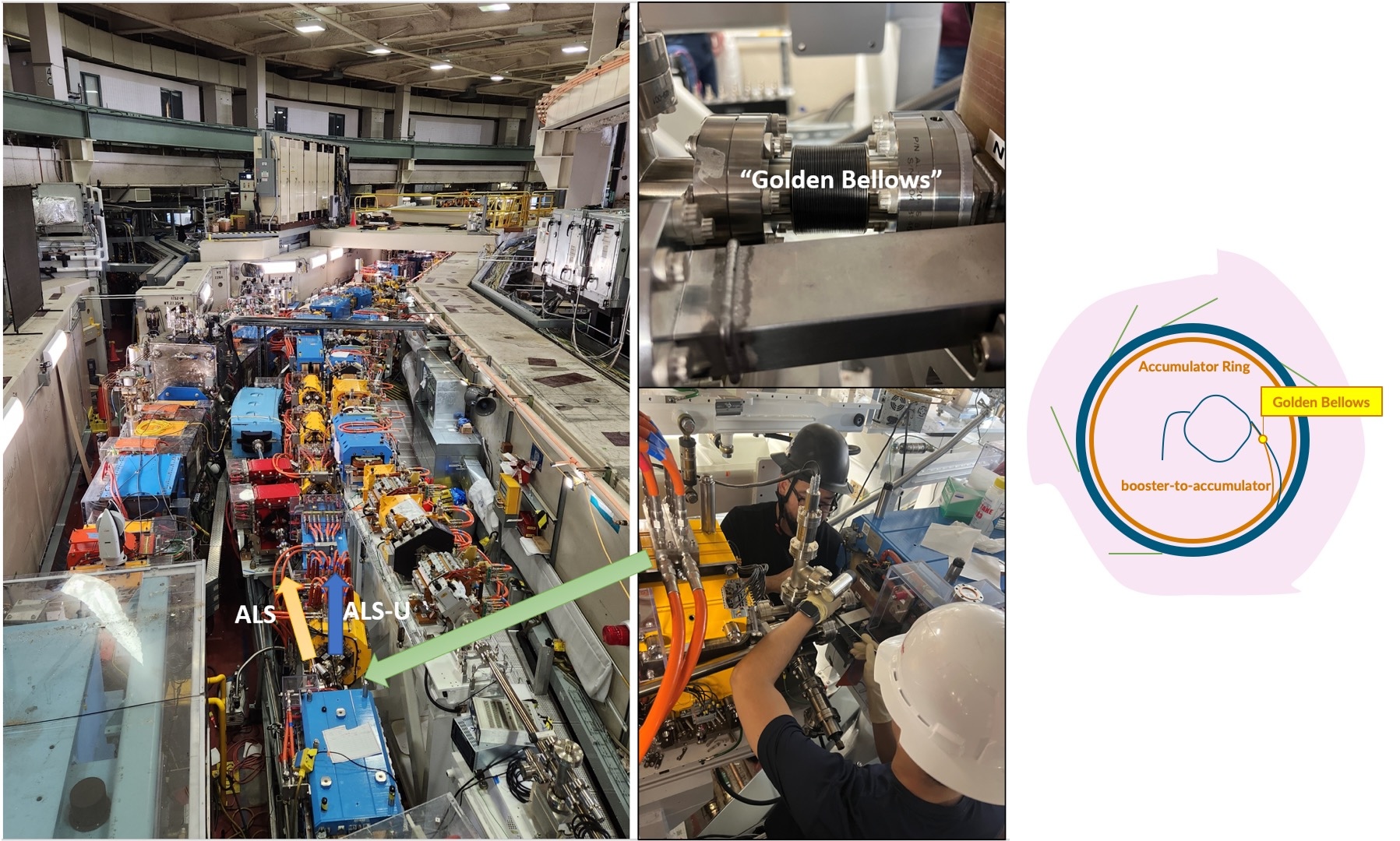
The ALS Upgrade project (ALS-U) is replacing the current accelerator with an ultra-high-brightness design that will provide nearly diffraction-limited soft x-ray performance while continuing to offer the ALS’s breadth of capabilities from IR imaging to hard x-ray diffraction and tomography. One key system that has been under construction for the last couple of years is the new accumulator ring, a second accelerator in the storage ring tunnel that links the existing ALS injector system to the future ALS-U storage ring. The vacuum system of the accumulator ring is now complete with the “Golden Bellows” connecting the injection system to the accumulator ring. The “Golden Bellows” is actually made of stainless steel, but it receives special recognition as the final component connecting the old ALS to a new ALS-U accelerator. Once the remaining electrical installation work is concluded and the new ring receives its radiation certification, commissioning will start. Electrons will pass through this link for the first time during the first half of 2027.
A good portion of the commissioning of the accumulator is expected to occur without disrupting user experiments. The existing booster will serve both the existing storage ring and the new accumulator ring until the ALS shuts down for the dark time, which will occur as early as Summer 2027 and will require about two years. To formalize a new baseline and schedule for the upgrade project, ALS-U is currently preparing for an important DOE Independent Project Review (IPR) on February 2–6. We will be providing community updates about the ALS-U project, its schedule, and resulting impacts on ALS operations throughout the year.
Periodic operations reviews are important accountability events for publicly funded facilities. In May 2025, the ALS hosted a team of international reviewers and observers from DOE to assess the quality and scientific impact of our operations and our vision for the future. The review, which covered a period of four years, highlighted the ALS’s high scientific productivity, the strong ALS safety culture and staff morale, and a clear framework provided by our Strategic Plan. It also noted challenges related to the changes in the ALS-U project schedule, emphasized the need for continued updates to the community, and observed tight staffing in some operations areas. I am excited to see ALS staff’s contributions and fantastic work recognized. We also acknowledge the challenges we are facing, and we will make all efforts to address them and continue on our path of scientific discovery through instrumentation advances while offering a safe and respectful place for scientific advancement and collaboration.
The dark time of the ALS, which is required for the installation of a new ring, is a once-in-a-lifetime opportunity to work on beamlines and data systems that are usually difficult to access during regular operating cycles. Staff who are not tied up with upgrade work will have the opportunity to touch and improve systems that can’t be modified during normal operations, and our ambition is to exit the dark time hosting AI-ready beamlines with advanced automation capabilities that benefit from the two-orders-of-magnitude increased brightness. To test new capabilities and workflows while the ALS is down, we have started conversations with US and international facilities about staff exchanges and joint R&D. To this end, ALS staff recently visited SSRL, our Bay Area neighbor at SLAC National Laboratory. For the first time, SSRL, LCLS, and the ALS will also be hosting a joint Bay Area User Meeting in September that will highlight the commonality of our research goals and the complementarity of our instrumentation approaches.

The ALS is in its 33rd year of operation and we look back onto a history rich in scientific discoveries. The upgrade is not without impact and challenges, but it is an essential step toward maintaining and advancing our leadership in x-ray science. With advancements in both computing technology and AI, the upgraded ALS will be prepared to tackle the scientific challenges of the coming decades.
Happy new year!
Andreas Scholl, Interim ALS Director