by Rachel Berkowitz
SCIENTIFIC ACHIEVEMENT
X-ray microscopy tools at the Advanced Light Source (ALS) mapped the chemistry of wildfire ash, revealing microscale organizational changes in elements within the ash.
SIGNIFICANCE AND IMPACT
These findings shed light on how wildfires drive transient mineral formation that impacts micronutrient cycling and soil resilience, with implications for landscape recovery strategies.
Heat transforms nutrients in mysterious ways
Wildfires are becoming more frequent and severe across the globe, especially in the western United States. Not only do they burn vegetation, they also change the chemistry of the soil in unknown ways. Researchers are examining individual ash and soil particles to learn which minerals form during a fire and how they influence nutrient mobility and ecosystem recovery later.
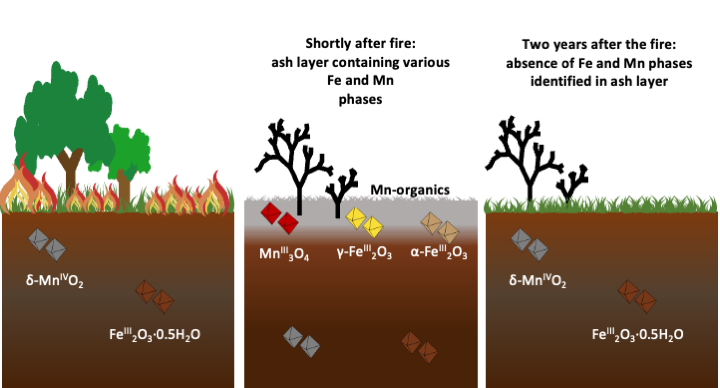
Following a wildfire, ash deposited on the soil surface contains a mixture of burned vegetation, burned soil, and newly formed minerals containing iron and manganese. These essential elements regulate key soil processes, including microbial metabolism, nutrient availability, and organic matter turnover. But researchers know little about how fire alters their molecular-scale form and reactivity.
In this study, UC Davis and Berkeley Lab Earth and Environmental Sciences Area scientists from the Belowground Biogeochemistry team collaborated with ALS scientists to examine the chemical structure of ash collected three weeks after the 2020 Glass Fire in Northern California and soil samples collected two years later. The samples represent different stages of post-fire soil evolution, allowing the researchers to probe how pyrogenic minerals evolve.
Wildfire minerals are fleeting
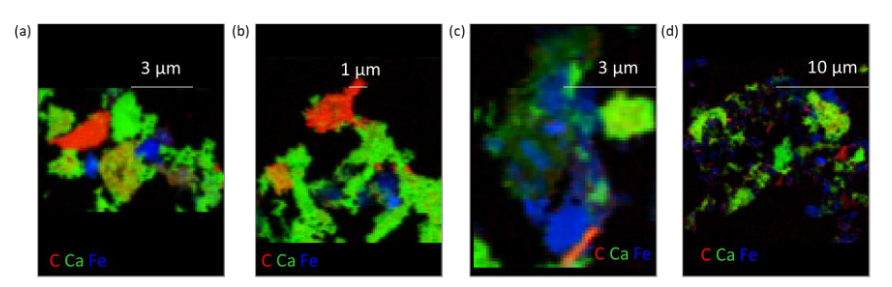
Using scanning transmission x-ray microscopy (STXM) at ALS Beamline 5.3.2.2, the team looked inside the ash particles and unburned soil particles. Nanoscale maps of each particle’s chemical composition allowed them to visualize the spatial relationships among carbon, calcium, and iron in individual particles at the sub-micrometer scale.
The ALS STXM measurements showed that wildfire significantly altered the microscale organization of elements within the ash. Notably, the maps indicated that wildfire disrupted the iron–organic complexes commonly observed in soils. By combining these maps with x-ray absorption spectromicroscopy at the Stanford Synchrotron Radiation Lightsource (SSRL Beamline 2-3), the researchers identified new iron and manganese minerals in the ash that exhibited a distinct reactivity compared to the native soil minerals.
Surprisingly, the new minerals produced during wildfire were conspicuously absent in soil samples collected two years post-fire. Their loss from the soil surface may be due to erosion or chemical weathering, the researchers proposed. This increased mobility—likely a response to compounds exuded by microbes and roots—could facilitate soil and vegetation recovery.
Tracking soil recovery processes with the upgraded ALS
The ALS measurements provided direct visualization of how wildfire reorganizes elements and minerals within ash particles and revealed the formation of altered mineral–organic associations compared to those common in unburned surface soil. Future work will investigate how pyrogenic iron and manganese minerals interact with organic matter as the soil recovers.
Looking forward, the researchers plan to use emerging in situ experimental capabilities at the ALS, many of which are being expanded as a result of the ALS Upgrade (ALS-U) project. The substantially higher brightness and coherent flux of the upgraded source will enable improved sensitivity for nanoscale spectromicroscopy experiments. These advances will allow researchers to track how iron-bearing particles evolve under environmentally relevant conditions, including warming and fluctuating redox conditions in soils.
Combining in situ nanoscale spectromicroscopy with complementary geochemical measurements will allow the team to observe mineral transformations as they occur. Then, they can determine how these changes influence carbon cycling, micronutrient availability, and water quality in post-fire landscapes.
Contacts: Kyounglim Kang, Jasquelin Peña, Matthew Marcus
Researchers: K. Kang (ALS, UC Davis, and University of Minnesota); E.M. Whelan (UC Davis); S. Bone (SSRL and Forschungszentrum Jülich); M.C. Rowley (UC Davis, Berkeley Lab, and University of Zurich); M.A. Marcus (ALS); and J. Peña (UC Davis and Berkeley Lab).
Funding: University of California, Davis; US Geological Survey; US Department of Energy, Office of Science, Biological and Environmental Research program; and Laboratory Directed Research and Development Program of Lawrence Berkeley National Laboratory. Operations of the ALS and SSRL are supported by the DOE Basic Energy Sciences program.
Publication: K. Kang, E.M. Whelan, S. Bone, M.C. Rowley, M.A. Marcus, J. Peña, “Wildfire Produces Transient Minerals: Speciation, Reactivity, and Fate of Iron and Manganese in Surface Soils Post Wildfire,” Environ. Sci. Technol. 59, 27342 (2025), doi:10.1021/acs.est.5c07438.