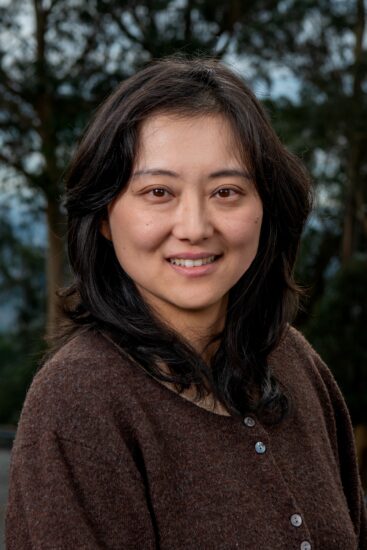
Shan Wu first came to the ALS as a postdoc at UC Berkeley/Berkeley Lab. Working on quantum phenomena as an assistant professor at Santa Clara University, she uses the ALS as well as other user facilities. She treasures the connections at the ALS, which inspired her to join the UEC.
What do you do for work?
I’m currently an assistant professor at Santa Clara University, not far from the ALS. I’m an experimental condensed matter physicist. I am particularly interested in quantum phenomena that emerge from strong electronic correlations. A well-known example is unconventional superconductivity in high temperature superconductors, which are beyond the understanding of the conventional theory of superconductivity. Some other examples are quantum spin liquids and emergent spintronics properties—all these amazing properties have the potential for future new quantum technology and materials science applications.
How did you get interested in that field?
I have always been passionate about science, about physics and math, since I was a kid. My mom was a high school physics teacher and my dad was a professor in engineering, so more in the applied part of science. My scientific curiosity was influenced by my family.
When I was in college, I originally chose an engineering major. But then, after my first year, I felt like I was less interested in translating the knowledge into building the actual machine. Instead, I found myself more interested in the underlying mechanisms and phenomena that govern how the world works. So, I transferred to the physics department, which naturally led me to pursue a PhD in applied physics. During my PhD, my advisor opened the door to the quantum world and to neutron scattering, introducing me to how powerful large-scale probes can be for uncovering emergent phenomena in quantum materials. During my postdoc, synchrotron x-ray scattering deeply inspired me; the breadth of science it enables and its impact across disciplines. These experiences played a central role in shaping my research direction as well as my current career.
How do you use the ALS for your research?
I did my postdoc at UC Berkeley and Berkeley Lab with Professor Robert Birgeneau. The postdocs on his team all had slightly different backgrounds. Some people had a background in neutron scattering, like me. Some people had a background in synchrotron x-ray work, like photoemission and resonant soft x-ray scattering. So, I got attracted by the capability of the complementarity between synchrotron x-ray scattering and neutron scattering.
Neutron scattering is super powerful for directly probing magnetic interactions, but synchrotron light sources provide the benefit of being really versatile. You just need a tiny crystal, and you can study a lot of degrees of freedom. At the ALS, we can study the electronic structure and band properties. We can study how materials respond to extreme conditions such as really high hydrostatic pressure in quantum materials.
Moreover, I have been doing projects using the magnetic scattering/spectroscopy beamline as well as coherent x-ray scattering at the ALS. The dramatic increase in coherent soft x-rays with ALS-U will enable new capabilities, such as imaging heterogeneous quantum materials at the COSMIC beamline, opening entirely new directions for understanding emergent quantum phenomena.
Which beamlines have you used at the ALS? Are you also using other user facilities?
I’ve been using 4.0.2 magnetic spectroscopy and scattering, 12.2.2 diffraction under non-ambient conditions, and 7.0.1 COSMIC scattering beamlines.
And I have used some other synchrotron facilities, but also neutron facilities, like HFIR and SNS at Oak Ridge National Laboratory. I have also done experiments at the TRIUMF muon facility in Canada and I sometimes travel to Europe to the Paul Scherrer Institute (PSI), the European Synchrotron Radiation Facility (ESRF), and the ISIS Neutron and Muon source.
What inspired you to join the Users’ Executive Committee (UEC) at the ALS?
I have a lot of connections with LBNL since I did my postdoc here. A lot of my previous colleagues used the ALS resources a lot, and some of them were actually part of the UEC. I saw that it was a great way to connect more with the ALS and with ALS management. I find this is a really fantastic organization, and I really want to be of service to the entire ALS community. I would like this community to have transparent and effective channels of communication. And it is also a way for me to get to know the ALS better.
I feel a calling to help train the next generation of scientists. It is always nice to expose talented students to user facilities at an early stage of their career. Currently, I have several undergrad students working with me. They’re super talented, and bringing them to the ALS exposes them to all these wonderful opportunities.
What are you looking forward to after dark time?
I’m especially looking forward to the enhanced coherence after dark time, particularly for COSMIC scattering, which I have been using recently. With the increased coherence, we may be able to perform x-ray photon correlation spectroscopy measurements on magnetic systems and directly study time correlations. This will allow us to investigate not just magnetic properties in momentum space but in the time domain.
That’s going to really open up a new horizon for quantum materials research, being able to probe slow dynamics, fluctuations and emergent behavior in ways that would be challenging for some cases before the upgrade.
What advice do you have for first-time ALS users?
Oh, that’s a great question. Talk to the beamline scientist. Any questions, reach out to us UEC members. I think my interactions with beamline scientists have all been great. They’re always happy to answer any questions, they are very responsive.
So for a first-time user, particularly if you don’t know which beamline you should use or which technique can answer your scientific question, I always encourage them to reach out. And the ALS UEC is always here to help and support them.
What role do you see the ALS UEC playing in contributing to the future of the ALS user community?
When I was a PhD student, I was not really aware of the existence of the ALS. Maybe it’s just because I was on the East Coast. Hopefully through the ALS UEC, we can strengthen the visibility to even more potential users, for example by organizing joint meetings and creating more pathways for early-career researchers to discover the capabilities of the ALS.
Another benefit is the enhanced collaboration, not just among universities, but also with industry. Looking ahead, emerging areas such as AI offer opportunities to accelerate discovery from experiment design to data analysis. I am confident that ALS, across many scientific topics, can benefit from these developments.
What do you like to do in your spare time?
I had a lot of hobbies before, but as my career is growing, the bandwidth has become limited. I like dance, another passion from childhood. I learned different types of dance: ballet, Asian dance, traditional dance, modern dance. I was actually part of a ballroom dance group in graduate school. But I also enjoy Korean dance, hip-hop, all these different things.
Since I’m a Californian, I’m also someone who really loves all outdoor activities, like hiking with friends or family on the weekend. I also enjoy running, cycling, and yoga.