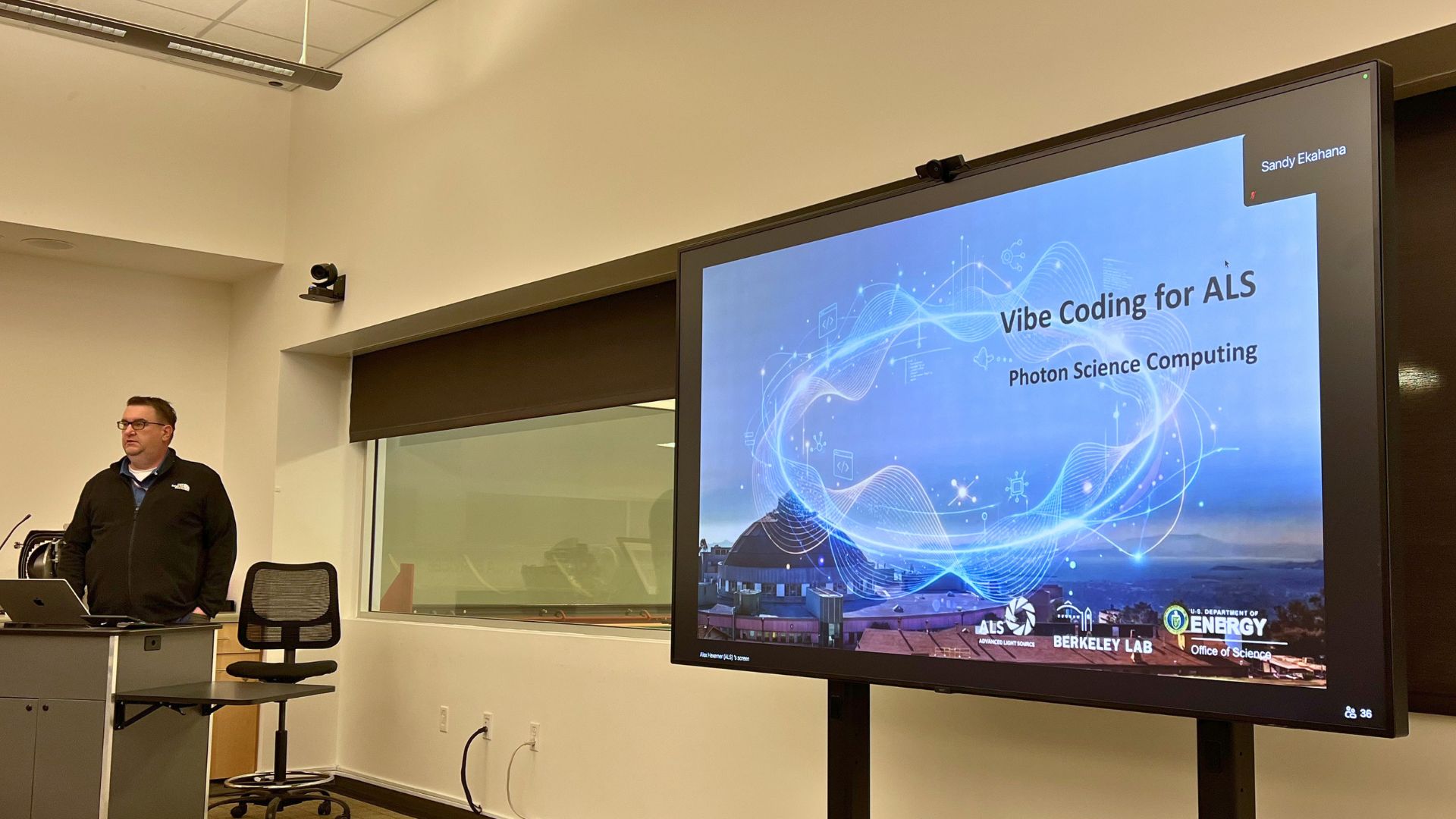
Everyone is talking about it. Many are doing it. Some are even doing it well. What is vibe coding, anyway? How does it support scientific discovery? A panel of vibe coders recently hosted a tutorial that answered these questions for researchers at the Advanced Light Source (ALS).
About one year after the term “vibe coding” catapulted into the vernacular, a lot of ALS staff and users are already incorporating the tool into their workflow. Their colleagues who are not as well-versed in the field also got to dive in during the tutorial, where they learned that vibe coding is collaborative programming with artificial intelligence (AI). In his introduction, Photon Science Computing (PSC) group lead Alex Hexemer noted that the popular impression of vibe coding is that a researcher can explain what they want, and the software will produce the result in a neat package.
“There’s more to it than that,” said Hexemer. “We want to help people be more efficient.”
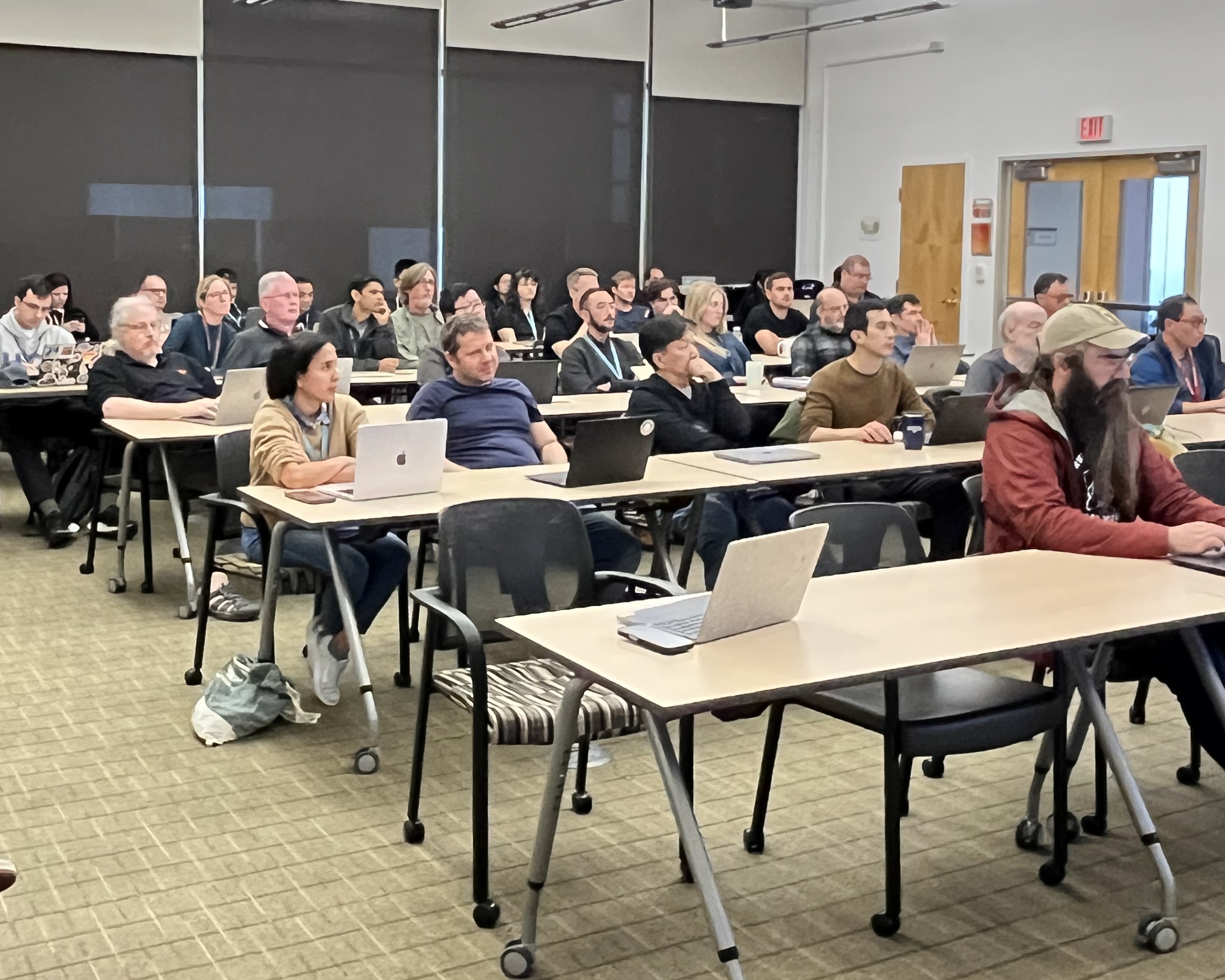
Not only did the tutorial speakers cover the basics of vibe coding and how to optimize commands, they also presented the potential pitfalls of vibe coding and strategies to mitigate those risks. The rapid-fire talks quickly immersed attendees in the world of vibe coding.
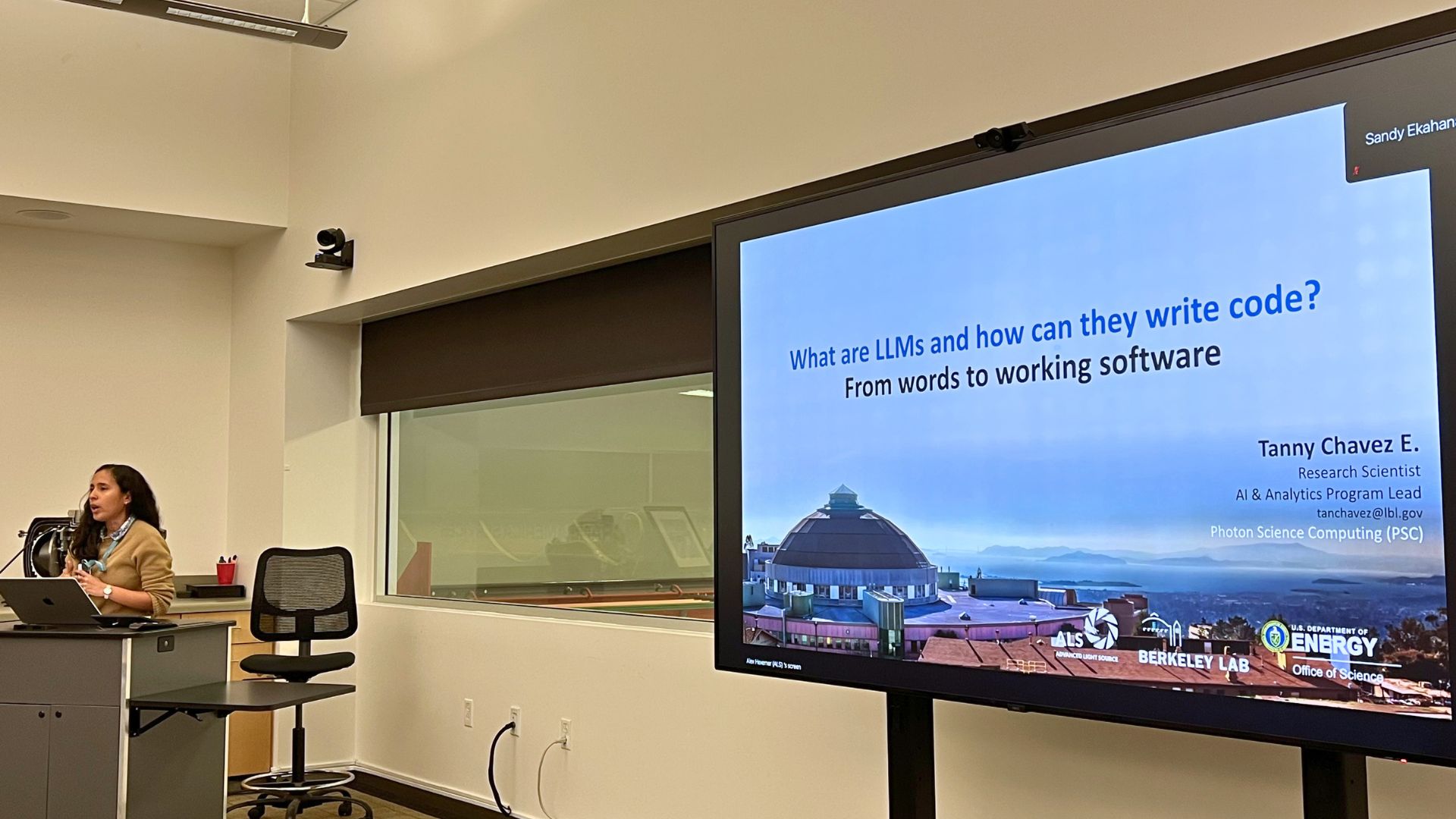
What are LLMs and How Can They Write Code?
ALS Computational Research Scientist Tanny Chavez explained that large-language models (LLMs) are trained on huge datasets and learn the statistical patterns and structure of language, rather than understanding it in a human sense.. “This is why it’s important to keep a human in the loop,” said Chavez.
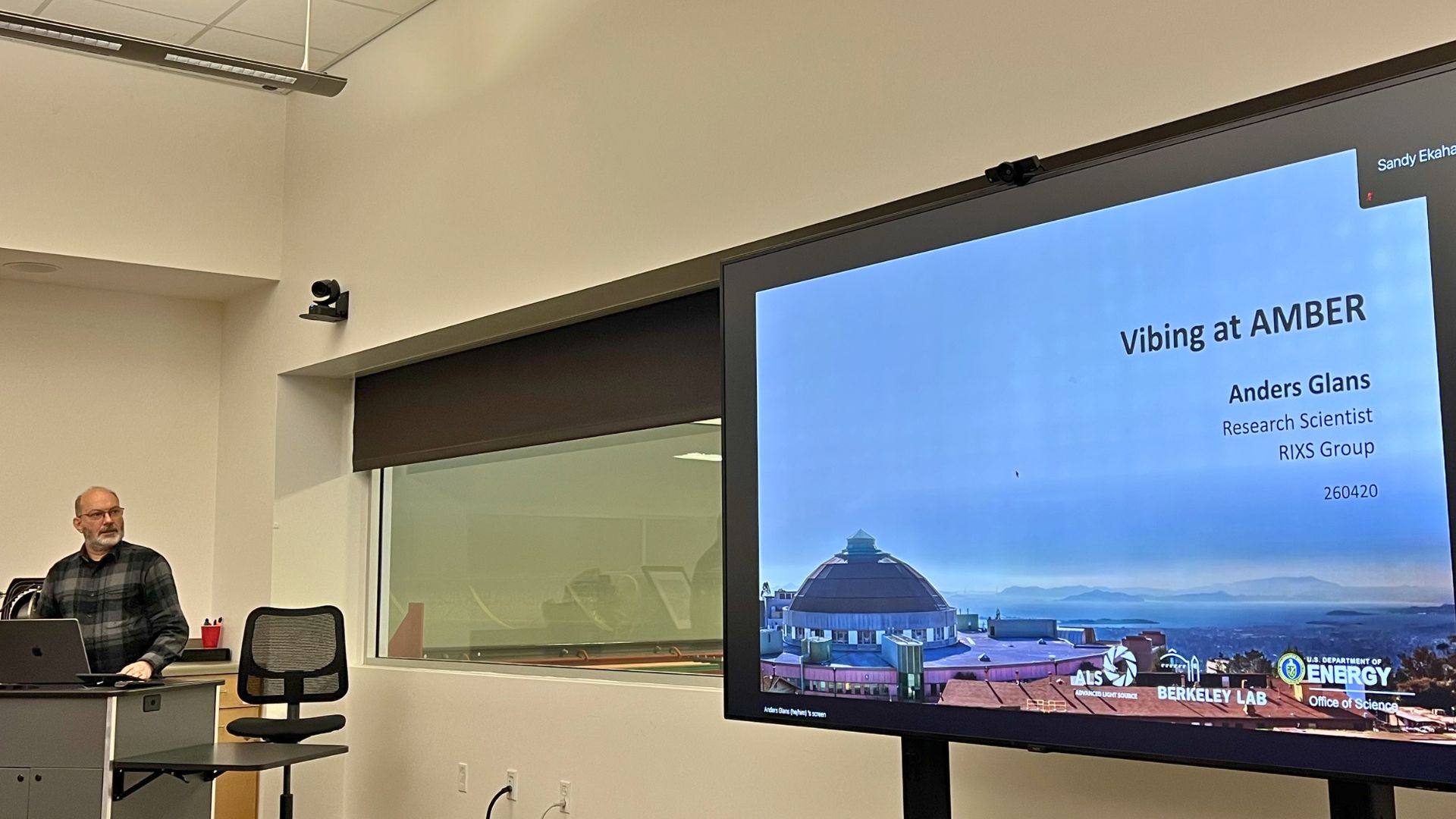
Vibing at AMBER
In a flash talk, ALS Beamline Scientist Anders Glans walked through the process of vibe coding to set up a graphical user interface (GUI) for the controls at his beamline. He wanted a system that would be more sophisticated than a glorified engineering panel. “A workflow-based GUI will have to be unique to a particular beamline,” he said. With a preliminary GUI in place, he is already planning the next iteration for the AMBER beamline.
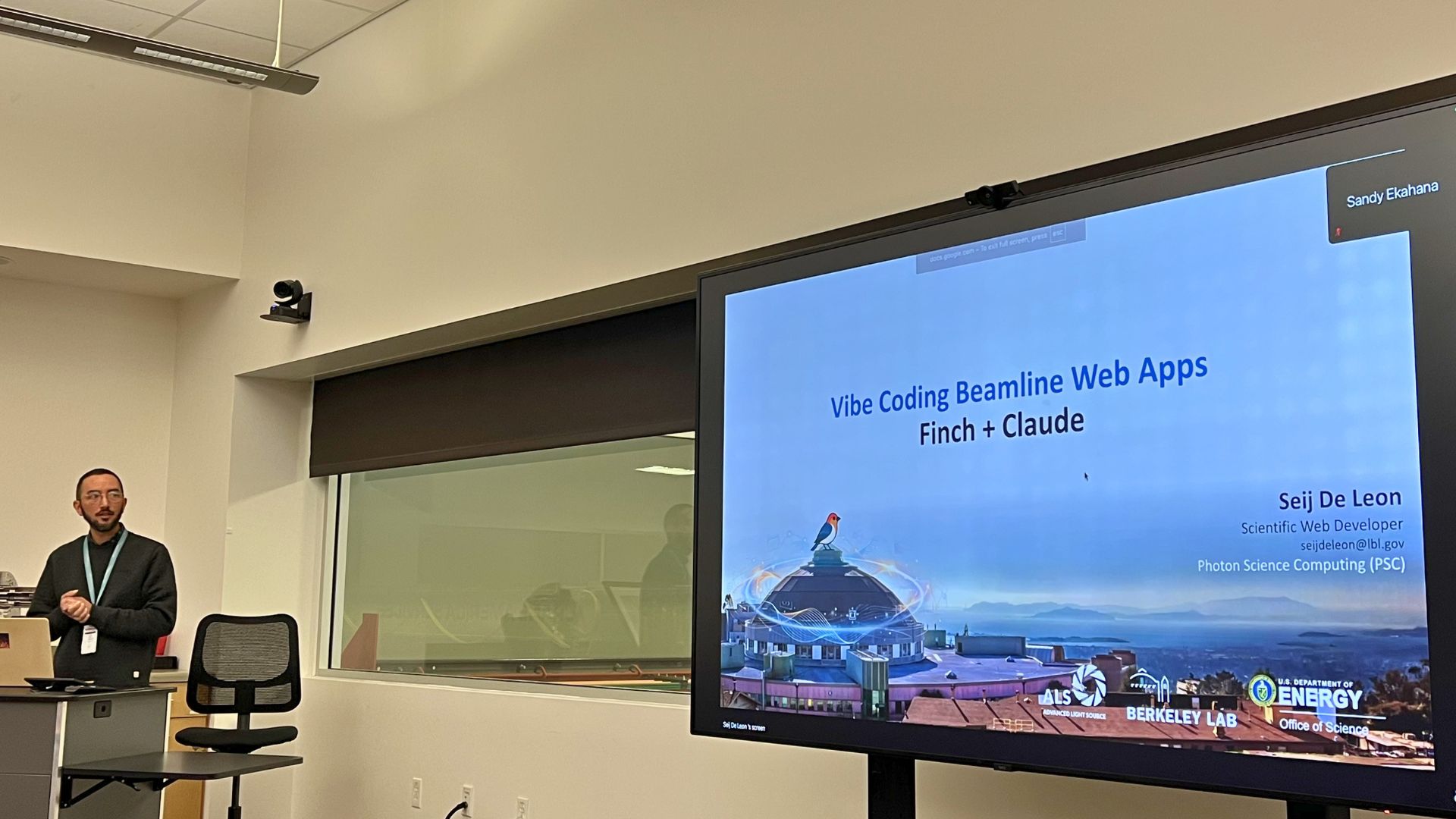
Vibe Coding Beamline Web Apps
ALS Computer Systems Engineer Seij De Leon gave a flash talk on resources to make vibe coding more efficient. “You need to spend a lot of tokens for Claude to figure out how to properly make calls to your beamline control system,” he described. Then, he presented a solution: connecting the AI assistant Claude with a resource library called Finch.
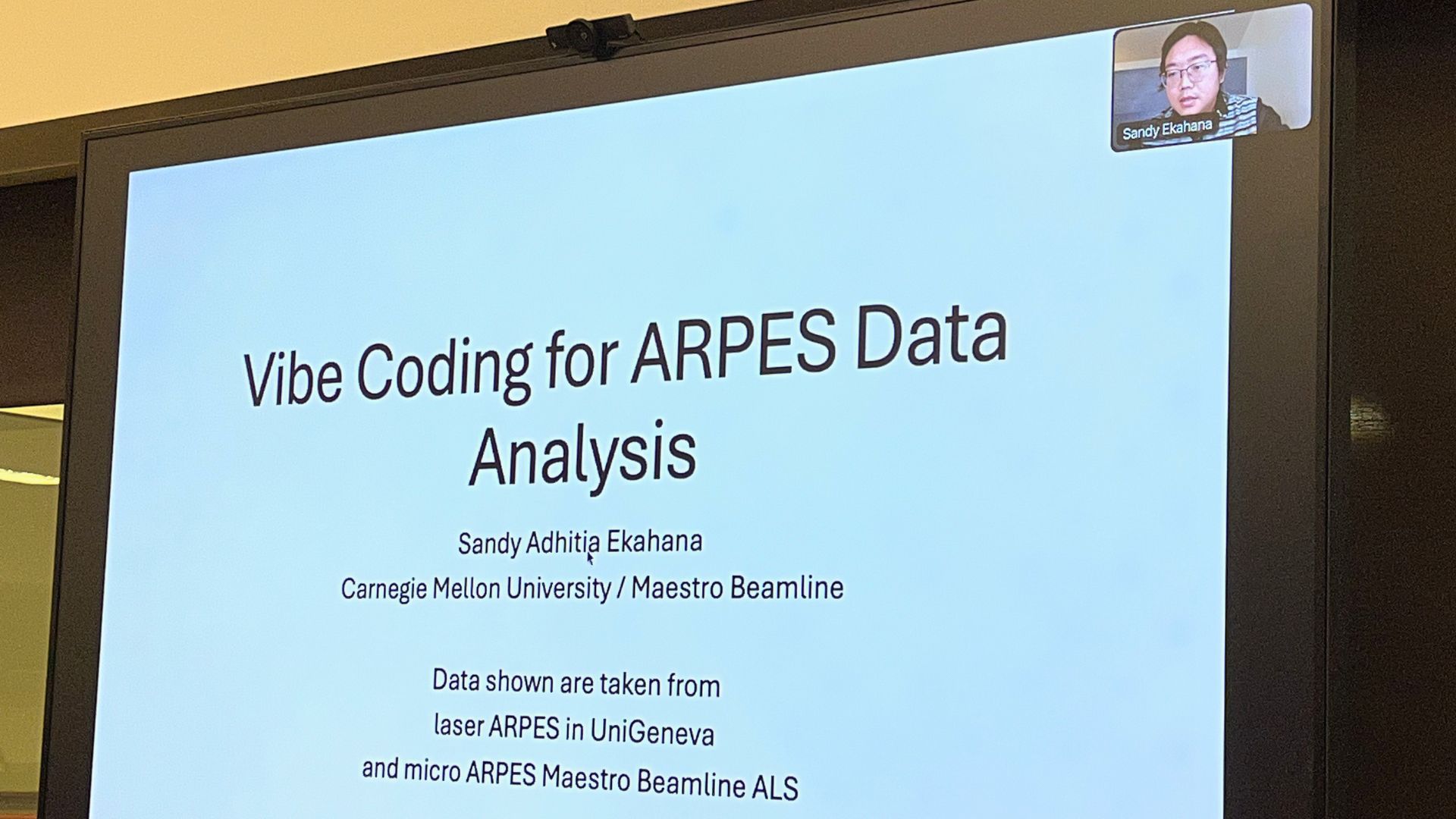
Vibe Coding for ARPES Data Analysis
Next, Sandy Adhitia Ekahana of Carnegie Mellon University gave a user’s perspective. Vibe coding has accelerated the analysis of his data from using the MAESTRO beamline. But, he cautioned, “This is your assistant, not your cheat sheet.”
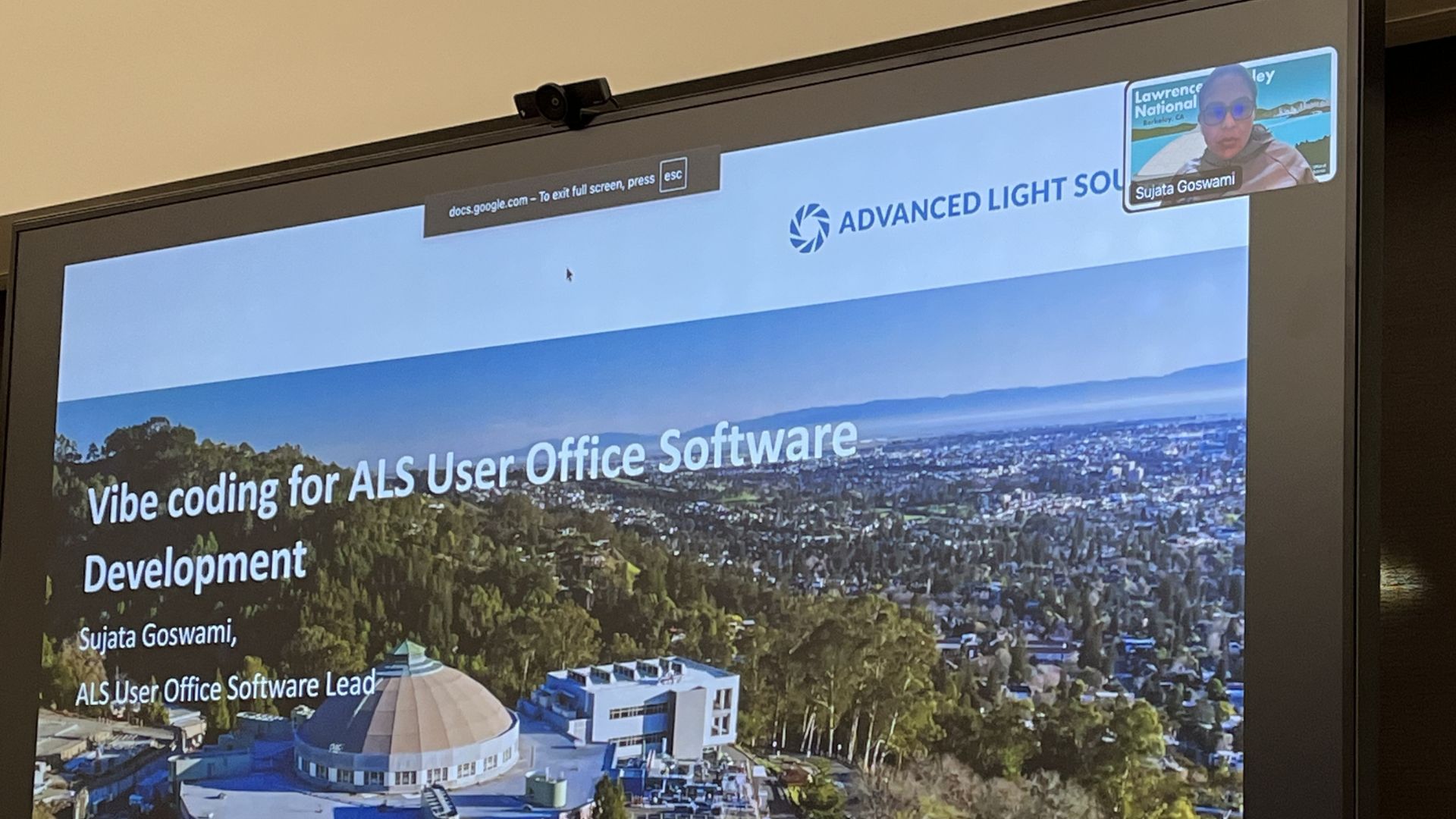
Vibe Coding for ALS User Office Software Development
ALS User Office Lead Software Engineer Sujata Goswami tackled her group’s sprawling legacy database using vibe coding. The User Office databases span more than 20 years of user proposals, publications, and other critical research records, making it one of the most complex data systems at the facility. “Using LLMs for our software development has certainly enhanced my productivity and ability to ship features much faster,” she said.
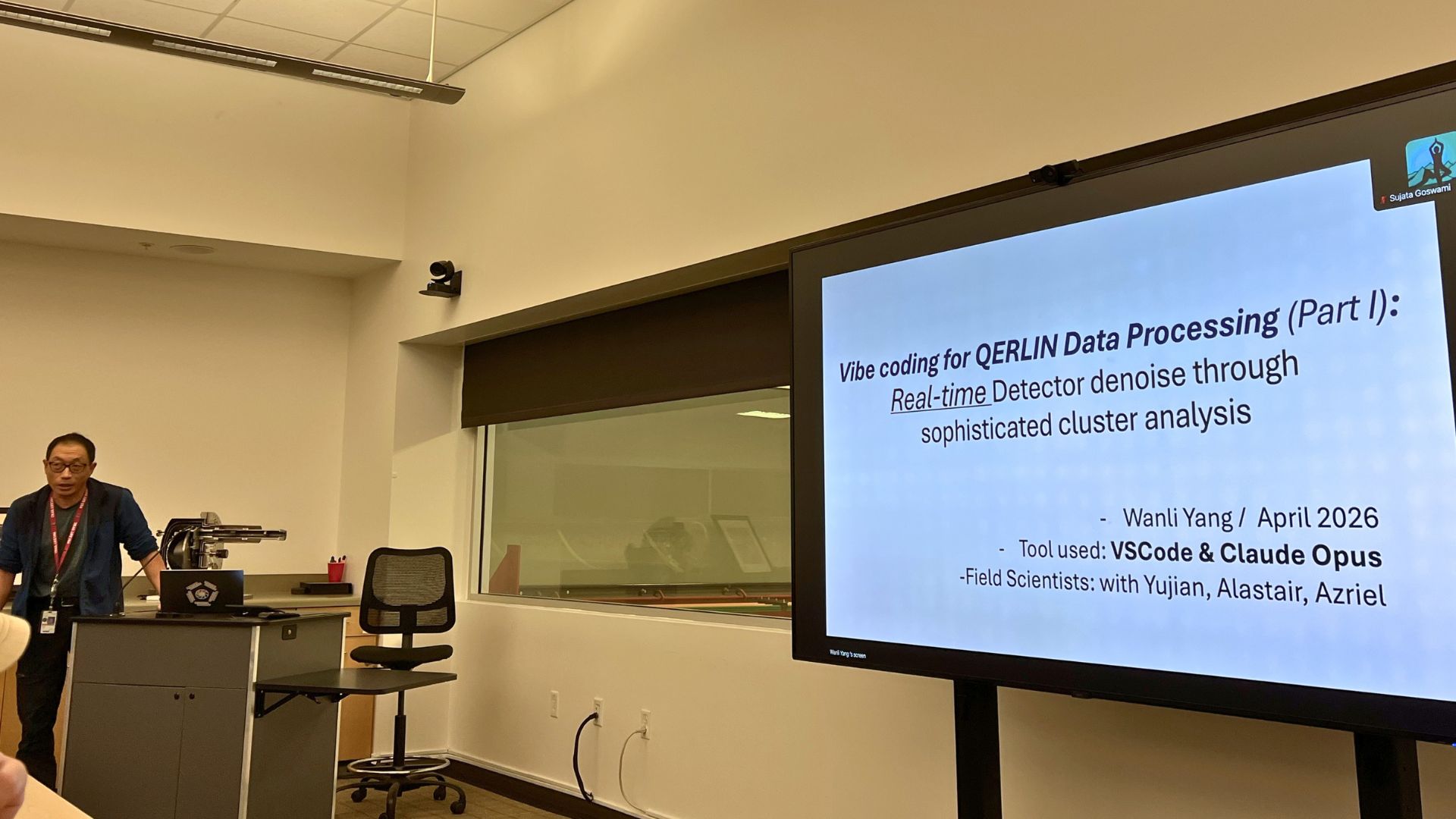
Vibe Coding for QERLIN Data Processing
In the next flash talk, ALS Senior Scientist Wanli Yang approached the problem of noisy data at the QERLIN beamline. Working with the ALS detector group and vibe coding allowed him to achieve time-sensitive resonant inelastic x-ray scattering (RIXS) mapping.“We didn’t imagine RIXS, as a photon-hungry technique, could do this!” he exclaimed.
Recreating the ALS Scheduler GUI with AI Studio
Interim ALS Director Andreas Scholl also tried his hand at vibe coding. “Can I, while I do my normal job, talk to this AI from time to time and have it make something that organizes beamtime allocations?” he asked. Scholl was impressed by what AI produced but shared concerns about enforcing cybersecurity standards for public facing applications.
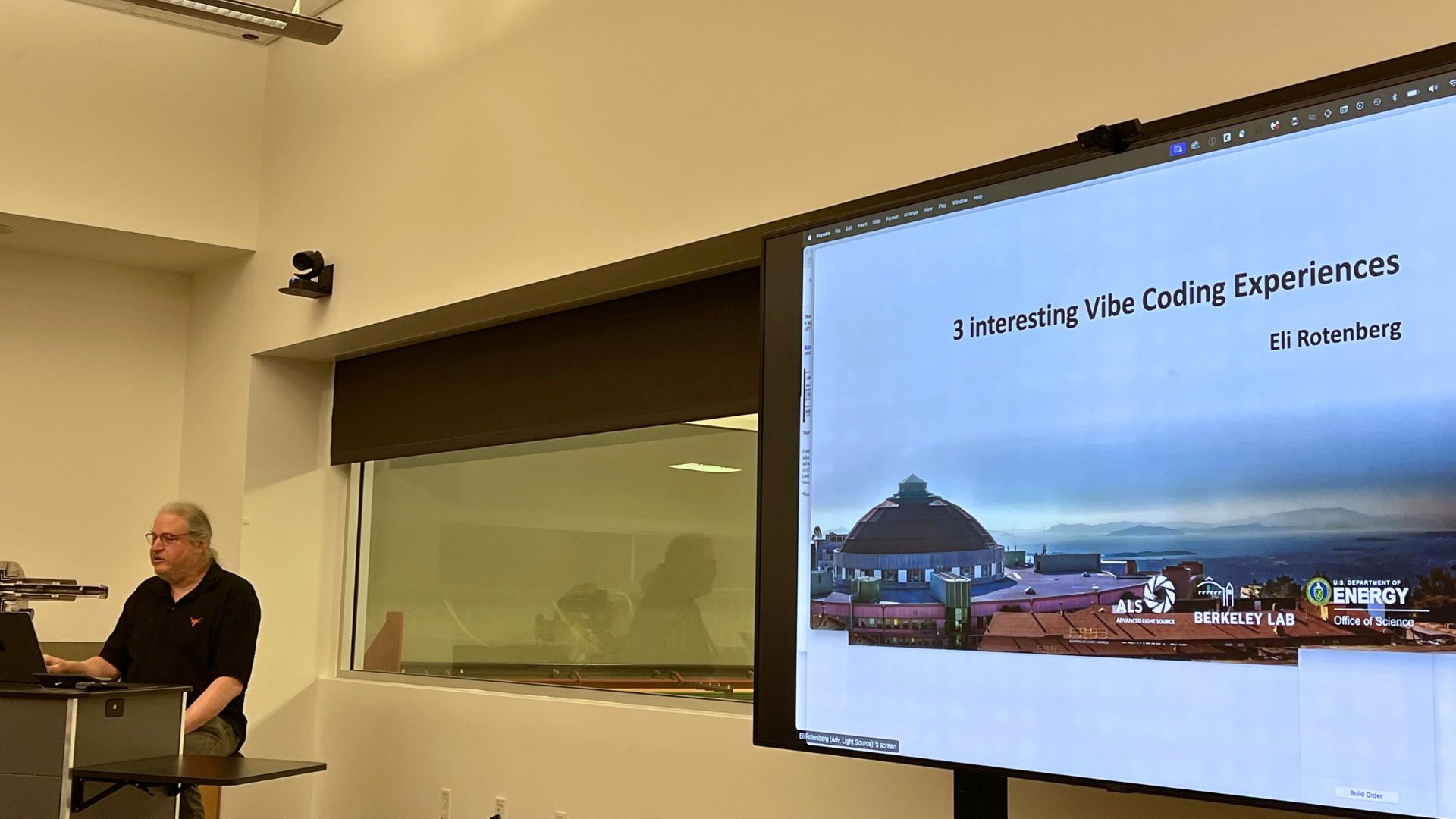
Three Interesting Vibe Coding Experiences
ALS Senior Scientist Eli Rotenberg has used vibe coding for everything from organizing a scientific conference to parsing beamline data. “I wanted to take the load off the administrative staff,” he cited as his motivation for streamlining conference organization. He was also able to run theory code for his research, which he had not previously been able to do.
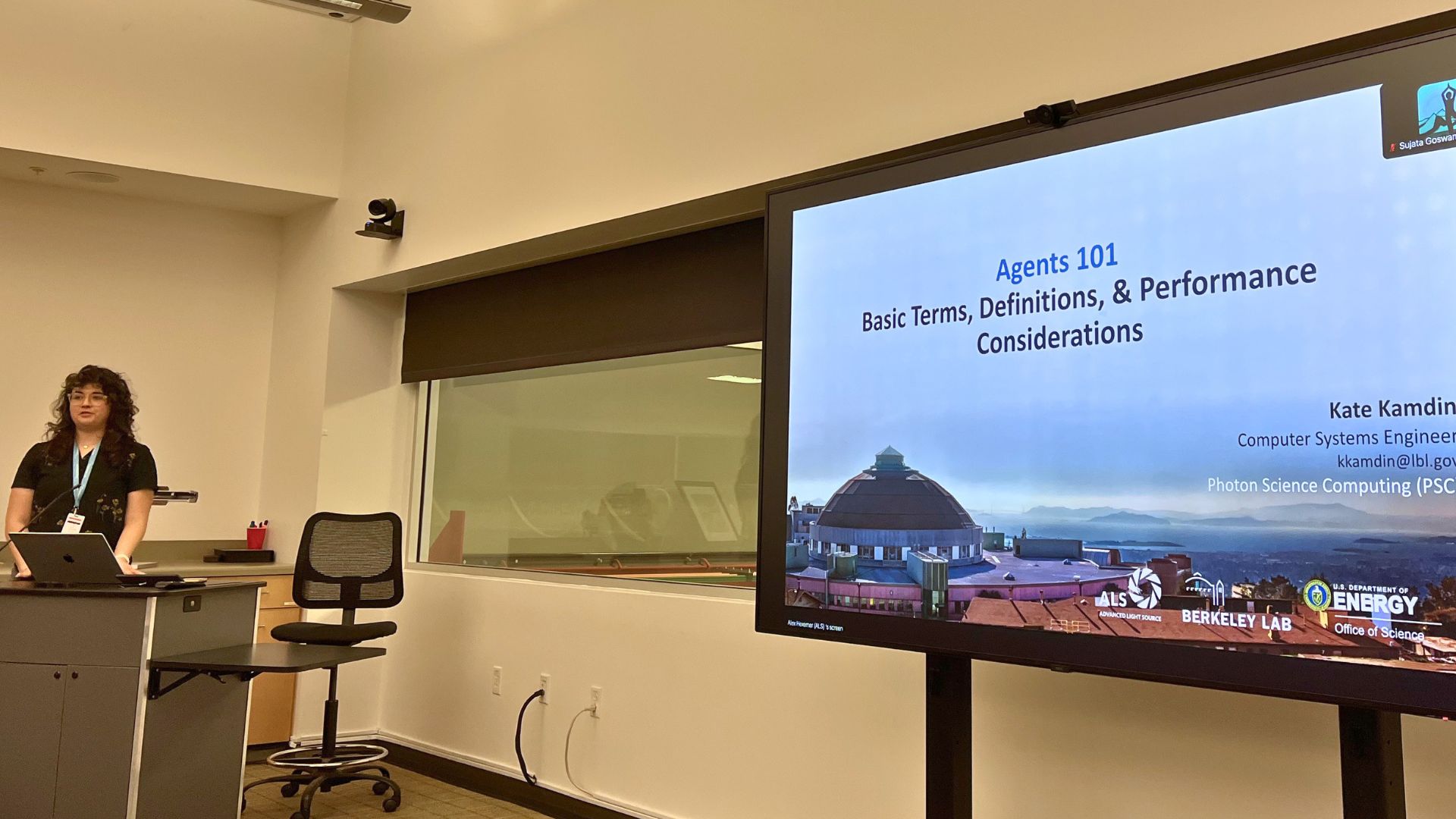
Agents 101: Basic Terms, Definitions, and Performance Considerations
After the seven flash talks, attendees were eager to learn how to vibe code. ALS Computer Systems Engineer Kate Kamdin elaborated on the steps—and iterations—of vibe coding with agentic AI. Then, she gave tips on improving agent performance, such as using sub-agents.
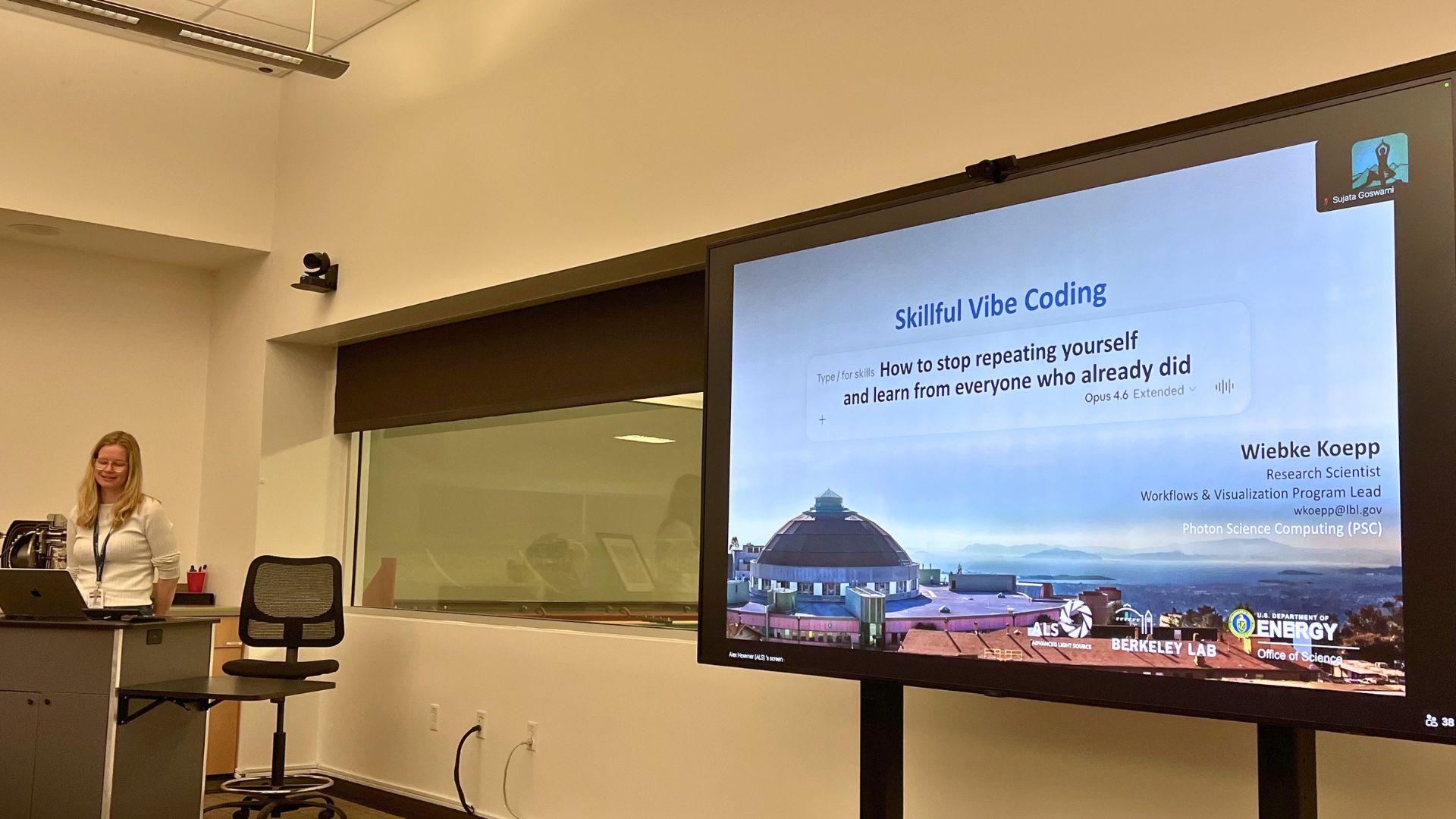
Skillful Vibe Coding: How to Stop Repeating Yourself and Learn from Everyone Who Already Did
ALS Computational Research Scientist Wiebke Koepp discussed a common slowdown in vibe coding: no memory between sessions. So, she presented the Rule of Two. “If you type the same instruction more than twice, it belongs in a file–not in a prompt,” Koepp said.
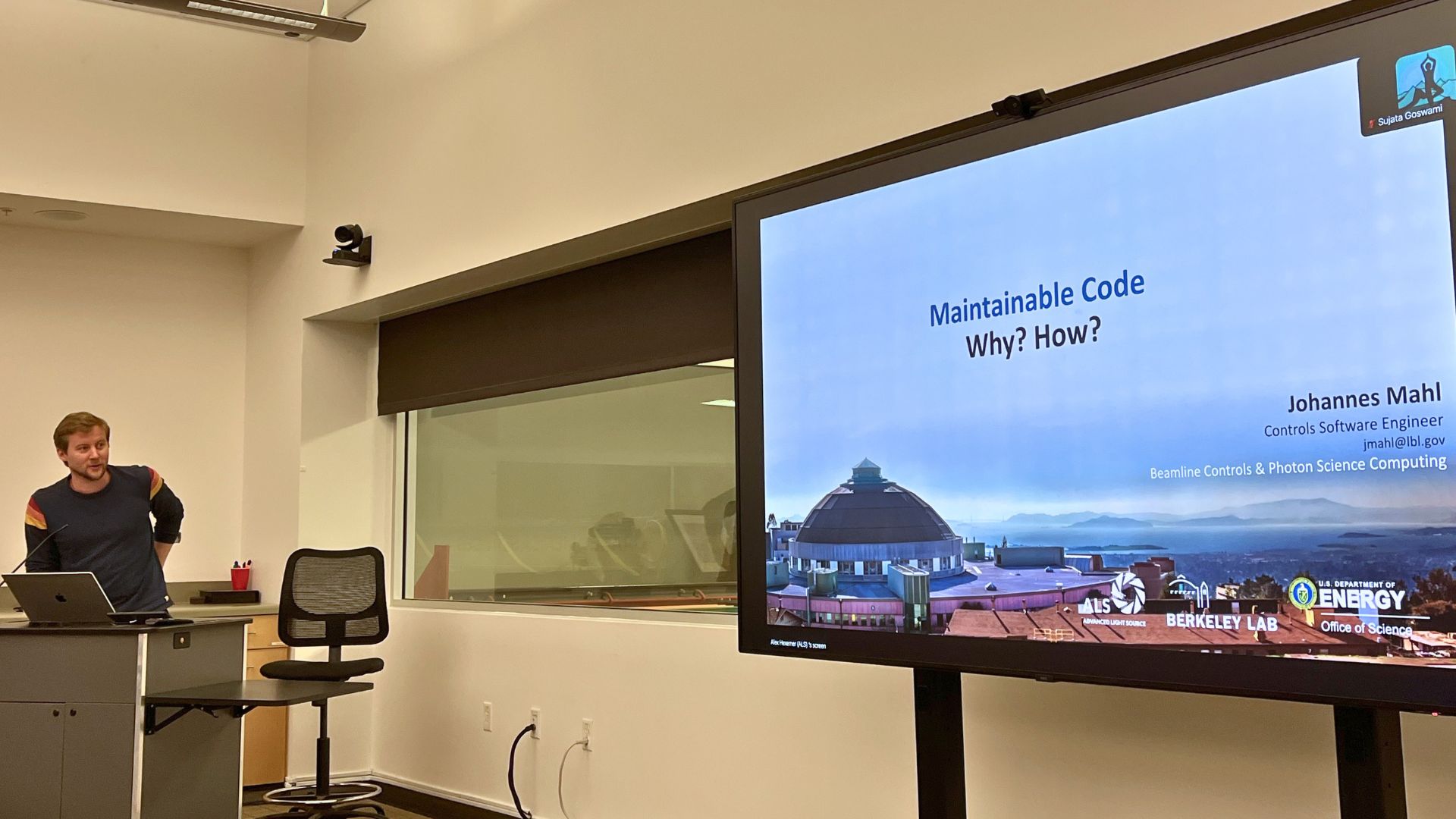
Maintainable Code: Why? How?
Computer Systems Engineer of the PSC and Beamline Controls groups Johannes Mahl brought a measure of quality control to the workshop. He encouraged the attendees to use version control for their projects. He reminded participants to plan extensively at the beginning of their vibe coding sessions and gave current best practices on “cleanup” sessions to keep their vibe code maintainable.
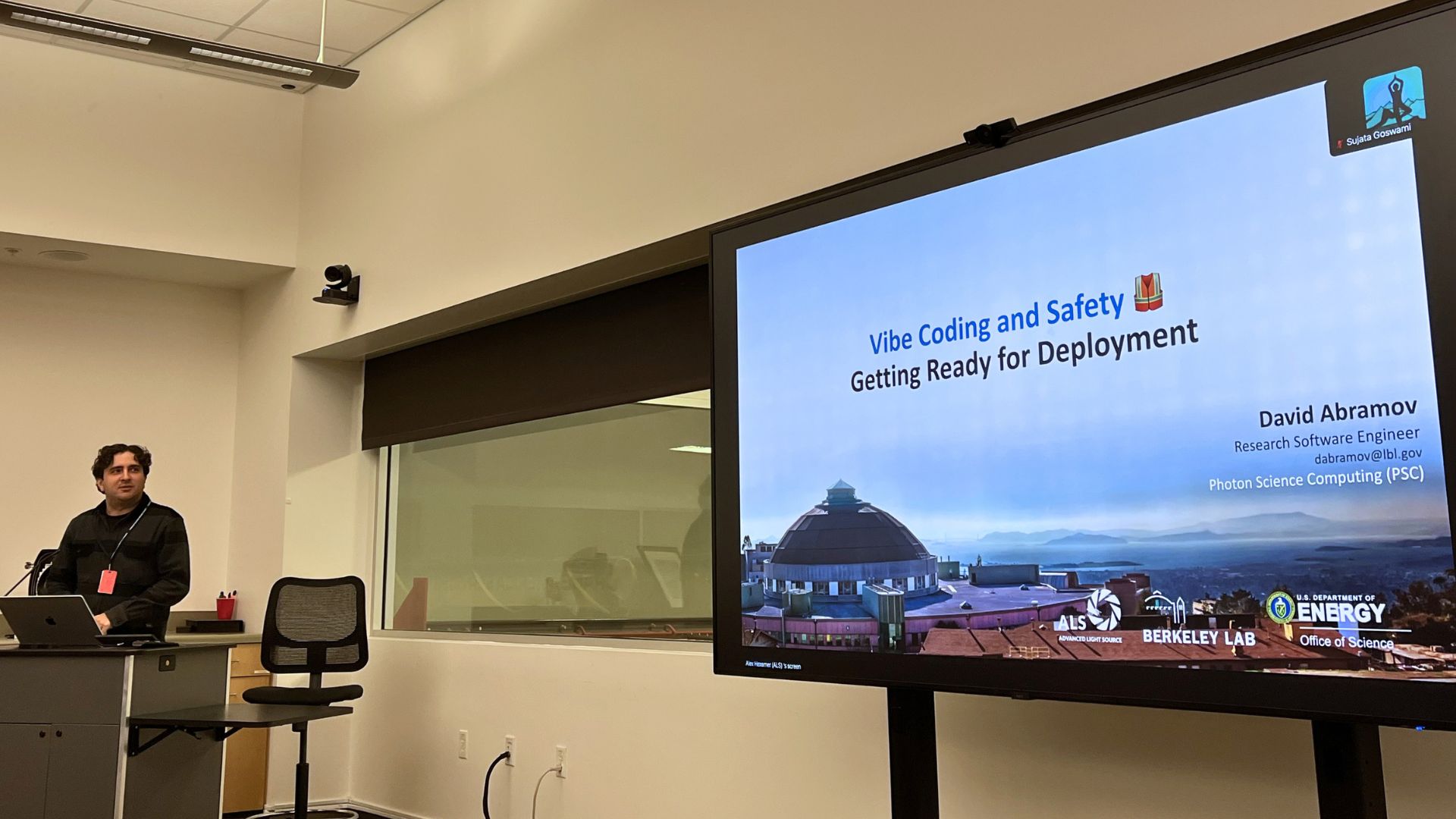
Vibe Coding and Safety: Getting Ready for Deployment
Computer Systems Engineer of the Photon Science Computing group David Abramov presented another guiding principle for vibe coding: security best practices. He warned the attendees that bots can quickly scrape a public platform like GitHub for secrets and API keys, highlighting the importance of reviewing AI-generated code. This would not only be a problem for an individual; a security breach could take down services for everyone.
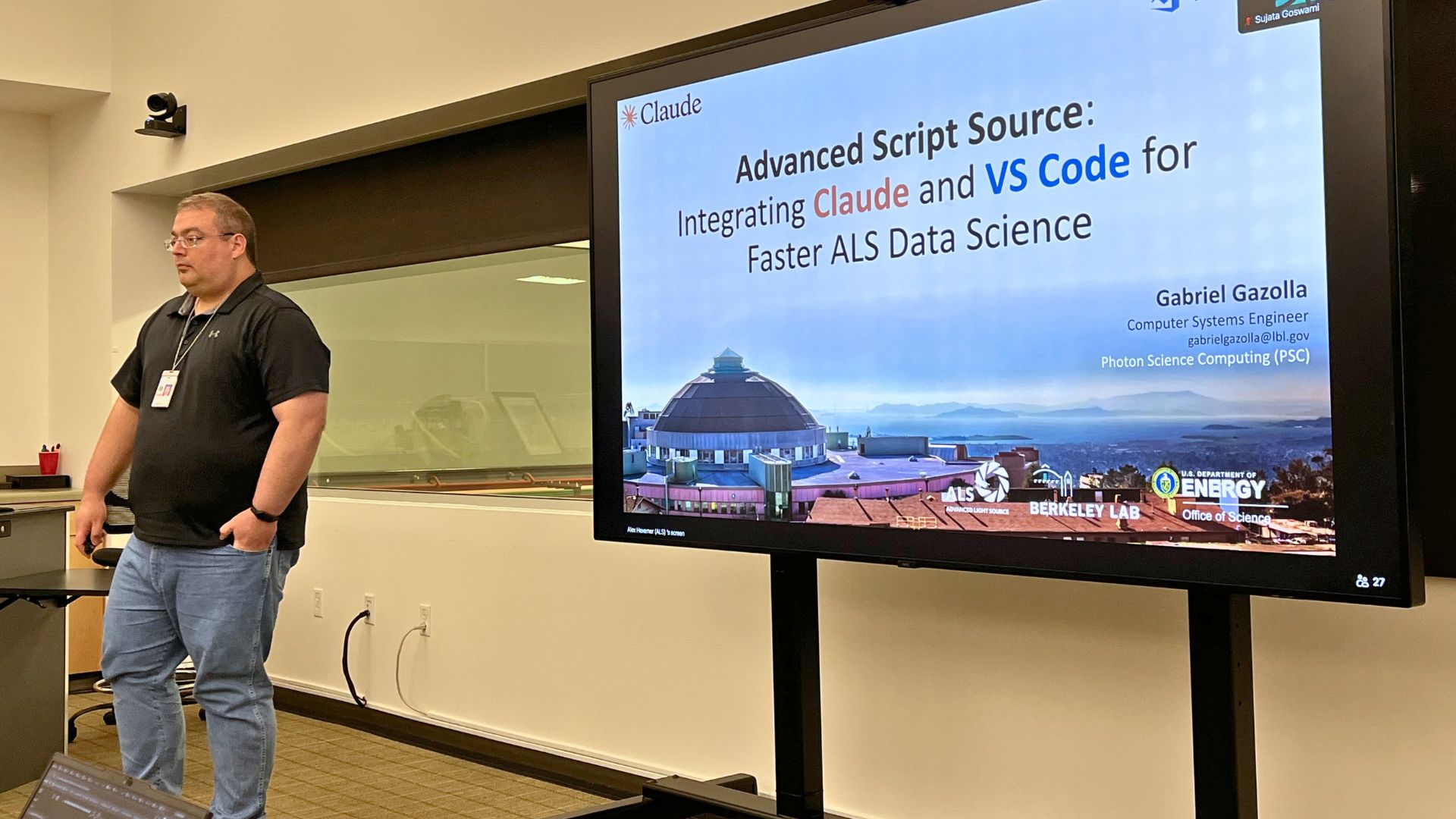
Advanced Script Source: Integrating Claude and VS Code for Faster ALS Data Science
Computer Systems Engineer of the Photon Science Computing group Gabriel Gazolla showed how using both Claude Code and Visual Studio Code (VS Code), a code editor, can enhance the vibe coding process. He also explained how to avoid accidentally deleting work.
Moving at the Speed of Light and Not Stopping
In the second half of 2026, the ALS will be shut down for a necessary power upgrade. This time period would have been a natural fit for beamline and computer scientists to bulk up their vibe coding, but the reality is that many across the ALS are already vibe coding. So, the Photon Science Computing group brought everyone into one room for a vibe coding workshop during the user operations cycle. Although—or because—the ALS community is busy, it is important to master techniques like vibe coding to streamline and enhance the vital work around the ring.
This workshop is not the end of the discussion. Attendees are already brainstorming next steps, and the Photon Science Computing group has planned an entire series of workshops.
“It’s unreal. It’s pretty much impossible to keep up,” said Hexemer. But, we’re going to try.