Key Requirements Pre-proposals and full proposals will be evaluated on: Scientific Motivation and AI Need: Proposals must demonstrate a strong scientific case where the integration of AI is central to achieving the scientific objectives and justifies the requested amount of beamtime beyond conventional methods. Mandatory Staff–User Partnerships: Every project must be an active collaboration betweenRead More Read more »
AI-Enabled Research Campaigns (ARCs)
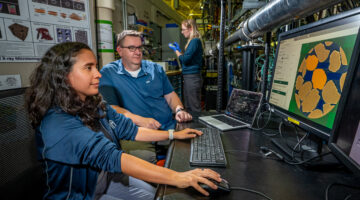
ARC is a pilot program for 2027 beamtime designed to advance high-impact user science through the practical development, testing, and refinement of artificial intelligence (AI) workflows across ALS beamlines. This is a special, off-cycle proposal call that is separate from our general user proposal call. Pre-proposals are open until September 27. Read more »
Powering Science: How SYNAPS-I Builds on Meta’s Open Source AI
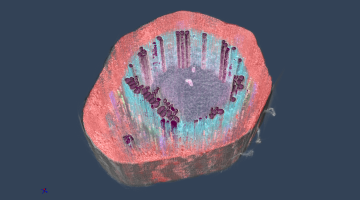
SYNAPS-I, a DOE initiative led by Berkeley Lab, unites 60 researchers across five labs to speed up X-ray and neutron data analysis using AI. Because prepublication data must stay on secure government systems, open-source models from Meta — SAM 3 and DINOv3 — let the team fine-tune cutting-edge AI entirely in-house. Read more »
American Science and Security Cloud: A Platform for AI
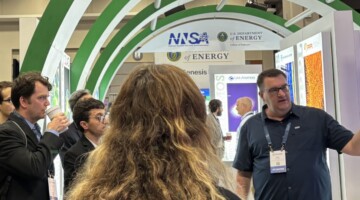
What is the American Science and Security Cloud? Data Platforms Program Lead Dylan McReynolds explains how the ALS is using this network of tools and helping build an even more robust platform. Read more »
A World of Vibe Coding Opportunities at the ALS
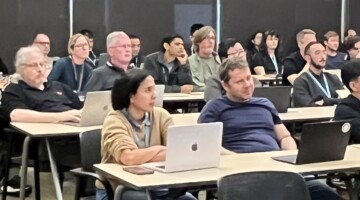
In April 2026, a panel of vibe coders hosted a tutorial at the ALS. From a general overview to specific strategies to optimize the code, participants learned all about how vibe coding can improve their workflows. Read more »
Accelerate UX Workshop Brings Global Expertise Together at the ALS
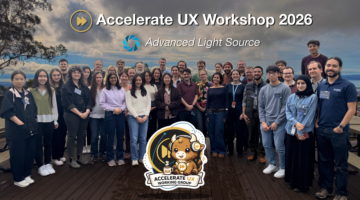
Staff from eleven different accelerator lab facilities gathered at the ALS to improve the user experience for operators, researchers, engineers, and more. Workshop participants learned from experts in the UX field and even took part in a hackathon that paired beamline scientists with interface developers. Read more »
AI for Smarter, More Powerful, More Efficient Particle Accelerators
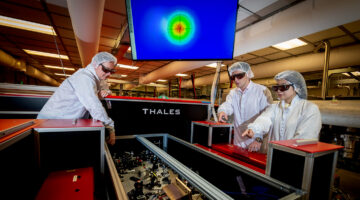
The Multi-Office particle Accelerator Team (MOAT) is developing artificial intelligence tools to improve particle accelerators and speed breakthroughs. The collaborative effort is led by Berkeley Lab and is part of the Genesis Mission, a new national AI initiative. Read more »
How a Machine Learning Pipeline Could Accelerate Innovation
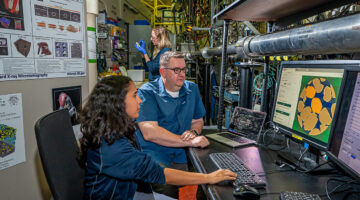
SYNAPS-I, a new multi-lab AI platform supporting DOE’s Genesis Mission, aims to accelerate discoveries at advanced light and neutron scattering user facilities. The results could speed breakthroughs in energy, semiconductors, medicine, and many other technologies critical to modern society. Read more »
AI Delivers Rapid, Precise Design of Tumor-Targeting Protein
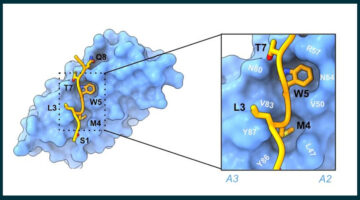
A new protein designed using AI can precisely recognize a key therapeutic target for cancer. X-ray crystallography data collected at the ALS confirmed the new protein’s specificity for its target, demonstrating a configurable and scalable approach to cancer therapy. Read more »
Berkeley Lab Hosts Agentic AI for User Facilities Workshop
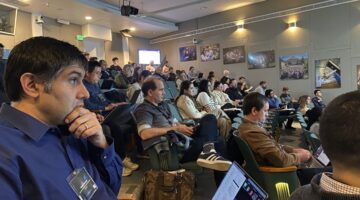
Berkeley Lab hosted a workshop on Agentic AI for User Facilities with about 100 registered participants from user facilities across the US national lab complex and European light sources. The two main goals of the workshop were to identify cross-facility patterns, gaps, and design principles for agentic AI at DOE user facilities, and ground agentic AI in domain realities and identify domain-specific constraints, opportunities, and readiness. Read more »