by Brooke Kuei
Magnetic materials are the backbone of modern data storage, but most technologies rely on ferromagnets, which create a net external magnetic field from aligned spins. Altermagnets, on the other hand, are a new class of magnets that have alternating spins with crystal symmetries that create powerful, ferromagnet-like electronic properties without a net external magnetic field.
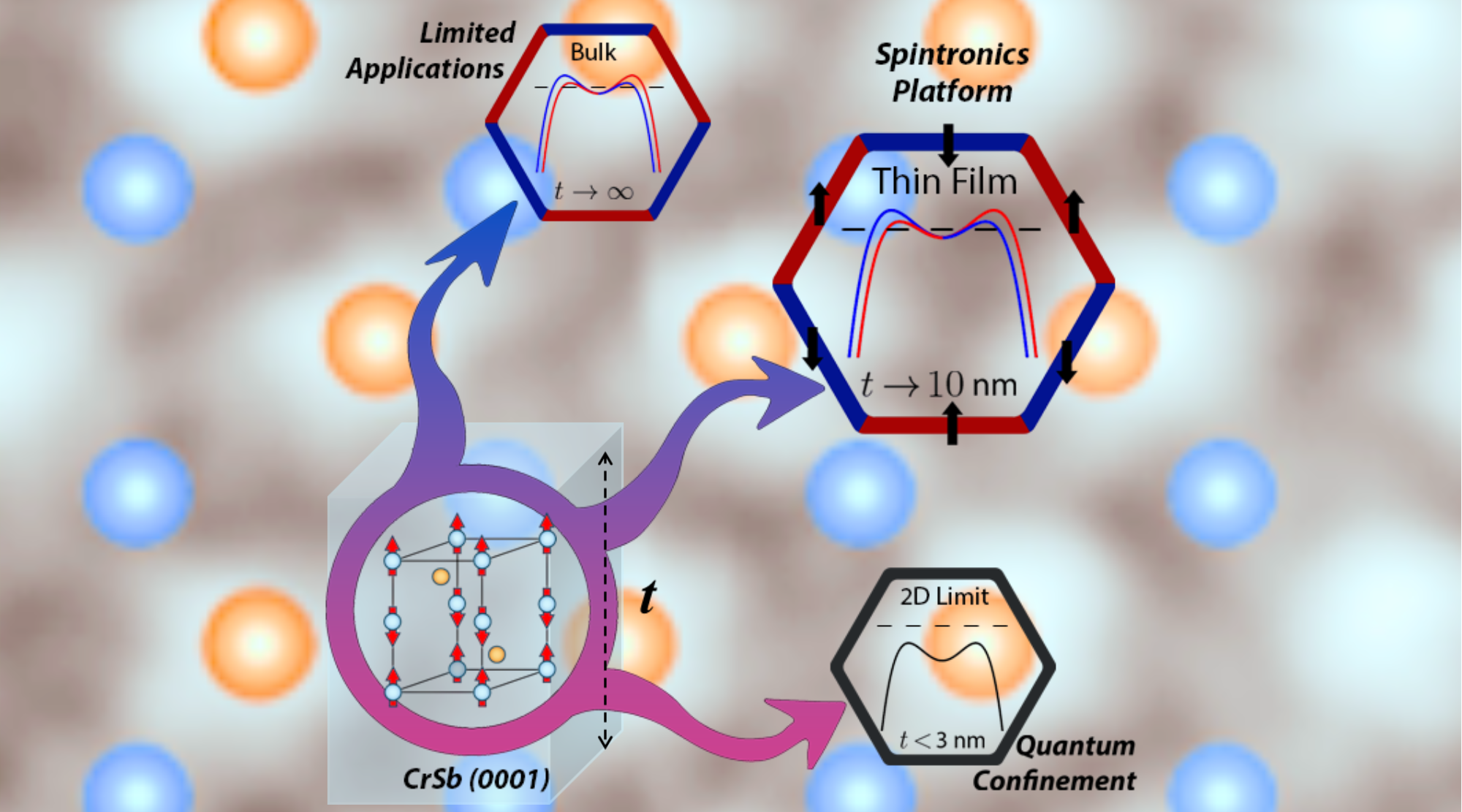
Altermagnetism offers the potential for spintronics—technologies that use electron spin to enable faster, smaller, ultra-low-power memory and processors—as well as advancements in quantum computing. Until now, however, altermagnetism had only been observed in bulk crystals and “thick” bulk-like films. In a recent paper published in Advanced Materials, researchers used the Advanced Light Source’s (ALS) high-performance angle-resolved photoemission spectroscopy (ARPES) capabilities at Beamline 10.0.1 to demonstrate that symmetry-driven splitting of electronic bands, the hallmark of altermagnetism, persists in thin films of chromium antimonide (CrSb) down to 10 nm, the relevant thickness for real-world device application.
“Theory predicted that CrSb is a candidate altermagnet, and experiments have already established CrSb as an altermagnet using single crystal samples,” explained Nitin Samarth, professor of physics and materials science and engineering at the Pennsylvania State University. “But our work explored crystalline thin films approaching the thickness that might be used in devices.”
The very thin samples of CrSb were synthesized by molecular beam epitaxy through the 2D Crystal Consortium (2DCC), a National Science Foundation (NSF)-funded national user facility at the Pennsylvania State University. To keep the samples pristine, the thin films were transported with a custom-built, ultra-high-vacuum suitcase to collaborators at UC Santa Barbara and then to the ALS. The development of the suitcase involved close collaboration with the ALS and was supported through the UC Santa Barbara NSF-funded Quantum Foundry.
The thin films of CrSb were characterized by ARPES at Beamline 10.0.1.2, the only operational instrument in the country for resolving electron spins. “The key result from our ALS measurements was the snapshot of the electronic band structure of the material,” said Alexei Fedorov, staff scientist at the ALS. “The observed structure was in line with the predictions that the material is an altermagnet, a new form of magnetic ordering that was just discovered a few years ago.” ARPES is one of the few experimental techniques capable of directly mapping a material’s electronic band structure. At the ALS, the high-brightness synchrotron x-rays and high resolution in energy and momentum allowed researchers to resolve the symmetry-driven features that define altermagnetism.
“The compatibility of the ultra-high-vacuum suitcase with the spin-resolved ARPES system at the ALS, and Alexei’s support, made it possible to perform these exciting experiments,” added Chris Palmstrøm, distinguished professor of electrical and computer engineering at UC Santa Barbara. “Teamwork was an important component of this project.” The experiments showed a sizeable band splitting of almost 700 meV even in CrSb films as thin as 10 nm in thickness, in agreement with theoretical predictions. This work sets the stage for further experiments where the team will examine films going down to the 2D limit, where quantum confinement forces electrons into an ultra-thin layer, enabling precise control over electronic properties for advanced devices. Spin-resolved measurements will be an important aspect of these future experiments.
The technological potential of altermagnets still remains to be unlocked, but the observation of altermagnetism in thin films is the first step toward understanding their use in energy-efficient, high-density, non-volatile magnetic memory chips.
S. Santhosh, P. Corbae, W.J. Yánez-Parreño, S. Ghosh, C.J. Jensen, A.V. Fedorov, M. Hashimoto, D. Lu, J.A. Borchers, A.J. Grutter, T.R. Charlton, S. Islam, D. Golovanova, Y. Zhao, A. Tauraso, A. Richardella, B. Yan, K.A. Mkhoyan, C.J. Palmstrøm, Y. Ou, and N. Samarth, “Altermagnetic Band Splitting in 10 nm Epitaxial CrSb Thin Films,” Adv. Mater. 37, e08977 (2025), doi:10.1002/adma.202508977.