SCIENTIFIC ACHIEVEMENT
Using the Advanced Light Source (ALS), researchers identified nitrogen-rich polymers in samples from the asteroid Bennu, revealing early chemical alterations in rocky bodies.
SIGNIFICANCE AND IMPACT
The results support the idea that asteroids, such as Bennu, may have carried water and the other chemical building blocks of life to Earth in the distant past.
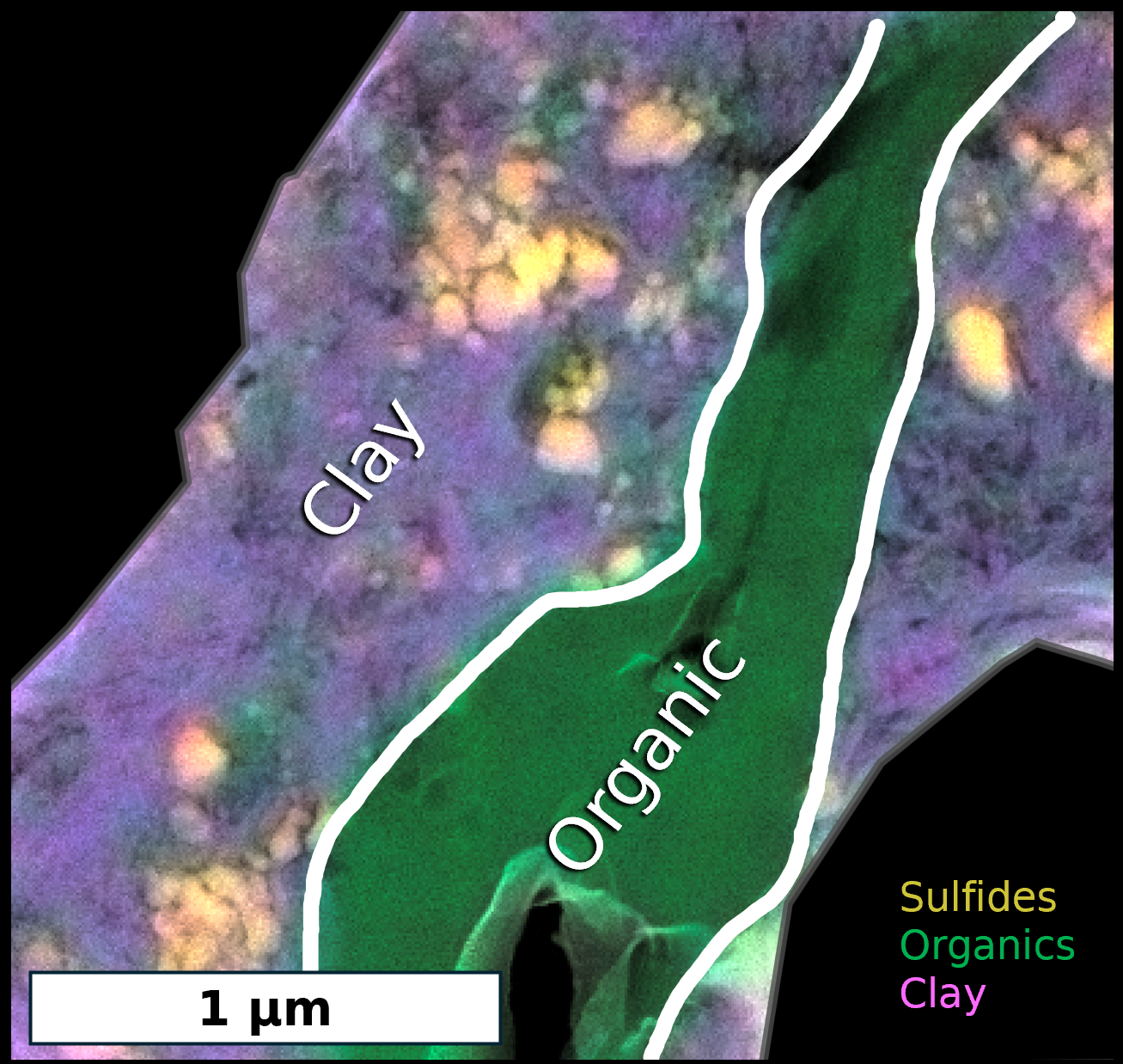
Asteroid holds hidden secrets
In 2023, NASA returned material gathered from the 4.5-billion-year-old asteroid Bennu, which formed from minerals and ice in a primordial nebula. The rocks were gathered as part of NASA’s OSIRIS-REx mission, the first US mission to return samples from an asteroid. Lawrence Berkeley National Laboratory (Berkeley Lab) continues to participate in a series of multi-institutional research studies investigating Bennu’s chemical makeup to better understand how our solar system and planets evolved.
Past research on Bennu samples at Berkeley Lab’s ALS revealed that many minerals formed in watery environments. In the current study, the researchers rolled back the clock to examine a narrow period shortly after the asteroid formed but before it was exposed to the water that altered the chemical nature of the rock.
The researchers identified long chains of organic molecules, richer in nitrogen and oxygen than the previous samples. With this information, the team reconstructed the conditions during the earliest periods of the asteroid’s existence.
Probing the chemistry of Bennu
A large number of researchers from many institutions have used a wide variety of techniques to study samples from Bennu. For this analysis, ALS scientists teamed up with researchers from the NASA Ames Research Center (ARC), University of California, Berkeley’s Space Sciences Laboratory, Washington University, California State University San Marcos, NASA Goddard Space Flight Center (GSFC), University of Arizona, Berkeley Lab’s Molecular Foundry, and more. The multidisciplinary and multi-facility collaboration yielded a robust characterization of Bennu.
At the Foundry, the samples were carved into thin, microscopic sections. The team used transmission electron microscopy to obtain sharp images of the specimen and determine the crystallinity of the constituents.
The researchers then took the samples to ALS Beamline 5.3.2.2 and probed them at various beam energies using scanning transmission x-ray microscopy (STXM). They determined the type and location of chemical bonds within the specimen compared with the surrounding asteroid material. Their work verified the presence of organic compounds, revealing carbon–carbon, carbon–nitrogen, and carbon–oxygen bonding.
The team turned to synchrotron infrared nanospectroscopy (SINS) and microspectroscopy at Beamline 5.4 to achieve high-spatial-resolution, nanoscale reconstructions of the micrometer-sized sample fragments. These studies detailed how the chemistry changed across the specimen, illustrating an organic layer with complex chemistry.
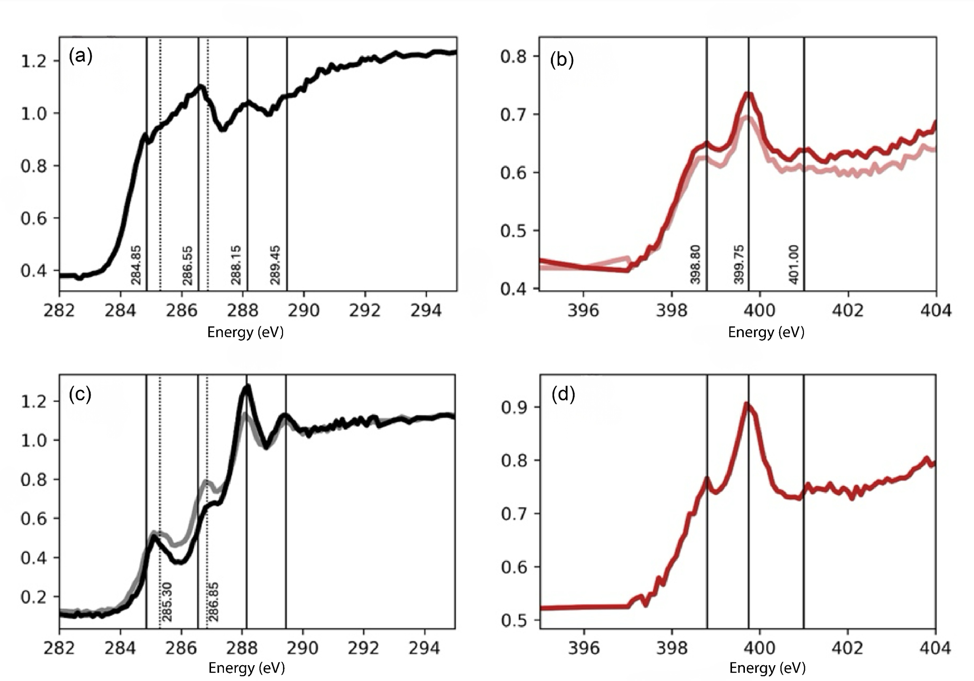
Carbamate precursor to amino acids, life
By comparing SINS and STXM data, the team confirmed the material’s unique organic composition. Based on the substance’s chemical nature, they reconstructed the environment that would support its formation.
The team suggested the organic compounds formed when heat from the radioactive decay of unstable atoms in the rock warmed the asteroid. The frozen chunks of ammonia and carbon dioxide combined chemically to form carbamates, which subsequently polymerized into a gum-like material. The nitrogen-rich composition of carbamate may have played a role in the formation of amino acids, nucleobases, and other chemical precursors that could have contributed to the prebiotic inventory necessary for the emergence of life.
Contacts: Zack Gainsforth and Scott Sandford
Researchers: S.A. Sandford and M. Nuevo (NASA Ames); Z. Gainsforth (University of California, Berkeley); M.A. Marcus and H.A. Bechtel (ALS); R.C. Ogliore and C. Jones (Washington University of St. Louis); G. Dominguez (California State University, San Marcos); D.P. Glavin and J.P. Dworkin (NASA Goddard); T.J. McCoy (National Museum of Natural History); S.S. Russell (Natural History Museum, London) T.J. Zega and D.S. Lauretta (University of Arizona); and H.C. Connolly Jr. (University of Arizona, Rowan University, and American Museum of Natural History)
Funding: National Aeronautics and Space Administration (NASA). Operations of the ALS and Molecular Foundry are supported by the US Department of Energy, Office of Science, Basic Energy Sciences program.
Publication: S.A. Sandford, Z. Gainsforth, M. Nuevo, M.A. Marcus, H.A. Bechtel, R.C. Ogliore, C. Jones, G. Dominguez, D.P. Glavin, J.P. Dworkin, T.J. McCoy, S.S. Russell, T.J. Zega, H.C. Connolly Jr., and D.S. Lauretta, “Nitrogen- and oxygen-rich organic material indicative of polymerization in pre-aqueous cryochemistry on Bennu’s parent body,” Nat. Astron. 9 (2025), doi:10.1038/s41550-025-02694-5
Read more about these Bennu findings in the NASA press release. Read more about previous ALS work on asteroid samples in “Bennu’s Ancient Brine Sheds Light on Recipe for Life” and “Vestiges of the Early Solar System in Ryugu Asteroid.”
ALS SCIENCE HIGHLIGHT #533

