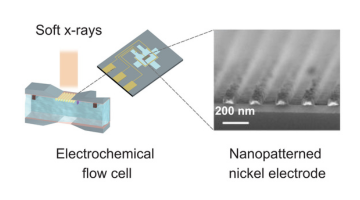
Berkeley Lab researchers developed a new x-ray technique that uses nanoscale patterns to amplify weak signals, allowing scientists to observe chemical reactions at buried solid–liquid interfaces that were previously challenging to study. Read more »
Science Briefs
Aerosol Chemistry Offers Clues to the Arctic’s Future

Researchers used scanning transmission x-ray microscopy to analyze Arctic aerosols, which strongly influence cloud formation and overall climate. Understanding what these particles are and how they change as they travel could help improve climate models and yield more accurate predictions of the changing Arctic environment’s global impact. Read more »
How Zinc Alters Mineral Structure in Early Arthritis
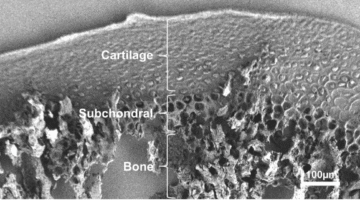
Using high-resolution x-ray techniques, researchers from UCSF, the ALS, and SSRL uncovered structural evidence that zinc subtly alters bone mineral in vulnerable joint regions, revealing early changes that may explain how arthritis begins and progresses. Read more »
The Goldilocks of Ethylene Purification
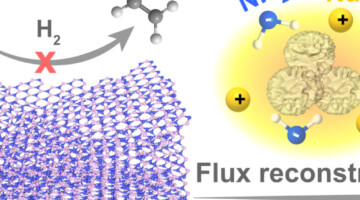
Researchers engineered defects in boron nitride to develop a metal-free route for purifying ethylene to remove acetylene. The ALS shed light on how the engineered defects were responsible for exceptional selectivity. Read more »
Altermagnetism All the Way Down
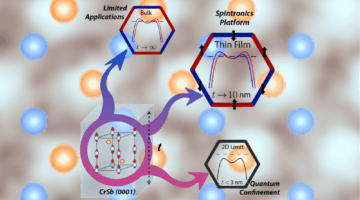
Altermagnets are an emerging class of magnetic materials that offer the potential for energy-efficient, high-density memory chips. Researchers at Penn State, UC Santa Barbara, and the ALS demonstrated that characteristic altermagnetic band splitting in chromium antimonide is evident in thin films relevant for real-world device application. Read more »
To Study Alien Atmospheres, ALS Fractures Nitrogen Gas
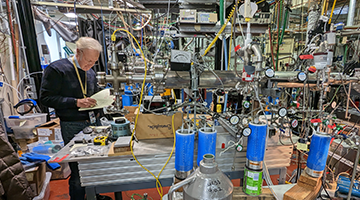
A research team used the ALS to recreate how the Sun breaks apart nitrogen to inform a new model that can be used to understand the fate of a variety of elemental isotopes to explain atmospheric evolution on planets across the solar system. Read more »
Separating an Electron into Waves of Spin and Charge
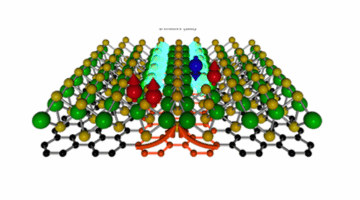
Researchers are exploring how a thin film can host a Tomonaga–Luttinger liquid, which separates an electron’s charge and spin. The research findings could contribute to the development of ultra-compact and energy-efficient technologies. Read more »
The Quest for an Altermagnet
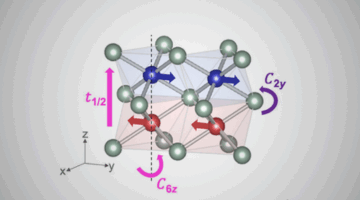
Researchers determine the unique electronic structure of altermagnets, which offers numerous benefits in creating energy-efficient devices based on spin-polarized electron currents. Understanding how altermagnetism works could contribute to the development of next-generation memory, logic, or sensing devices that are faster and consume less power. Read more »
Designing Quantum Materials for Future Electronics
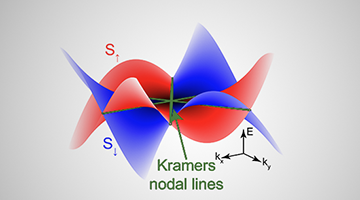
Researchers bring theory into practice and confirm a new material’s characteristics at the ALS. The study opens new opportunities to design a substance that renders extra “handles” on the electron—not just its charge, but its spin and valley—so we can build computers that are faster, cooler, and more energy-efficient compared to traditional electronics. Read more »
Dehydration Key Element in Soil Microbe Evolution
A new study illustrates how microbes respond, in real time, to environmental stress, improving the research community’s knowledge of the hidden microbial engines that keep our planet running. Read more »
- 1
- 2
- 3
- …
- 23
- Next Page »