Dahlia An and Alyssa Brand received the 2026 Tim Renner User Services Award at the 2026 Bay Area Light Sources Joint Users’ Meeting. The Advanced Light Source (ALS) Users’ Executive Committee (UEC) recognized them for their collaborative approach that allows users to conduct complex science in a safe manner.
“People see what we’re doing,” answered Alyssa Brand when asked what this award means to her. “People see how much we’re trying, and they appreciate that. All I want is to make a positive impact on our user community, and this is sort of a recognition that I am making a positive impact on the user community, and that’s amazing.”
Life before the ALS
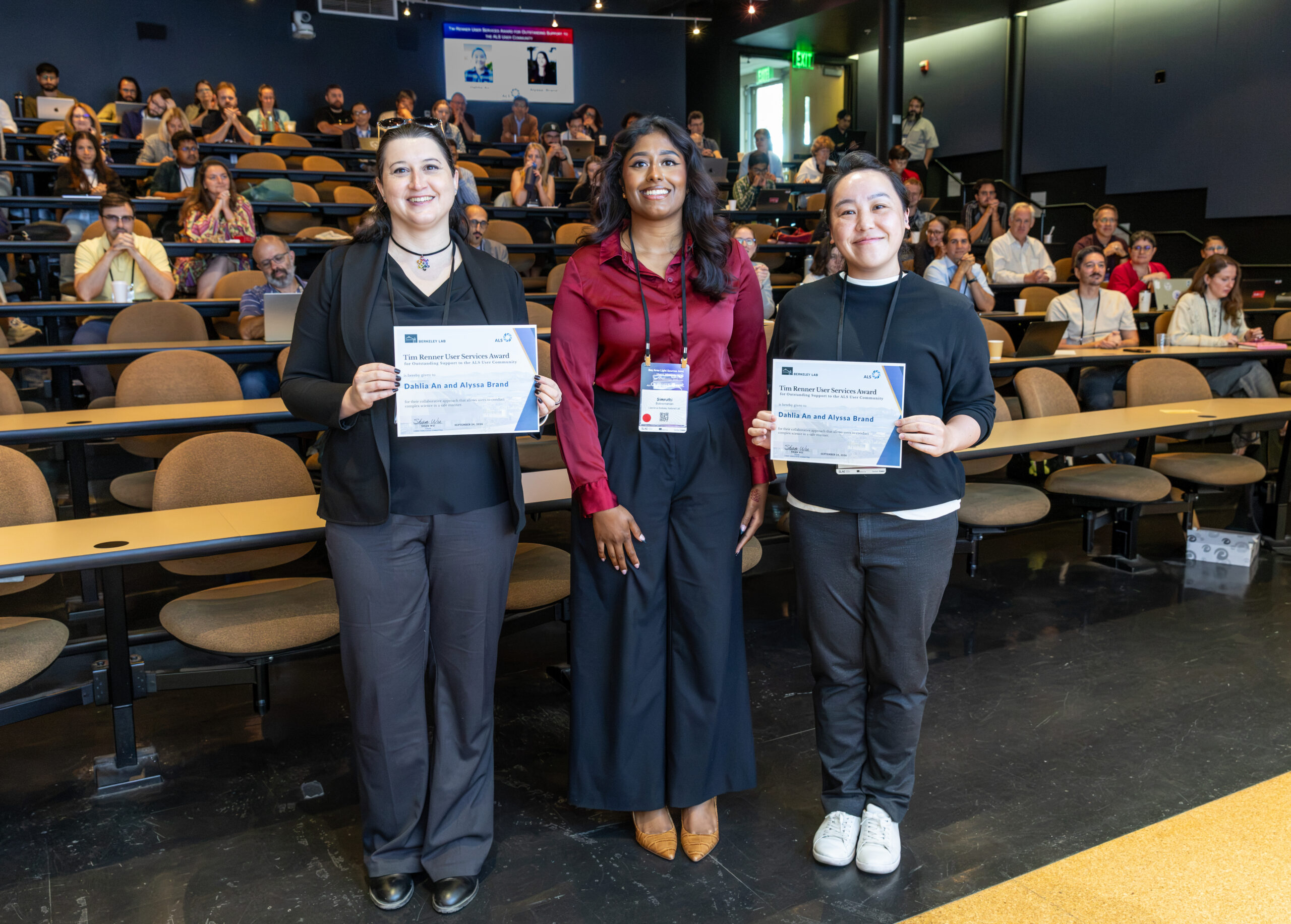
An and Brand are both part of the ALS safety team. An is the user safety and biosafety specialist and Brand the chemical safety specialist. Both have worked in other areas of Berkeley Lab before joining the ALS. A worked as a researcher in the Abergel Research Group before coming to the ALS. “She kept them super safe,” said Brand. “And made sure they didn’t get in trouble and trained everybody so all the amazing work that comes out of that group is because Dahlia taught people how to do it right.”
Brand had worked in Berkeley Lab’s Environment, Health, and Safety Division and the Molecular Foundry before joining the ALS. At the Molecular Foundry, she worked with Tracy Mattox who now heads the ALS User Office. Brand actually credits Mattox with teaching her a lot about lab management, writing training documentation, and training people.
Deep subject matter expertise and judgement
Proposed user experiments get reviewed for safety well before their beamtime. This is the point where An and Brand come in. If, for example, chemicals are involved, they make sure the experiment can be conducted safely.
“Great user support is often invisible,” mentioned Musa Ahmed, senior scientist in the Berkeley Lab Chemical Sciences Division. “Scientific facilities are often judged by the capabilities of their beamlines and instrumentation. Those are, of course, essential. But after more than 30 years at the ALS, I have come to believe that what ultimately distinguishes one user facility from another is its people.”
“I think what we do is a lot like public health,” explained An. “If we are doing our job correctly, you may or may not see us very often or hear about what we do or know what we do because a lot of what we do is prevention, or it happens before someone shows up at a beamline. So it’s validating to receive this award. It says we are doing our job, and people do seem to appreciate it, and that’s pretty cool.”
But this invisible support is what often makes world-class science happen. “It is because of the diligent leadership, subject matter expertise, and expert judgment of Brand and An that the users can perform world-renowned science at as low a safety risk as possible,” explained ALS research scientist Liz Clark.
Proactive education and communication
Often, users want to use materials or processes where safe handling of the experiment can be challenging. An and Brand’s collaborative and proactive approach to safety is what makes them stand out.
”Rather than treating unconventional chemical processes or exotic reagents as obstacles,” noted Miquel Salmeron, senior scientist in the Berkeley Lab Materials Sciences Division, “they engage with these challenges head-on, taking the time to thoroughly educate both individual users and broader research groups. Their guidance transforms what could be sources of uncertainty into opportunities and allows complex user experiments.”
Compassionate and tailored support
“I am continuously impressed by An’s familiarity with each experiment when she meets with our user groups on a near-daily basis,” marveled Clark. “She is an excellent communicator, relaying complex and critical safety protocols effectively in a manner appropriate for users of diverse academic backgrounds.” And as much as both try to make things happen, sometimes they have to tell a user that their proposed experiment cannot proceed. If this happens, An helps users to achieve as much of their goal as possible while being compassionate that their first plan was not feasible.
Similarly, Brand is lauded not just for her subject matter expertise, but also for her customer service. “Brand has spent several hours working with me one-on-one to help me become comfortable working with different compressed and flammable gasses,” explained Clark, “giving me the appropriate knowledge base and confidence to support users.” This has allowed experiments which have resulted in new scientific insights to be performed safely while dealing with compressed gases, something Clark was not very familiar with initially. She credits Brand with enabling her “to have a safe work environment, scientific success at 8.3.2, and ongoing skill development in this area to continue empowering users.”
Mentoring the next generation
An and Brand also mentor the next generation of scientists. “They have worked closely with PhD students and postdoctoral researchers in our group,” said Salmeron, “providing expert, patient instruction on the safe operation of specialized chemical laboratory equipment used in electrochemical cell experiments.” They ensure that users are not just told what to do and what not to do. They understand the reasoning behind it. And they can carry that knowledge forward. Considering that in a typical year over 600 graduate students and around 300 postdoctoral researchers conduct experiments at the ALS, An and Brand have a significant impact on the next generation of scientists.
Collaborative and holistic approach
“Rather than merely imposing regulations, they work collaboratively with users to establish conditions that permit complex research in a safe manner,” summarized ALS staff scientist Hans Bechtel. “Ultimately, Dahlia and Alyssa aim to reach a ‘yes’ for groundbreaking experiments. Their smiles and approachable nature foster a robust safety culture, embodying the principle that great science is safe science.” This echoes Ahmed’s earlier remarks that it’s not the beamlines, but the people that make the ALS stand out.
Tim Renner was a beamline scientist at the ALS whose battle with cancer cut short a career distinguished by a caring attitude and larger-than-life personality. This award recognizes the services of people across the ALS organization who have made outstanding contributions to the ALS user community.