by Gianna FazioLiu
Scientific Achievement
Experiments at the Advanced Light Source (ALS) revealed a hidden electronic phase that breaks time-reversal symmetry before a charge-density wave forms in kagome metal CsV3Sb5.
Significance and Impact
Because hidden electronic order can compete with or shape superconductivity, this finding helps guide the search for high-temperature, unconventional superconducting materials.
Research Details
- Used circular dichroism ARPES at ALS beamline 4.0.3 (MERLIN) to detect electronic flow in kagome metal CsV₃Sb₅
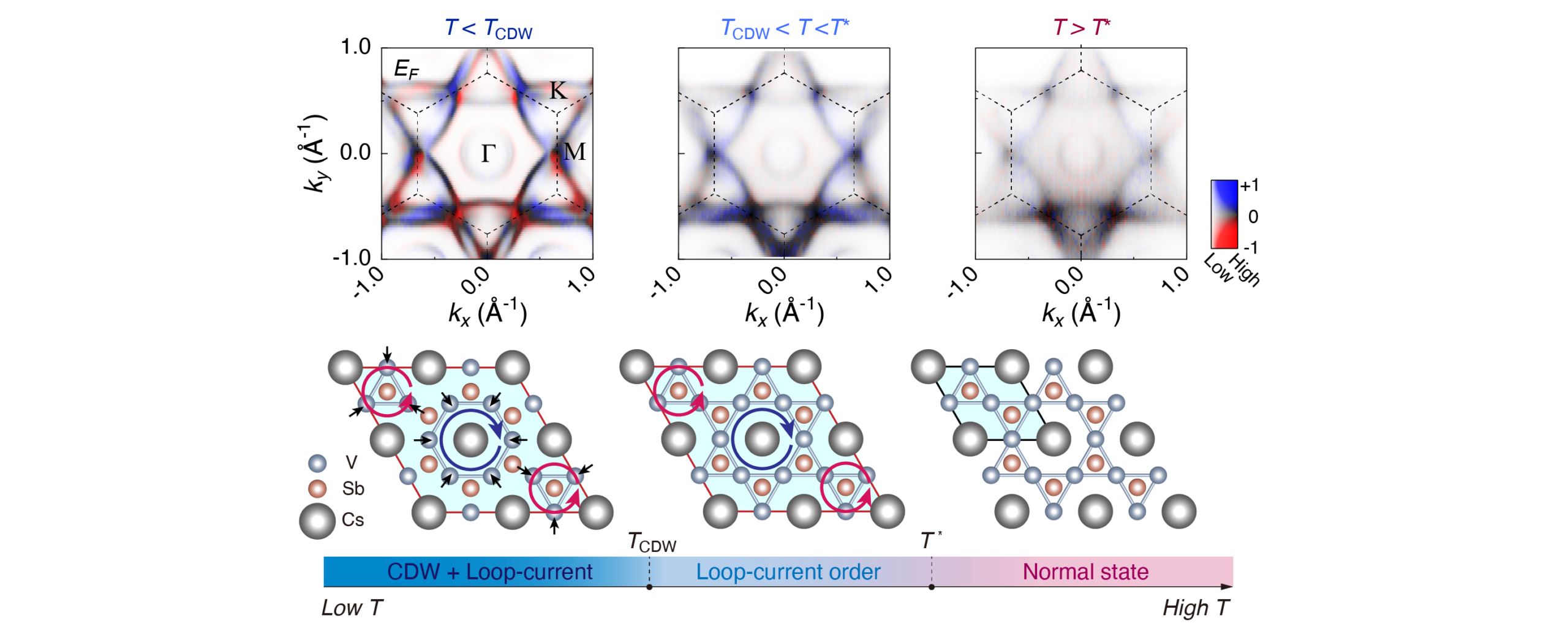
- Found the dichroic signal emerges near 150 K, well above the charge-density-wave transition, marking a distinct higher-temperature electronic phase
- Theoretical modeling and simulations identified signals as loop-current order
Research Summary
Kagome metals, materials whose atoms form a woven basket-like lattice pattern, are a prime testing ground for unusual quantum behavior that emerges when a material’s atomic geometry interacts with the topology of its electronic bands. In this geometry, electrons can follow several competing pathways and strongly influence one another.
Kagome metal CsV3Sb5, for instance, can hold multiple electronic states in one material. When it is cooled, it develops a cluster of electrons, known as a charge-density wave (CDW), before the emergence of superconductivity.
For several years, scientists have debated whether this metal also breaks time-reversal symmetry, a subtle asymmetry that would point to hidden “loop currents” circulating within each unit cell without producing any net magnetization. Some experiments hinted at this symmetry breaking, but whether it exists at all, and whether it emerges with the CDW or independently at a higher temperature, remained highly contested.
To address this, researchers used circular dichroism angle-resolved photoemission spectroscopy (CD-ARPES) at the ALS’s MERLIN endstation (beamline 4.0.3). This technique compared photoelectrons emitted under left- and right-circularly polarized light, revealing the orbital angular momentum structure of the electrons and providing evidence for the loop-current order associated with broken time-reversal symmetry.
Using this approach, the team tracked the dichroic signal across a wide temperature range and found it appeared at 145 K, nearly 50 K above the CDW transition. It became substantially stronger after the CDW formed, which was evidence of an intermediate electronic phase, governed by loop-current order, that precedes superconductivity. Revealing this new type of symmetry-breaking order can clarify how charge order and electronic chirality emerge from the same electronic system. The beamline provided a tunable circular polarization that gave the sensitivity needed to detect the subtle dichroic signal, and its precise sample alignment let the team rule out contributions from measurement geometry—confirming the signal was intrinsic to the material.
Combined with theoretical modeling, the results establish a three-step progression—loop-current order, its coexistence with CDW order, and finally superconductivity—reshaping the understanding of how unconventional superconductivity develops in kagome metals. Understanding this hidden symmetry-breaking order helps explain how unconventional superconductivity emerges in kagome metals, guiding the search for chiral and topological superconductors for future quantum technologies.
Contacts: Kim Yeongkwan, Jaehun Cha, and Jonathan Denlinger
Affiliations and Institutions: Lawrence Berkeley National Laboratory: Advanced Light Source. Ajou University. Donostia International Physics Center. Korea Advanced Institute of Science and Technology. Seoul National University. University of Cambridge.
Funding: Mid-Career Researcher Program and the Accelerator Manpower Training Program (Ministry of Science and ICT, National Research Foundation of Korea); the Korea Research Institute of Standards and Science (KRISS); the Air Force Office of Scientific Research (AFOSR). Operation of the ALS is supported by the US Department of Energy, Office of Science, Basic Energy Sciences program.
J. Cha, H. Lee, S. Sim, Y. Sur, K.-T. Kim, J.-H. Han, S.-W. Kim, G. Lee, J. Hyun, C.-Y. Lim, Y. Ahn, S. Gim, J.D. Denlinger, S. Kim, K.H. Kim, S. Lee, M.J. Han, and Y. Kim, “Evidence of time-reversal symmetry breaking above the charge density wave order in a kagome metal,” Nat. Phys. 22, 1245 (2026), doi:10.1038/s41567-026-03331-2.