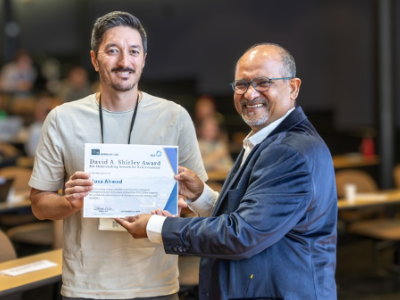
Musahid Ahmed, senior scientist in the Chemical Sciences Division at Lawrence Berkeley National Laboratory (Berkeley Lab) and leader of the Advanced Light Source (ALS) Chemical Dynamics Program, received the 2026 David A. Shirley Award for Outstanding Scientific Achievement at the 2026 Bay Area Light Sources Joint Users’ Meeting.
The ALS Users’ Executive Committee (UEC) recognized Ahmed for pioneering unique, tunable experimental endstations and techniques at the ALS that support the worldwide advancement of chemical reaction kinetics and dynamics. The instruments he has built and the doors he has opened for other chemists have shaped the field well beyond Berkeley Lab.
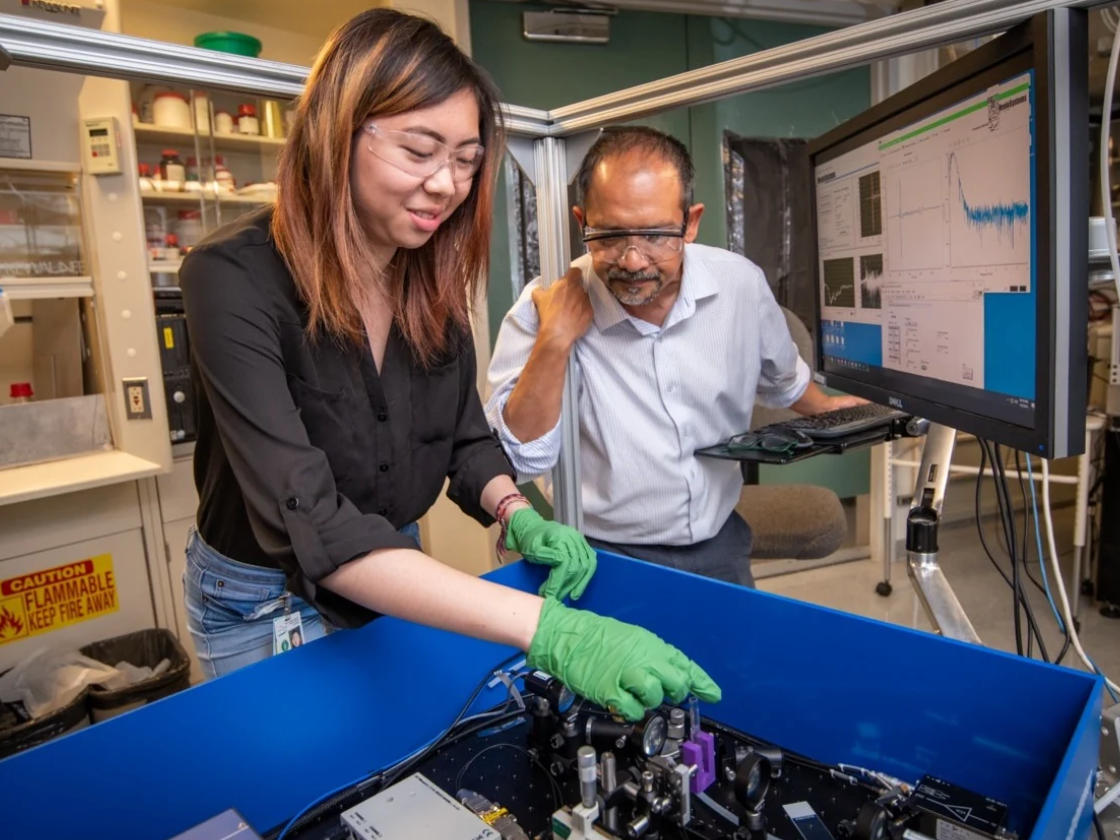
Ahmed has used synchrotron techniques to study elementary chemical processes and interactions since 1994, when he worked at the Daresbury Synchrotron Radiation Source in the United Kingdom. At the ALS, he and his collaborators have built numerous instruments to study the chemical dynamics of molecules, clusters, aerosols, and liquids. His recent projects have yielded insights into the dynamics of water clusters as well as how phosphoric acid molecules bond together in water-based solutions. These fundamental findings have applications ranging from battery development to atmospheric water capture.
A beamline built for chemical dynamics
Chemical dynamics is the study of how molecules collide, bond, and break apart as reactions unfold. As one of the ALS’s first beamlines, the vacuum ultraviolet (VUV) chemical dynamics beamline, beamline 9.0.2, has evolved through Ahmed’s dedication. He has operated the beamline, recruited new users, trained many postdoctoral researchers, and developed its science program.
“The fun part was building it from scratch. When we started, there was nothing like this built anywhere else in the world,” said Ahmed.
The beamline was the first to provide monochromatized VUV and soft X-ray capabilities simultaneously.
Ahmed not only adapted the beamline over 25 years—he also built the instruments to move the science forward. Over the years, the beamline offered an impressive diversity of endstation capabilities and techniques, such as cluster sources, flame sampling mass spectrometers, low temperature Laval nozzle kinetics, crossed molecular beams, aerosol photoelectron and mass spectrometers, shock tubes, elementary reaction kinetics, and 2D gas chromatography. Discoveries from this beamline have allowed deeper understanding of phosphoric acids in aerosols and the complex origins of molecules in the outer Solar System.
Ahmed pioneered many of these advances directly as a principal investigator. As leader of the former Chemical Dynamics Participating Research Team, he also enabled others through his advocacy and partnerships with outside user groups. Together, the endstations have made substantial impacts on the fields of combustion, chemical dynamics, and Earth and planetary atmospheres.
Ahmed further advanced aerosol chemistry and physics by securing funding for and building two new endstations. The first is an aerosol mass spectrometer that probes atmospheric aerosol chemistry and dynamics. The second is a velocity-map imaging spectrometer to allow near-edge X-ray absorption fine structure (NEXAFS) spectroscopy and X-ray photoelectron spectroscopy (XPS) studies of aerosol beams. These instruments were the first synchrotron endstations of their kind worldwide, yielding over 100 papers from local and outside user groups.
Collaborating with the next generation
Ahmed’s impact reaches beyond his own instruments or science. Throughout the years, he has supervised and mentored many postdoctoral scholars and graduate students. Many of these researchers have carried Ahmed’s innovations to other light sources, building upon the ideas first developed at the chemical dynamics beamline.
“The cluster-based machine and approaches pioneered by Dr. Ahmed have been replicated at other light sources, including Soleil, the Swiss Light Source, and the Taiwan Light Source,” said Kevin Wilson, senior scientist in the Chemical Sciences Division at Berkeley Lab.
That ripple effect is, in many ways, the most salient measurement of his legacy. Techniques once unique to the ALS are now found at synchrotron and other research facilities around the world, shaping the course of chemistry research well beyond Berkeley Lab.
“I couldn’t have done it without all of the postdoctoral support along the way,” said Ahmed. “Together, we built a scientific program that has made an impact throughout the community.”
The David A. Shirley Award was established in 1998 and recognizes the scientific contributions of researchers who are at least mid-career. David Shirley was a professor of chemistry at UC Berkeley and director of LBNL from 1980 to 1989, and was instrumental in having the Advanced Light Source built. He passed away in 2021.