by Rachel Berkowitz
SCIENTIFIC ACHIEVEMENT
Experiments at the Advanced Light Source (ALS) showed how magnetic Co atoms sandwiched between TaS2 layers reshape the material’s electronic structure.
SIGNIFICANCE AND IMPACT
Understanding how unusual magnetic order influences electron movements in new quantum materials like CoxTaS2 could guide their use in advanced quantum technologies.
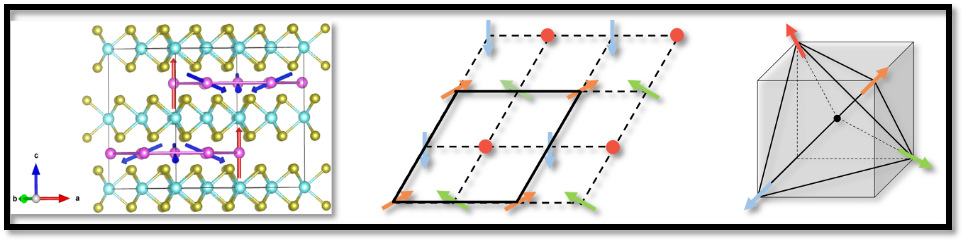
Tracing the electronic fingerprints of exotic magnetism
Van der Waals magnets that have layered structures offer a unique platform for exploring novel quantum states and their underlying physics. To discover how to harness their properties for use in next-generation electronics and data storage technologies, researchers are working to identify the electronic fingerprints of the exotic magnetic features in systems such as CoxTaS2.
CoxTaS2 belongs to a class of van der Waals magnets called magnetically intercalated transition metal dichalcogenides (TMDs). In these structures, magnetic atoms (cobalt, Co) are inserted between layers of a two-dimensional semiconductor (2H-TaS2). At extremely low temperatures, the cobalt atoms develop a very unusual non-coplanar magnetic order which researchers believe is responsible for the material’s exotic properties. In particular, they suspect that the unusual magnetism strongly influences how electrons move.
In this study, a group of researchers led by UC Berkeley, in collaboration with ALS scientists, aimed to reveal spectroscopic evidence of how magnetic order changes the behavior of itinerant electrons in CoxTaS2.
Excited electrons show their origins
Previous work had led to the discovery of a distinctive “3Q” antiferromagnetic state in triangular cobalt lattices such as those in CoxTaS2. This complex spin texture appears at extremely low temperatures, giving rise to quantum transport phenomena defined by unusual electron movements. But predictions of how these transport behaviors emerge have focused on the cobalt lattice itself without considering its coupling to a semiconductor sandwich.
The UC Berkeley team synthesized Co1/3TaS2 by inserting Co atoms into the gaps between two layers of TaS2. Then, using angle-resolved photoemission spectroscopy (ARPES) tools at the ALS, they examined its electronic band structure. In these experiments, light focused on the material excites electrons, causing them to be emitted from the surface—with energies and momenta that can then be measured.
The small spot size at the micro-ARPES endstation of ALS Beamline 7.0.2 (MAESTRO) enabled high-resolution spatial mapping and allowed the team to selectively measure different surface terminations. The spin-ARPES technique at ALS Beamline 10.0.1 enabled measurements of the spin polarization. Together, these measurements allowed the team to reconstruct the electronic structure and intrinsic spin texture within the bulk Co1/3TaS2.
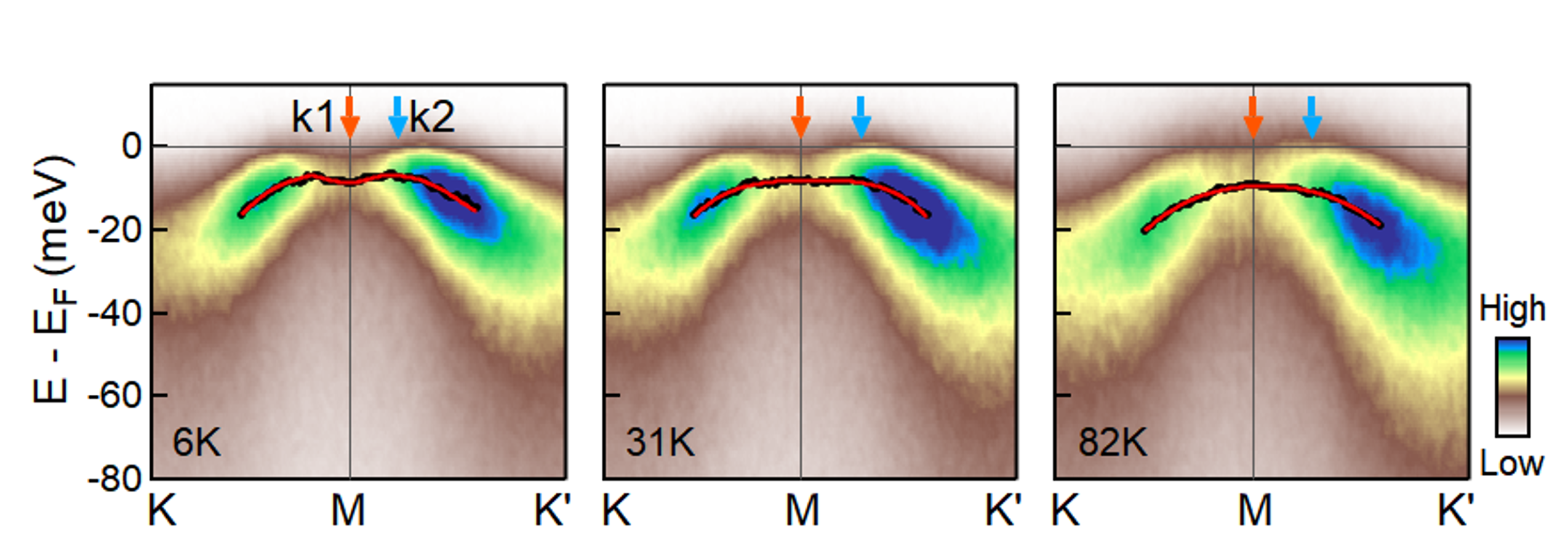
Cobalt lattice underpins electronic movements
The micro-ARPES measurements revealed distinct electronic bands in different magnetic states of the cobalt lattice. In particular, a clear modification of the band structure near regions with high-density-of-states—known as van Hove singularities—emerged below the temperature at which the cobalt lattice became magnetically ordered.
Additionally, the spin-ARPES measurements showed regions on the TaS2 surface that had opposite spin polarization. Calculations combining these measurements revealed that the cobalt intercalation modified the interlayer coupling between TaS2 layers and thereby influenced the observed spin texture.
Future studies will examine 2D versions of the material with carefully tuned energy levels. This could provide a route toward realizing electron transport phenomena, including the quantum anomalous Hall effect. This effect enables resistance-free electrical edge current flow without an external magnetic field, which is fundamental for developing ultra-compact, low-power electronic and spintronic devices.
Contacts: Hai-Lan Luo and Chris Jozwiak
Researchers: H. I. Luo, H. Jiang, L. Moreschini, D.H. Lee, A. Lanzara (UC Berkeley, Berkeley Lab), M. Huber (Berkeley Lab), J. Rodriguez, C. Xu, J. Analytis (UC Berkeley), A. Fedorov, C. Jozwiak, A. Bostwick (ALS), D. Dutta, and G. Chang (Nanyang Technological University).
Funding: US Department of Energy, Office of Science, Basic Energy Sciences program (DOE BES), Materials Sciences and Engineering Division; National Research Foundation of Singapore; and Singapore Ministry of Education. Operation of the ALS is supported by DOE BES.
Publication: H.L. Luo, J. Rodriguez, D. Dutta, M. Huber, H. Jiang, L. Moreschini, C. Xu, A. Fedorov, C. Jozwiak, A. Bostwick, G. Chang, J. G. Analytis, D.H. Lee, and A. Lanzara, “Discovery of Van Hove Singularities: Electronic Fingerprints of 3Q Magnetic Order in a van der Waals Quantum Magnet,” Nat. Commun 17, 3610 (2026). doi:10.1038/s41467-026-70063-5.
H.L. Luo, J. Rodriguez, M. Huber, H. Jiang, L. Moreschini, P. Madathil, C. Xu, C. Jozwiak, A. Bostwick, A. Federov,, J. G. Analytis, D.H. Lee, and A. Lanzara, “Spin-Valley Locking in 2H–TaS2 and Its Co-Intercalated Counterpart: Roles of Surface Domains and Co Intercalation.” Nano Lett. 26, 1011 (2026). doi:10.1021/acs.nanolett.5c05292.
ALS SCIENCE HIGHLIGHT #543