Scientific Achievement
Researchers used the Advanced Light Source (ALS) to visualize calcite cracks healing in real time, revealing how mechanical strain and trace moisture work together to seal geologic fractures.
Significance and Impact
These findings could improve reservoir management for more efficient extraction of resources such as hydrocarbons and geothermal energy from complex underground reservoirs.
Research Details
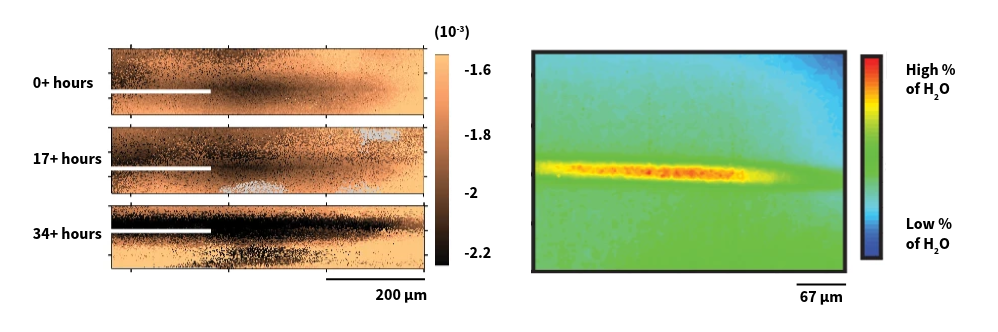
- Laue X-ray microdiffraction data from ALS beamline 12.3.2 was used to create high-resolution maps of mechanical strain in the calcite at several time-points throughout the healing process.
- Infrared spectroscopy at ALS beamline 2.4 revealed that water had been absorbed from ambient air along the crack’s surface, affecting the sealing of the crack.
- Combined, the ALS techniques revealed how mechanical and chemical processes worked hand-in-hand to seal the fracture.
Research Summary
Extracting resources from underground reservoirs depends on understanding and controlling complex networks deep in the earth. To produce geothermal energy, for example, water must flow through a matrix of underground cracks against hot rock to extract heat. Over time, these fractures can seal themselves shut, shrinking the surface area of hot rock exposed to water and reducing the amount of energy that can be extracted from the reservoir. Scientists are working to understand exactly how common minerals like calcite heal these fractures in their structure.
In this study, researchers applied external stress to a calcite crystal, causing a central crack to form, then released the pressure. The team used Laue X-ray microdiffraction—a technique that shines a continuous beam of high-energy X-rays spanning multiple wavelengths through a sample—at ALS beamline 12.3.2 to create a high-resolution map of its structure, pinpointing where mechanical strain was acting. Researchers took three Laue scans over a period of 44 hours to understand how the crack evolved over time in ambient conditions. Throughout these time-intensive scans—each taking between 14 to 16 hours—the ALS provided a steady stream of X-rays, enabling researchers to create high-resolution scans and capture subtle changes in the calcite. Then, they used infrared spectroscopy at ALS beamline 2.4 to study the calcite’s chemical composition and found that water had been absorbed from the air onto the crack’s surface.
The diffraction results showed that, while mechanical strain throughout most of the rock lessened with time, strain perpendicular to the crack increased over the course of the experiment, physically forcing the crack closed. Infrared spectroscopy data revealed that water became strongly bound at the crack interface. By combining both ALS techniques, the team demonstrated that mechanical and chemical processes were working hand-in-hand to seal the fracture in calcite. These insights could help scientists design strategies that keep underground fractures open and improve the efficiency of underground reservoirs.
Contacts: Michelle Devoe and Harrison P. Lisabeth
Affiliations and Institutions: Lawrence Berkeley National Laboratory: ALS. University of California, Berkeley.
Funding: US Department of Energy (DOE), Office of Science (SC), Office of Workforce Development for Teachers and Scientists, SC Graduate Student Research program; DOE Office of Energy Efficiency and Renewable Energy, Geothermal Technologies Office; DOE SC Office of Basic Energy Sciences, Chemical Sciences, Geosciences, and Biosciences Division. ALS Doctoral Fellowship in Residence. Operation of the ALS is supported by DOE BES.
M. Devoe, H.P. Lisabeth, S. Nakagawa, Z. Hao, N. Tamura, and H.-R. Wenk, “Spontaneous crack healing in calcite reveals the influence of dynamic strain evolution and surface chemistry,” Nat. Commun. 17, 4703 (2026), https://doi.org/10.1038/s41467-026-71110-x.