Scientific Achievement
Using X-rays tuned to specific elements at the Advanced Light Source (ALS), researchers discovered skyrmions occupied only alternating layers in a synthetic antiferromagnet, not all layers as expected.
Significance and Impact
Using layer design and magnetic fields, researchers can control where skyrmion bits form in stacked layers, potentially enabling 3D memory devices with increased storage density.
Research Details
- Fabricated a synthetic antiferromagnet with alternating cobalt-boron (CoB) and cobalt-iron-boron (CoFeB) layers.
- Used magnetic force microscopy and Lorentz transmission electron microscopy to confirm the presence of skyrmions in the material.
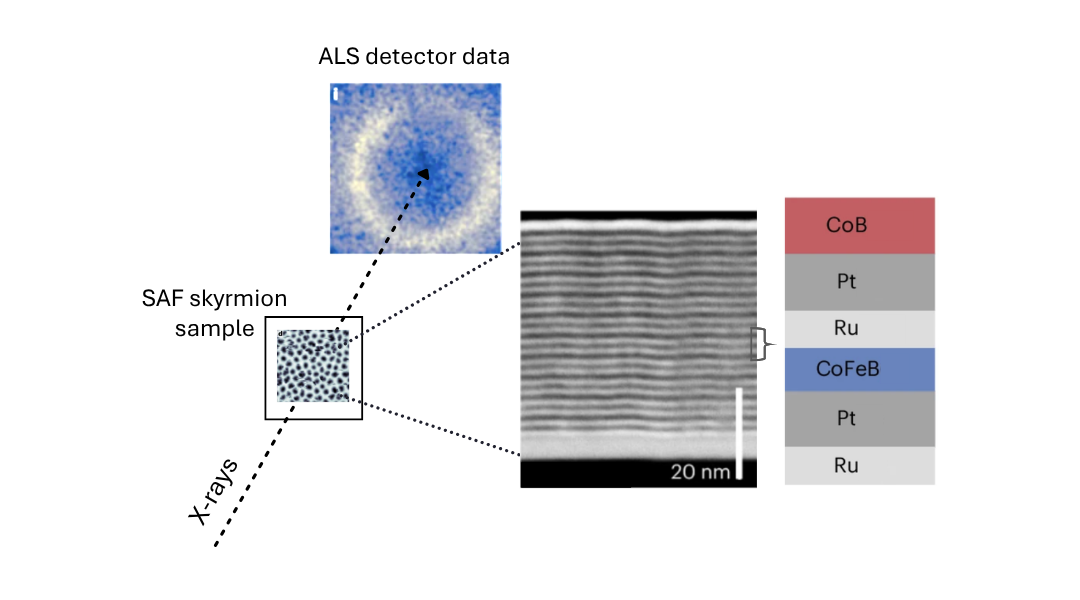
- Used X-ray magnetic circular dichroism at ALS beamline 7.0.1.1 to track the way that specific layers respond to magnetic fields, revealing that skyrmions were confined to the CoFeB layers rather than all layers as expected.
- Found that low applied fields produced unconventional skyrmions, with magnetic cores aligned to the field, while high fields produced conventional skyrmions, with cores anti-aligned to the field.
Research Summary
Materials scientists are seeking to boost data storage density and computing efficiency by stacking today’s flat, two-dimensional memory into three-dimensional architectures, and by leveraging skyrmions—nanoscale swirls of electron spin in magnetic materials—as individual bits of data. Multilayer magnetic materials combine both approaches, making them promising candidates for low-power, high-density chips. Realizing functioning devices, however, requires knowing which layers host skyrmions and how they behave, which is difficult when the layers are only a few atoms thick.
Synthetic antiferromagnets (SAFs), one type of multilayer magnetic material, are ultrathin, layered structures with opposing magnetic orientations. As in conventional multilayer stacks, skyrmions in SAFs were expected to exist in every layer, but with spins opposite to those in adjacent layers.
To test that hypothesis, researchers examined an SAF made of alternating cobalt-boron (CoB) and cobalt-iron-boron (CoFeB) layers under applied magnetic fields. Magnetic force microscopy and Lorentz transmission electron microscopy confirmed skyrmions were present. To distinguish which layers hosted the skyrmions, the team used X-ray magnetic circular dichroism at the ALS COSMIC Scattering beamline (7.0.1.1), applying magnetic fields with a newly installed in-vacuum magnet. By tuning the X-ray beam to cobalt (which is sensitive to both the CoB and CoFeB layers) and to iron (sensitive to only the CoFeB layers) while changing the magnetic field, they could isolate how each type of layer behaved. Hysteresis loops, which chart how a material’s magnetization responds to the magnetic field, revealed that the CoFeB layers responded gradually—as expected when skyrmions form—while the CoB layers switched abruptly. Together with microscopy and simulations, this showed that skyrmions exist only in the CoFeB layers, not in every layer as expected. The CoB layers likely drive this through a Ruderman-Kittel-Kasuya-Yosida (RKKY) exchange field, a magnetic influence that passes between the layers.
The study also found that two distinct skyrmion families could be activated by field strength. At high fields, skyrmions formed with their magnetic cores opposite to the field direction, which is how skyrmions in non-RKKY-coupled systems normally orient, while at low fields, skyrmions appeared with cores aligned with the field because the RKKY interaction overcomes the weak magnetic field. The skyrmions also showed return point memory, the ability to appear and reappear in the same location, with each family having distinct return point locations, which is useful for reliably reading and writing data.
Taken together, these results show that both layer composition and applied field determine where skyrmions form in a stack and what type they are, offering a design strategy for three-dimensional memory with greater storage per volume. They also show that skyrmions do not necessarily occupy every SAF layer, so element-specific checks are essential to understanding where skyrmions exist in materials. Future analysis will use the ALS’s coherent light to study both the conventional and unconventional skyrmion stability and dynamics in real time.
Contacts: Christopher Marrows and Sophie A. Morley
Affiliations and Institutions: Lawrence Berkeley National Laboratory: Advanced Light Source; AREA Science Park; National Physical Laboratory; Politecnico di Bari; Sorbonne Paris Nord University; Swiss Federal Laboratories for Material Science and Technology; University of Basel; University of California, Santa Cruz; University of Glasgow; University of Leeds.
Funding: UK Engineering and Physical Sciences Research Council; Italian Ministry of Research; European Union National Recovery and Resilience Plan; Swiss National Science Foundation Lead Agency; UK Department for Science, Innovation and Technology. Operation of the ALS is supported by the US Department of Energy, Office of Science, Basic Energy Sciences program.
K. Fallon, R. Peremadathil-Pradeep, C.E.A. Barker, Z. Tumbleson, E. Darwin, A. Meo, E. Haltz, B.A. Brereton, T. Almeida, C. Kirkbride, S. Villa, S.A. Morley, M. Carpentieri, R. Tomasello, H.J. Hug, C.H. Marrows, and S. McVitie, “Unconventional skyrmions in synthetic antiferromagnets,” Nat. Mater. (2026), doi: 10.1038/s41563-026-02673-9.