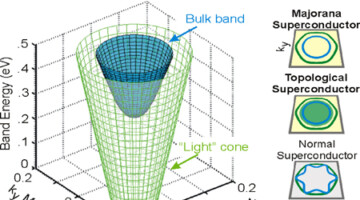
ARPES studies show that it’s possible to introduce superconductivity into a topological insulator. The resulting novel properties, such as relativistic electrons and quantum memory, may in the future provide the basis for a whole new type of computer.
Read more »

ALS Work Using ARPES
Angle-resolved photoemission spectroscopy (ARPES) is a technique in which a highly focused beam of x-rays is used to kick electrons out of the sample. By analyzing the ejected electrons' direction and energy, the researchers can obtain the material's band structure—a map of the electrons' behavior in the material.
ALS Reveals New State of Matter
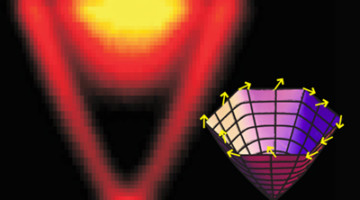
ALS user groups from Princeton and Stanford have been making waves this past year with several high-profile papers and extensive news coverage of their work on a new state of matter embodied by so-called “topological insulators,” materials that conduct electricity only on their surfaces. Read more »
Observation of a Macroscopically Quantum-Entangled Insulator
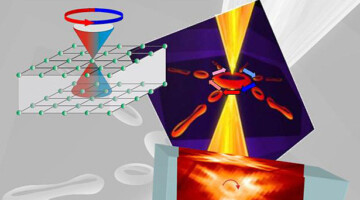
It has recently been proposed that insulators with large band gaps and strong spin-orbit coupling can host a new phase of quantum matter called a topological insulator that is characterized by entangled wavefunctions. The proposal has now been realized by an international collaboration led by researchers from Princeton University who studied the electronic structure of insulating alloys of bismuth and antimony by means of angle-resolved photoemission spectroscopy (ARPES) and spin-resolved ARPES. Read more »
- « Previous Page
- 1
- …
- 6
- 7
- 8