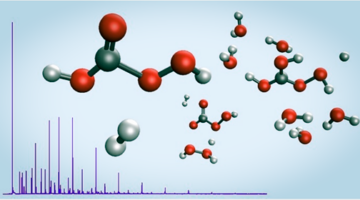
Using tunable vacuum ultraviolet light, researchers found that ionizing CO2–water clusters forms new oxygen–oxygen bonds. These findings provide a molecular pathway to understanding how radiation produces peroxide on the icy surfaces of moons, which may shed light on how complex molecules originate.
Read more »
To Study Alien Atmospheres, ALS Fractures Nitrogen Gas
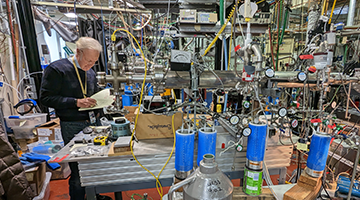
A research team used the ALS to recreate how the Sun breaks apart nitrogen to inform a new model that can be used to understand the fate of a variety of elemental isotopes to explain atmospheric evolution on planets across the solar system. Read more »
Electronic energy transfer ionization in naphthalene–CO2 clusters reveals excited states of dry ice

The interaction between CO2 and polycyclic aromatic hydrocarbons is of interest in astrochemically relevant ices, the transition to renewable energy, and the development of green chemistry. We investigate the VUV excitation of the naphthalene–CO2 complex and observe excited states of CO2 through a newly identified electronic energy transfer ionization mechanism. Read more »
New Pathway for SO2 Breakup Sheds Light on Earth’s Oxygenation
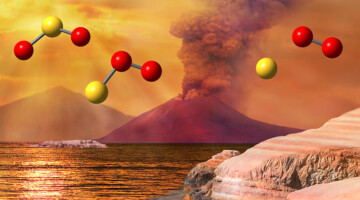
While calibrating a new scientific apparatus at the ALS, researchers discovered that ultraviolet light can break up sulfur dioxide (SO2) in a new way, with molecular oxygen (O2) as an unexpected product. The discovery sheds light on Earth’s Great Oxygenation Event 2.4 billion years ago, when atmospheric oxygen levels first began to rise. Read more »
SO2 Photodissociation at 193 nm Directly Forms S(3P) + O2(3Σg–): Implications for the Archean Atmosphere on Earth

Sulfur isotope patterns in ancient rock layers inform our understanding of Earth’s Archean atmosphere. Before the Great Oxygenation Event (~2.4 billion years ago), hard ultraviolet light penetrated into the Earth’s surface, photodissociating sulfur dioxide directly to S + O2. This new product channel may help resolve discrepancies in the Earth’s evolutionary history. Read more »
Gas-phase synthesis of racemic helicenes and their potential role in the enantiomeric enrichment of sugars and amino acids in meteorites

Molecular-beam experiments with isomer-selective photoionization via a targeted, vinylacetylene-mediated gas-phase reaction of aromatic helicenyl radicals coupled with electronic structure calculations and astrochemical modeling reveal an elegant synthetic route to racemic helicenes – ortho-fused polycyclic aromatic hydrocarbons (PAHs), in which benzene building blocks form helically-shaped molecules. Read more »
Dramatic Conformer-Dependent Reactivity of the Acetaldehyde Oxide Criegee Intermediate with Dimethylamine Via a 1,2-Insertion Mechanism

Acetaldehyde-oxide (CH3CHOO) is an atmospherically pertinent reactive intermediate that exists in syn (right) and anti (left) conformational forms. Experiment and theory reveal that the reaction of anti with dimethylamine is several orders of magnitude faster than that of syn with dimethylamine, despite both reactions being energetically downhill. Read more »
Chemical (and Strategic) Transformations at Beamline 9.0
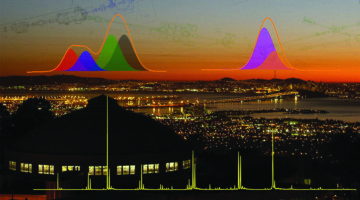
The Chemical Dynamics beamline, used for gas-phase vacuum ultraviolet (VUV) experiments, was one of the first beamlines built at the ALS. Since then, the program has undergone several strategic transformations, enabling the study of complexity in clusters, aerosols, and nanoparticles using both VUV and soft x-ray radiation. Read more »
Key to Cleaner Combustion? Look to the Stars
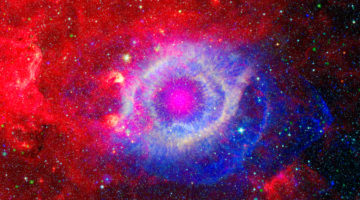
Researchers made the first real-time, lab-based measurement of free radicals reacting under cosmic conditions, prompting elementary carbon and hydrogen atoms to coalesce into primal benzene rings. The findings are key to understanding how the universe evolved with the growth of carbon compounds and could also help the car industry make cleaner combustion engines. Read more »
Gas-phase synthesis of corannulene—a molecular building block of fullerenes

Fullerenes have been implicated to play a key role in the astrochemical evolution of the interstellar medium. However, the formation mechanism of even their simplest molecular building block—corannulene—has remained elusive. Here we demonstrate that corannulene can be synthesized in the gas phase through reactions mimicking conditions in carbon-rich circumstellar envelopes. Read more »