by Maritte O’Gallagher
SCIENTIFIC ACHIEVEMENT
Using X-Ray interferometry at the Advanced Light Source (ALS), researchers characterized key optical and functional properties of magnetic materials with high sensitivity.
SIGNIFICANCE AND IMPACT
This novel magnetometer scheme could accelerate discovery of magnetic thin film materials with broad applications across modern technology.
Harnessing optics and synchrotron science for materials discovery
Accurate, quantitative measurement of optical parameters is a key aspect of advancing X-ray characterization techniques. Such techniques can be used to probe the functional properties of magnetic thin films, which are essential materials for applications in high-density data storage, magnetic sensors, and flexible electronics.
Standard lab X-ray or neutron sources often lack the sensitivity, resolution, and element specificity to analyze modern, complex magnetic systems. Synchrotron light sources, like that of the Advanced Light Source (ALS), provide the extremely bright, tunable, and polarized X-rays required to probe the atomic-scale origins of magnetism, including spin (the intrinsic magnetism of the electron), orbital moments (the magnetism from the electron’s motion around the nucleus), and isolated signals from specific elemental components in complex materials.
Inspired by foundational physics, ALS researchers leveraged the coherent X-rays and advanced focusing capabilities available at Beamline 7.0.1.1 (COSMIC Scattering) to develop a powerful method for measuring optical parameters of magnetic thin films. The sensitivity of their approach reveals nanoscale magnetic properties of these materials.
Coherence, resonance, and interference offer sensitive measurements
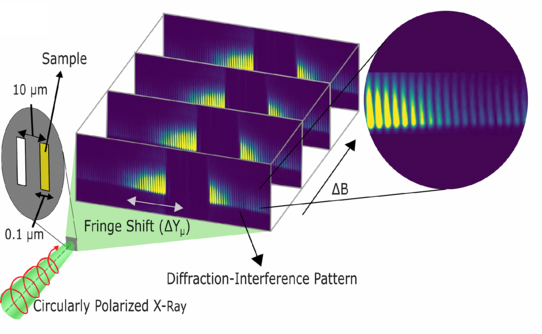
Thomas Young’s 1801 canonical double slit experiment famously demonstrated the wave nature of light. When light moving in the same phase (called coherent light) passes through two closely spaced slits, the emerging waves overlap and interfere, creating a distinct pattern of alternating bright and dark bands (fringes) on a viewing screen.
In this work, researchers iterated on Young’s work, using the small fraction of coherent light supplied by today’s ALS to do a similar X-ray interferometry experiment. But they also incorporated the effect of X-ray magnetic circular dichroism (XMCD), which probes magnetic properties on an element-specific basis by shining left- and right-circularly polarized X-rays onto a sample. The difference in how materials absorb these two types of X-rays reveals the magnetic state of individual atoms, including spin and orbital moments.
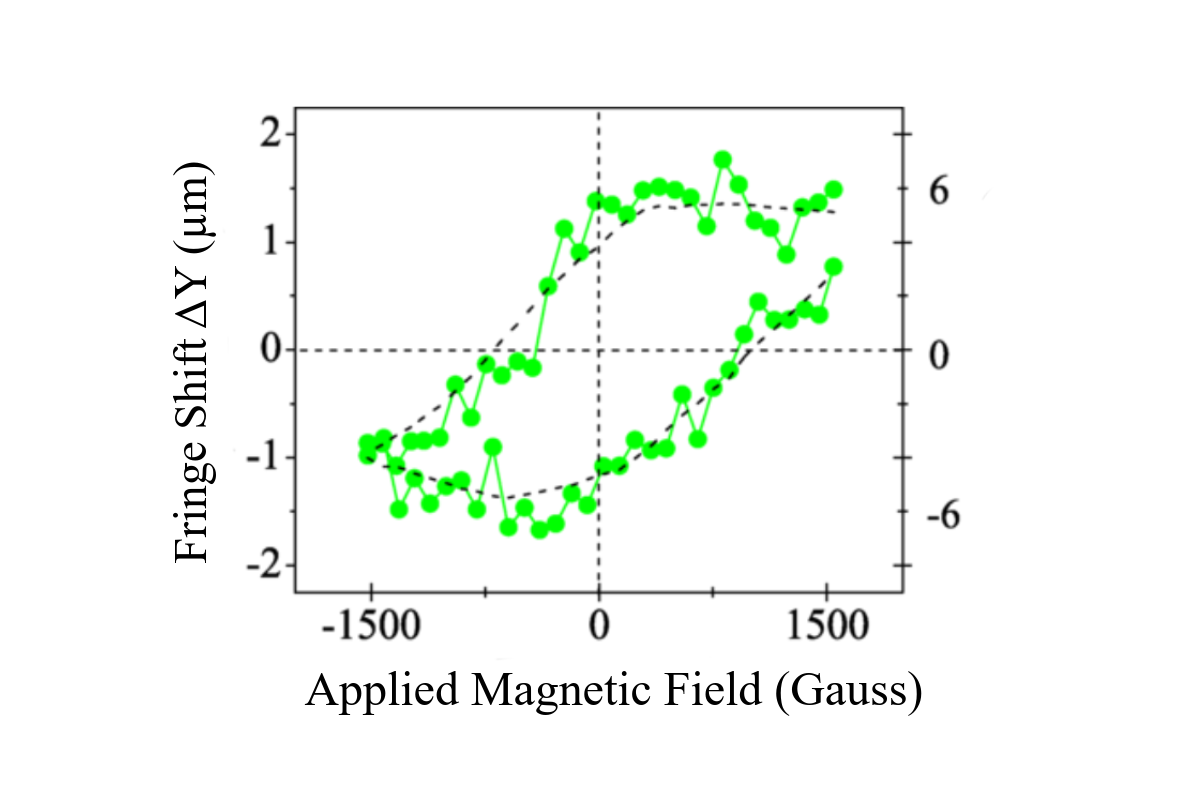
This combined approach involved focusing a resonantly tuned, polarized beam through a pinhole towards a double-slit structure with one empty slit and one slit covered by a sample of magnetic thin film. Next, the researchers applied a magnetic field and observed chances in the refractive index, a key optical property which measures how much a material slows down light. This shift affected the phase relationship between the two X-ray beams, and thus their interference pattern. By tracking fringe shifts, the researchers mapped cycles of magnetization and reversal. This coupling of changes in the refractive index with the applied magnetic field revealed global magnetic changes of the material, while XMCD detected spin-up and spin-down electron populations underlying that net magnetic moment.
A new magnetometer
This hybrid approach represents a powerful new magnetometer scheme that could address a key gap in the magnetic industry. Manufacturing nanofilm structures involves depositing materials in complex, multilayer stacks. Determining the exact thickness of layers in the stack is critical, as a film’s magnetic behavior, switching speed, and electrical properties change significantly at the nanoscale. The X-ray interferometry-based technique used in this study, which can detect thicknesses on the order of the wavelength of light being used, provides the necessary sensitivity to precisely characterize the thickness and location of buried magnetic layers in multilayer stacks. This capability can be scaled as needed for measuring miniscule changes, and could be applied to manufacturing hard drives, sensors, spintronic devices, and more.
The researchers plan to expand this experimental setup to investigate questions in fundamental physics and material science, including orbital angular momentum, ferroelectric materials, and quantum optics. With ALS-U significantly boosting flux and coherence, the researchers anticipate that the experimental capabilities of this magnetometer scheme will continue to compound, offering powerful new options for ALS users.
Contacts: Soham Atkar, Sujoy Roy, and Sophie Morley
Researchers: S. Atkar (Indian Institute of Technology and Berkeley Lab); Z. Tumbleson (Berkeley Lab and University of California, Santa Cruz): S. A. Morley, A. Islegen-Wojdyla, K. A. Goldberg, A. Scholl, and S. Roy (ALS), N. Burdet (SLAC National Accelerator Laboratory); S. A. Montoya (University of California, San Diego); and Trinanjan Datta (Augusta University).
Funding: US Department of Energy, Office of Science, Basic Energy Sciences (DOE BES), Office of Workforce Development for Teachers and Scientists (WDTS) Science Undergraduate Laboratory Internship (SULI) program. Operation of the ALS is supported by DOE BES.
Publication: S. Atkar, Z. Tumbleson, S. A. Morley, N. Burdet, A. Islegen-Wojdyla, K. A. Goldberg, A. Scholl, S. A. Montoya, Trinanjan Datta, and S. Roy, “Magnetically modified double-slit-based X-ray interferometry,” Phys. Rev. Research 8, 023092 (2026), doi:10.1103/5njk-mhwg
ALS SCIENCE HIGHLIGHT #545