Monday, September 11
The ALS User Meeting offers tutorials geared towards introducing new and seasoned users to various techniques, tools, and instrumentation. In addition, the second half of the User Meeting will be devoted to visioning workshops about the future of the facility, post-ALS-U.
Tutorials will run all day on Monday, September 11.
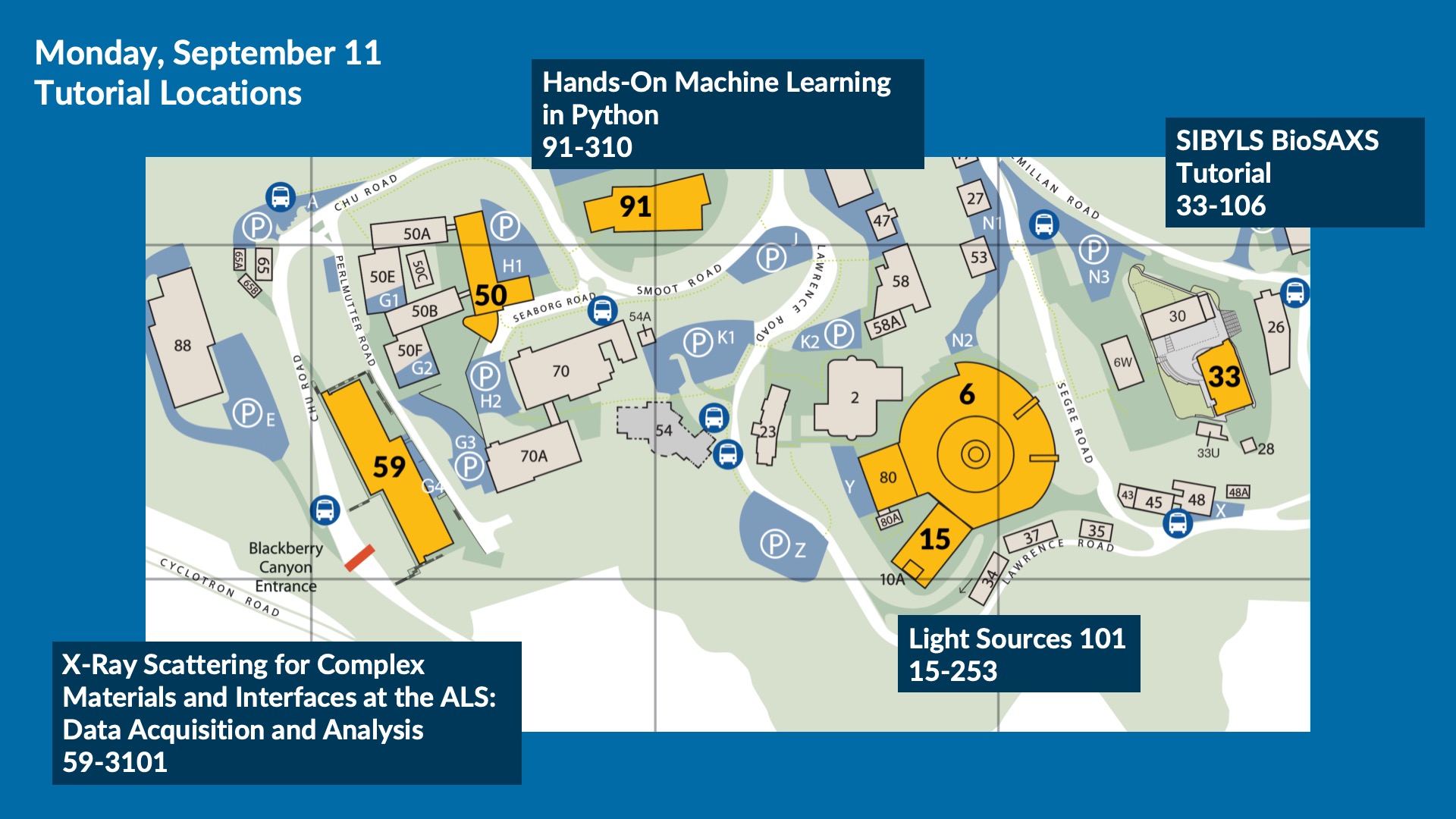
Light Sources 101
Inna Vishik (UC Davis), Yu He (Yale), Tamas Varga (PNNL)
In-person or virtual attendance
Location: 15-253 | Zoom registration for hybrid sessions
View the agenda
[su_spoiler title=”Abstract” icon=”chevron” class=”header6″]
This tutorial is tailored for students and postdocs, including those who have no prior exposure to synchrotron experiments. It provides a broad introductory overview of the science one can perform at the ALS with an emphasis on some of the experimental techniques, from photoemission and spectroscopy to scattering and imaging. This is the place to ask all the questions you have about a particular technique and how to successfully apply it to your scientific project! Students with no/limited prior synchrotron experience are particularly encouraged to attend.
[/su_spoiler]
Hands-On Machine Learning in Python
Alexander Hexemer (ALS), Tanny Andrea Chavez Esparza (ALS), and Wiebke Koepp (ALS)
In-person attendance only
Location: 91-310
View the agenda
[su_spoiler title=”Abstract” icon=”chevron” class=”header6″]
This tutorial offers an overview of scientific machine learning using Python and includes practical exercises for hands-on experience. The guide encompasses numerous methods and resources employed in data-driven research, starting with a brief introduction to reading and processing scientific data in Python—a programming language widely used in scientific computing. The tutorial investigates popular machine learning packages, such as scikit-learn, PyTorch, and TensorFlow, while discussing their potential in addressing a variety of scientific challenges.
Our tutorial provides a step-by-step guide on essential techniques, including linear regression, clustering, principal component analysis (PCA), and Uniform Manifold Approximation and Projection (UMAP) for dimensionality reduction. We then delve into advanced machine learning approaches, such as neural networks and convolutional neural networks (CNNs), showcasing their potential in handling complex scientific data. The tutorial elucidates the concepts of regression, clustering, classification, and dimension reduction techniques with emphasis on their applicability across diverse scientific data sets.
By providing a thorough overview of scientific machine learning techniques and tools, this tutorial aims to equip researchers with the necessary skills to tackle data-driven challenges in their respective fields. The tutorial emphasizes the importance of understanding and selecting appropriate techniques, ensuring that researchers can make informed decisions when applying machine learning to scientific problems.
[/su_spoiler]
Structurally Integrated BiologY for Life Sciences (SIBYLS) BioSAXS Tutorial
Kathryn Burnett (MBIB, LBNL) and Greg Hura (MBIB, LBNL)
Update: Virtual only; no in-person component
Zoom registration
View the agenda
[su_spoiler title=”Abstract” icon=”chevron” class=”header6″]
The 2023 SIBYLS BioSAXS tutorial is designed for current and future SIBYLS SAXS users. We will provide participants with software tutorial sessions for biological SAXS. The latest advances in SAXS studies on biological systems will be discussed with particular focus on advances in our mail-in SAXS program and on advances in synchrotron scattering techniques, modeling of dynamic and flexible structures, bioSAXS with membrane protein, and integrating bioSAXS analysis within cryo-EM imaging and crystallography. SIBYLS Lab’s SAXS beamline scientists will introduce the future of high-throughput and size-exclusion-coupled SAXS (HT-SAXS and SEC-SAXS). We will present talks about integrating high-resolution models in the SAXS modeling. We will provide an opportunity for participants to present and discuss their projects with the SIBYLS staff. Interested users can present their case studies for workshop analysis. This will provide for a flux of ideas among workshop participants and inspire new perspectives for future data analysis.
[/su_spoiler]
X-Ray Scattering for Complex Materials and Interfaces at the ALS: Data Acquisition and Analysis
Chenhui Zhu (ALS), Cheng Wang (ALS), Slavomir Nemsak (ALS), Maximillian Jaugstetter (MSD, LBNL), Paulina Rybak (University of Warsaw)
In-person or virtual attendance
Location: 59-3101| Zoom registration for hybrid sessions
View the agenda
[su_spoiler title=”Abstract” icon=”chevron” class=”header6″]
This tutorial session will serve as an introduction to the x-ray scattering technique and its applications in complex material characterization. Current scattering beamlines including hard, tender, and soft x-ray scattering will be introduced. The basic principles as well as data collection and analysis strategies will be presented. The tutorial will include practical examples as well as usage of simulation tools.
[/su_spoiler]