This page details how the ALS-U project will affect ALS beamlines. It also outlines planned or in-progress improvements to beamline capabilities. For more information on the project timeline, see the ALS-U Timeline & Facility Impacts page.
- Long-Term Beamline Impacts Overview
- Post-ALS-U Beamline Status Table
- New Beamlines and Capabilities
- Feedback and Questions
Long-Term Beamline Impacts Overview
This color-coded version of the ALS beamclock provides a high-level view of the post-ALS-U operational status of each beamline and indicates beamlines that are anticipated to turn off before the dark time. Additional details are provided in the Beamline Status Table below.
Click on the image to view or download a high-resolution version.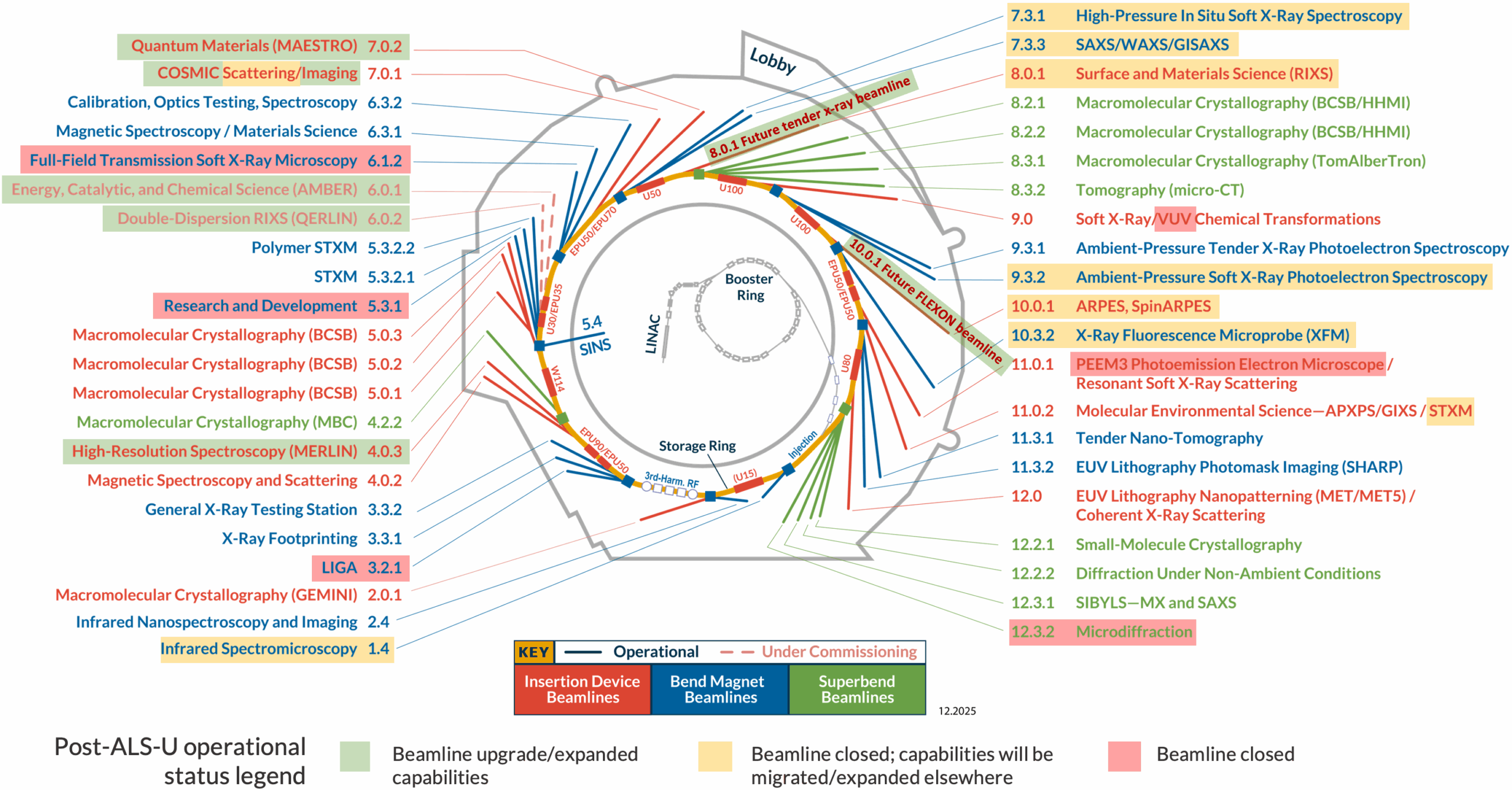
Post-ALS-U Beamline Status Table
The table below lists the high-level plans for each beamline—its current and future operational status. Additional information, such as post-ALS-U energy ranges and anticipated turn-on dates, will be added when available.
Click here to open the table in a separate window.
New Beamlines and Capabilities
- The COSMIC Imaging Beamline (7.0.1.2) will be rebuilt to leverage the full brightness and coherence of the upgraded ALS to perform zone-plate-based microscopy, ptychography, and 3D tomography with an up to hundred-fold increase in measurement speed and an improvement in spatial resolution down to 1 nm.
- The MAESTRO Beamline (7.0.2) will be rebuilt to take full advantage of the improved coherence of the upgraded ALS to improve the angle-resolved photoemission spectroscopy (ARPES) collection efficiency by more than an order of magnitude, enabling much better spatial resolution, faster measurements, and more comprehensive data sets for materials discovery.
- The new AMBER (6.0.1) and QERLIN (6.0.2) Beamlines, currently in commissioning, will offer enhanced RIXS capabilities that will serve users of Beamline 8.0.1 and new communities. AMBER will offer advanced-materials preparation and multimodal, high-energy-resolution and high-throughput, operando analysis of interfacial and chemical processes and energy systems. QERLIN will offer the ability to measure dispersion relations of low-energy excitations in spin and quantum materials directly, with high resolution and soft x-ray contrast, through crucial regions of the phase diagram and over a large region of momentum space.
- The upgrade now in progress on MERLIN (Beamline 4.0.3) will significantly improve its energy resolution, flux, and stability, preparing it for ultrahigh-energy-resolution spectroscopy, spin-resolved ARPES, and—as part of a possible future upgrade—momentum microscopy. These capabilities will serve users of Beamline 10.0.1 and complement ARPES capabilities at MAESTRO.
- FLEXON is a new soft x-ray beamline planned at 10.0.1 whose high-brightness coherent flux and multiple complementary techniques will probe the roles of multiscale heterogeneity in quantum materials. FLEXON is not included in the ALS-U project and is a high priority for construction after the ALS-U dark time.
- Tender is a new tender x-ray beamline planned at 8.0, whose coherent scattering and scanning spectromicroscopy capabilities will address challenges at the frontiers of diverse scientific areas, ranging from soft condensed matter and biomaterials to energy science and Earth and environmental sciences. Tender is not included in the ALS-U project and is a high priority for construction after the ALS-U dark time.
Additional Information, Feedback, and Questions
Feedback and questions are welcomed.
- Submit a question or comment to ALS leadership via this form
- Email a member of ALS leadership (see staff directory)
- Contact the Users’ Executive Committee at alsuec@lbl.gov
- For copies of slides presented at user forums on beamline closures, program migrations, or the ALS-U operating schedule, email alscommunications@lbl.gov
- For specific questions about beamline capabilities, you may also contact the beamline scientist