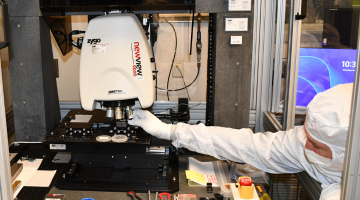
A collaboration between DOE user facilities and industry is redefining the precision with which synchrotron gratings can be fabricated and measured, advancing the optics that power X-ray science worldwide. Read more »
Scientists Unveil Radiation-Driven Chemistry on Icy Moons
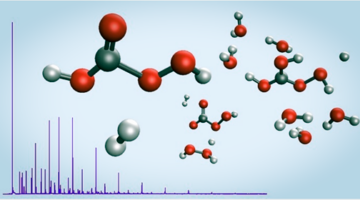
Using tunable vacuum ultraviolet light, researchers found that ionizing CO2–water clusters forms new oxygen–oxygen bonds. These findings provide a molecular pathway to understanding how radiation produces peroxide on the icy surfaces of moons, which may shed light on how complex molecules originate.
Read more »
Soft X-Rays Illuminate the Future of Microchips
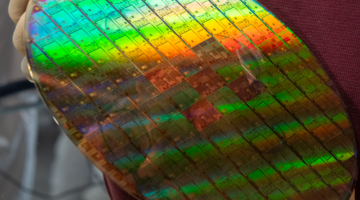
As devices do more every year, their microchips must keep advancing. At beamline 11.0.1.2, researchers Thomas Ferron and Qi Zhang use resonant soft X-ray scattering to reveal buried nanostructures in polymers used in extreme ultraviolet (EUV) photolithography, informing the microchips of the future. Read more »
Accelerator Team Receives DOE Genesis Mission Phase II Funding
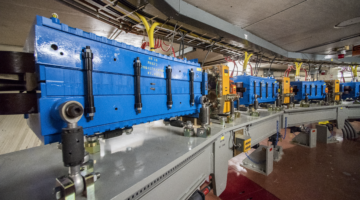
DOE’s Genesis Mission awarded Phase II funding to Berkeley Lab’s Multi-Office Accelerator Team (MOAT) to expand its Super Intelligence assistant, first launched at the ALS, helping optimize our facility during ALS-U for thousands of researchers. Read more »
Scientists Get Real-Time Look Inside Spacecraft Heat Shields During Extreme Heat Conditions
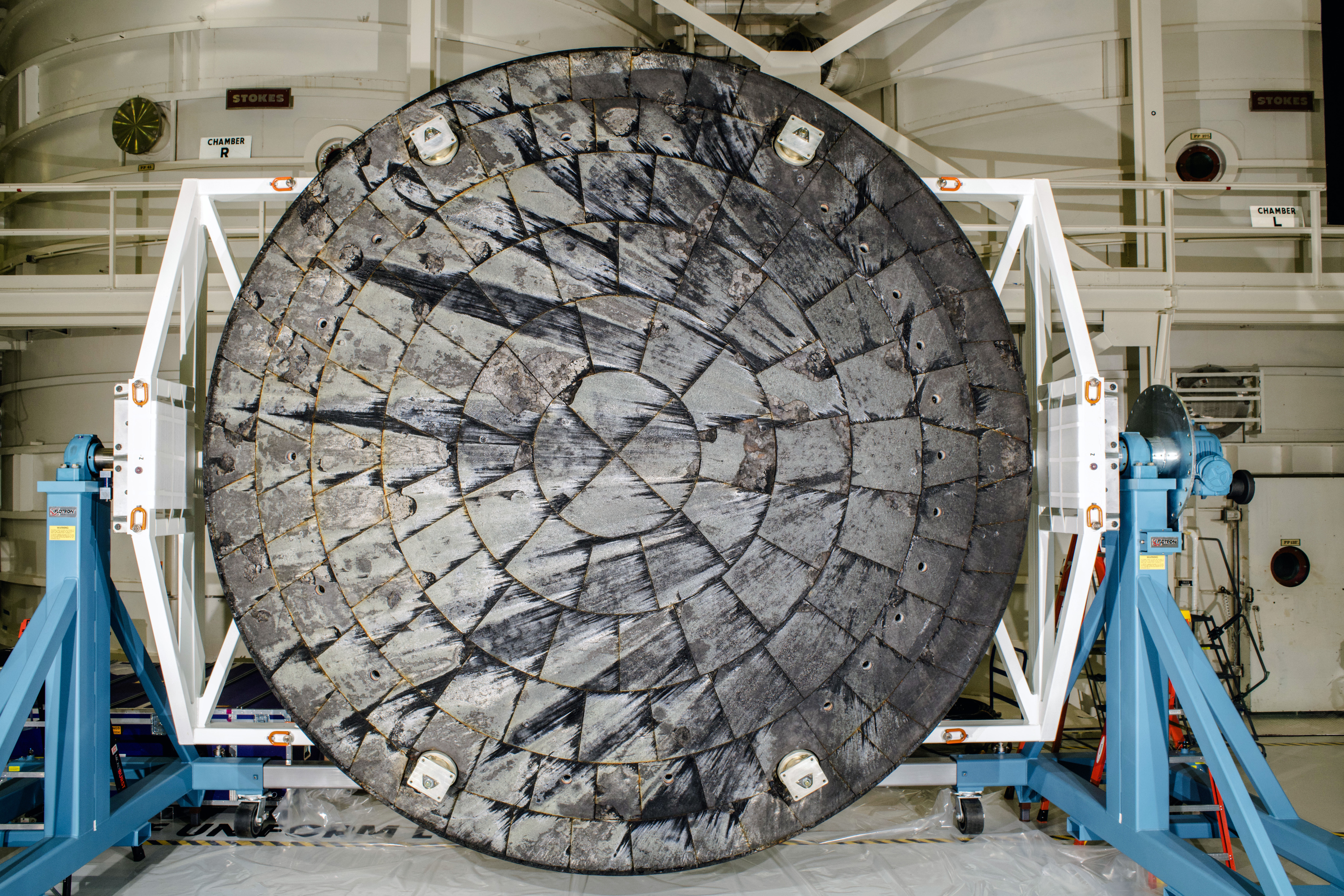
X-ray imaging and AI-powered analysis at the ALS reveal how heat shield materials degrade microscopically during atmospheric reentry conditions. After a decade of partnership with NASA, research at the ALS offered a new, detailed picture of this hidden process, one that has meaningfully improved how engineers model and design heat shields for space missions such as the recent Artemis missions. Read more »
The ALS Launches New AI Research Campaigns
ARC is a pilot program for 2027 beamtime designed to advance high-impact user science through the practical development, testing, and refinement of artificial intelligence (AI) workflows across ALS beamlines. This is a special, off-cycle proposal call that is separate from our general user proposal call. Pre-proposals are open until September 27. Read more »
How the Advanced Light Source Is Accelerating Our Quantum Future
The Advanced Light Source Upgrade project will generate brighter beams of X-ray light, allowing researchers to push the boundaries of quantum materials research further by collecting data with far greater detail than has been possible before. Read more »
Planning a New Era of Discovery with ALS-U
The ALS is undergoing an ongoing upgrade that will increase our brightness by at least 100 times compared with the current accelerator and improve X-ray coherence. Read about how this leap in brightness will enable groundbreaking sensitivity and precision, empowering researchers to see our world like never before. Read more »
Researchers Confirm Low-Nickel Cathode Resists Degradation
Researchers confirmed that a radially graded, low-nickel cathode sustains reversible oxygen redox across repeated cycling, enabling high capacity with minimal degradation. This cathode could cut nickel usage in electric vehicle batteries, lowering supply risk and financial and environmental costs, while preserving energy density and lifespan. Read more »
Hidden State Precedes Superconductivity in Kagome Metal
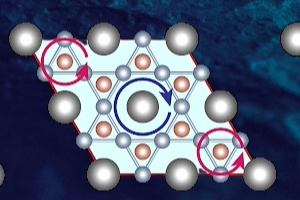
Experiments at the ALS revealed a hidden electronic phase that breaks time-reversal symmetry before a charge-density wave forms in a kagome metal. Because hidden electronic order can compete with or shape superconductivity, this finding helps guide the search for high-temperature, unconventional superconducting materials. Read more »
- 1
- 2
- 3
- …
- 6
- Next Page »