SCIENTIFIC ACHIEVEMENT
Multimodal in situ x-ray experiments at the Advanced Light Source (ALS) revealed the underlying mechanisms and evolution of copper–silver (Cu–Ag) nanoparticle catalysts during carbon dioxide (CO2) photoreduction.
SIGNIFICANCE AND IMPACT
The new insights, showing a dynamic catalyst restructuring process, could improve the selectivity and efficiency of CO2 conversion into high-value chemicals.
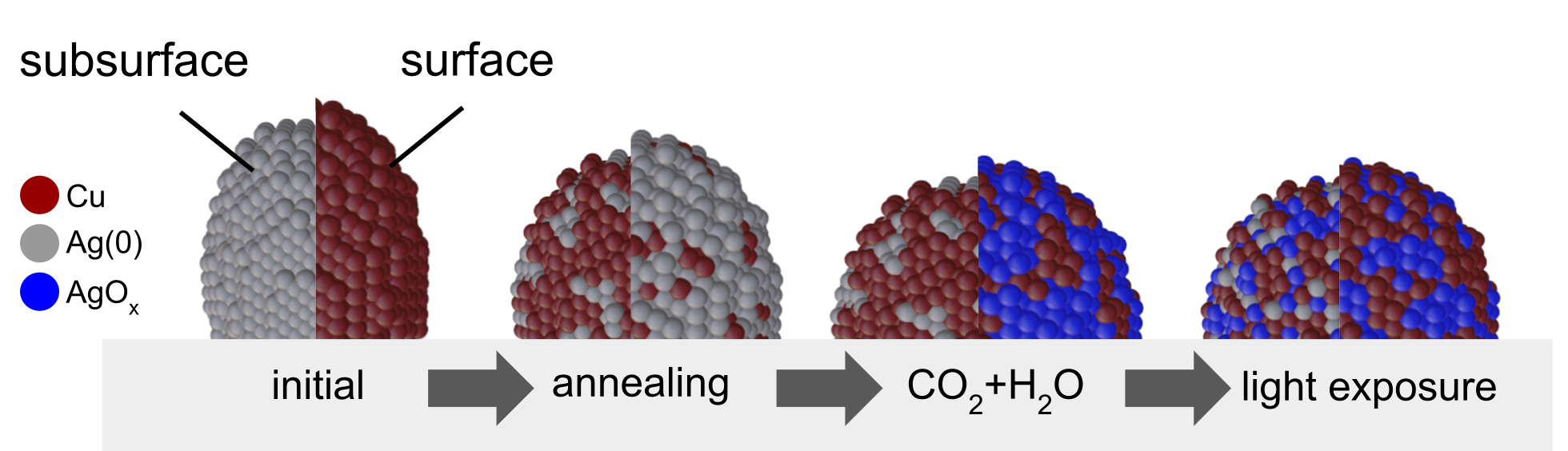
Two metals are better than one
Converting CO2 into valuable chemicals like methane and ethylene offers a promising avenue to produce high-value fuels and materials from an abundant resource, but achieving high efficiency and selectivity requires carefully optimized catalysts. Although copper and silver have shown potential, they suffer from limited efficiency and selectivity, respectively. This has led researchers to explore bimetallic systems that combine the strengths of both metals to enhance activity and selectivity.
Ag–Cu bimetallic nanoparticles have shown significant promise as catalysts in this photocatalytic reaction, leveraging sunlight and water to drive the conversion process. Despite their effectiveness, the precise mechanisms behind these catalysts remain poorly understood, particularly the stabilized surface state created by Ag–Cu interactions.
In this study, the researchers sought to explore how the structure and composition of the bimetallic nanoparticles evolve during catalytic activity, as well as how these transformations impact the efficiency of the reaction. Using the ALS, the team revealed a dynamic “shapeshifting” process that provides critical insights for designing improved catalysts for CO2 conversion.
Tracking nanoparticle transformation
To examine the photocatalytic reaction process in detail, the research team first fabricated model catalysts at Lawrence Berkeley National Laboratory’s (Berkeley Lab’s) Molecular Foundry, creating spheroidal silver nanoparticles coated with copper. They then exposed the nanoparticles to CO2 reduction conditions at the ALS while simultaneously monitoring their evolution using complementary x-ray techniques.
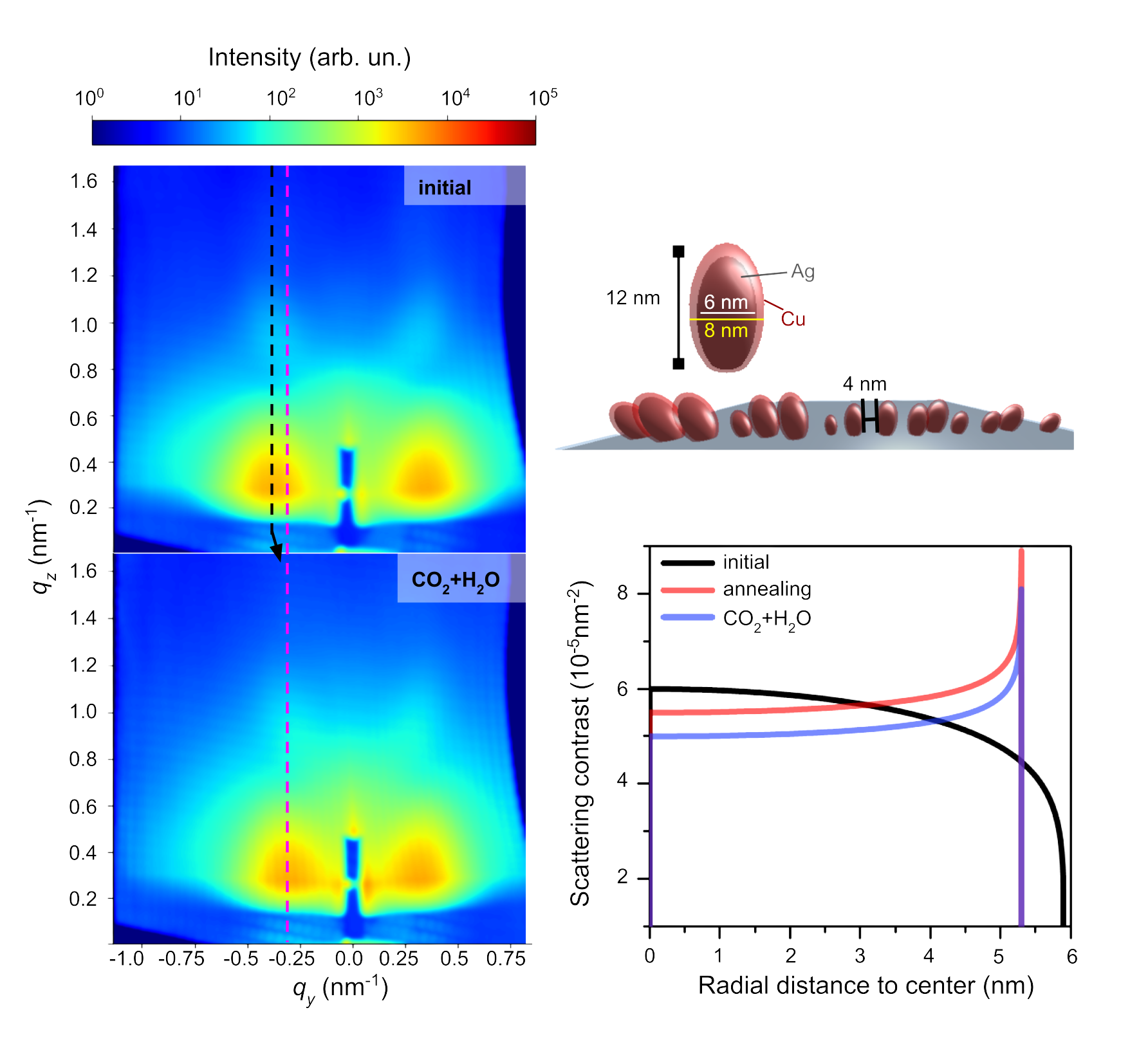
The researchers used the ambient-pressure soft x-ray photoelectron spectroscopy and x-ray scattering (APPEXS) endstation at Beamline 11.0.2.1, which uniquely enables simultaneous chemical and structural characterization under in situ reaction conditions. Photoelectron spectroscopy enabled the oxidation states of the elements to be tracked in real time. In parallel, grazing-incidence x-ray scattering captured morphological changes in the nanoparticles, showing how their shape evolved alongside their chemical transformation.
To corroborate and complement the ALS data, the team used electron microscopy at the Molecular Foundry’s National Center for Electron Microscopy to map the precise atomic distribution of silver and copper after the reaction. They also performed molecular dynamics simulations to model the nanoparticles’ size, shape, and electron distribution.
Surprising shapeshifting behavior revealed
The team’s data revealed that Ag–Cu nanoparticles undergo dramatic restructuring during CO2 conversion. Initially, copper forms the outer shell with an Ag-rich core. As reduction progresses, the metals migrate, with silver moving to the surface initially, then copper replacing it when exposed to CO2, water, and light, ultimately forming an Ag–Cu–O interface. Alongside this process, the nanoparticles flatten from spheroids into hemispheres.
The researchers concluded that this “shapeshifting” behavior significantly enhances the bimetallic particle catalytic performance by promoting charge transfer and forming a beneficial interfacial phase. In the future, the team plans to focus on disentangling the contributions of various factors influencing the process, such as examining other bimetallic systems and implementing time-resolved measurements to uncover kinetic effects related to atomic diffusion, thereby informing the design of more stable and efficient catalysts for electrochemical applications.
Contacts: Fabiano Bernardi and Slavomir Nemsak
Researchers: G.Z. Girotto, R.M. Martins, A.R. Muniz, and F. Bernardi (Federal University of Rio Grande Do Sul); M. Jaugstetter, L.P. Matte, and M. Salmeron (Materials Sciences Division, Berkeley Lab); D. Kim (ALS and Gwangju Institute for Science and Technology); T.P. Mishra (Molecular Foundry, Berkeley Lab); M. Scott (Molecular Foundry and University of California, Berkeley), and M. Salmeron (Materials Sciences Division, Berkeley Lab); and S. Nemsak (ALS, and University of California, Davis)
Funding: Foundation for the Support of Research of the State of Rio Grande do Sul (Brazil); National Council for Scientific and Technological Development (Brazil); Brazilian Federal Agency for Support and Evaluation of Graduate Education; US Department of Energy, Office of Science, Basic Energy Sciences (DOE-BES); and the ALS Collaborative Postdoctoral Fellowship. Operations of the ALS and Molecular Foundry are supported by DOE-BES.
Publication: G.Z. Girotto, M. Jaugstetter, D. Kim, L.P. Matte, T.P. Mishra, M. Scott, R.M. Martins, A.R. Muniz, M. Salmeron, S. Nemsak, and F. Bernardi, “Shapeshifting nanocatalyst for CO₂ conversion,” Adv. Mater. e09814. doi.org/10.1002/adma.202509814.
ALS SCIENCE HIGHLIGHT #531

