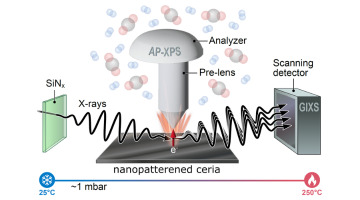
In a recent study at the ALS, researchers employed an approach that combines two techniques and uses a single X-ray beam to capture both chemical and structural changes in nanopatterned ceria during catalytic reactions. Read more »
Multiscale X-Ray Measurements Reveal How Stretchable Polymer Semiconductors Dissipate Stress
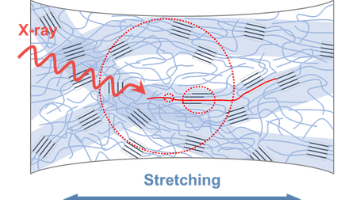
Using multimodal, in situ measurements at the ALS, researchers uncovered a two-stage process for how stretchable polymer semiconductors adapt their structure during stretching. The findings establish a multiscale design framework for conjugated polymers used in stretchable electronic devices. Read more »
Dynamic Surface Restructuring in Ag–Cu Boosts CO2 Conversion
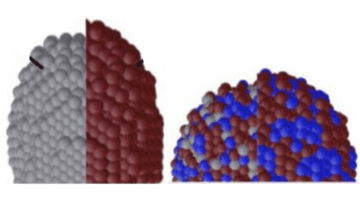
Multimodal in situ x-ray experiments at the ALS revealed how copper–silver nanoparticle catalysts evolve during CO2 photoreduction. The findings, which demonstrate dynamic catalyst restructuring at the atomic level, provide crucial insights for enhancing the selectivity and efficiency of CO2 conversion into high-value chemicals. Read more »

Stable 2D Interlayer Prolongs Perovskite Devices
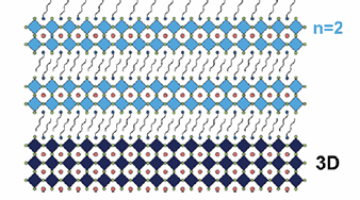
Layered 2D/3D perovskite bilayer heterostructures have the potential to boost the performance and durability of many types of electronic and photonic devices, but maintaining this performance depends on the stability of the cell’s 2D interlayer. In this study, researchers optimized time-resolved, spontaneous thin-film deposition of 2D perovskites using a mixed solvent approach to produce phase pure, stable thin films with high crystallinity. Read more »
Multimetallic Systems Convey Cost-Effective Hydrogen Storage

A bimetallic material (Pd-Ni) produces hydrogen-active nanopockets that improve the efficiency and lower the cost of hydrogen storage systems. Mechanistic understanding of a Pd-Ni bimetallic system paves the way to design cost-effective hydrogen storage, opening new opportunities to develop reliable energy technologies necessary to advance the energy industry. Read more »
Watching Nanoparticle Chemistry and Structure Evolve
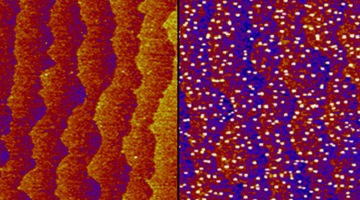
Using a multimodal approach, researchers learned how chemical properties correlate with structural changes during nanoparticle growth. The work will enable a greater understanding of the mechanisms affecting the durability of nanoparticles used to catalyze a broad range of chemical reactions, including clean-energy reactions. Read more »
Rapid In Situ Ligand-Exchange Process Used to Prepare 3D PbSe Nanocrystal Superlattice Infrared Photodetectors

A new strategy for retaining long-range order during ligand exchange of nanocrystal superlattices is used to construct PbSe infrared photodetectors. The ordered photodetectors have a 16× higher responsivity and 2× faster response time compared to disordered ones. Read more »
High-Efficiency Organic Photovoltaics using Eutectic Acceptor Fibrils to Achieve Current Amplification

Researchers report the fabrication of ternary organic solar cells, achieving a significant JSC boost, by virtue of their optimized crystalline feature, with the formation of eutectic crystalline fibrils. The optimal morphology suppresses energetic disorder and nongeminate recombination, and increases charge transfer and transport, yielding a high efficiency of 17.84% with significant current amplification. Read more »
Go With the Flow: Scientists Design Better Batteries for a Renewable Energy Grid

Researchers developed a versatile yet affordable battery membrane—from a class of polymers known as AquaPIMs. This class of polymers makes long-lasting and low-cost grid batteries possible based solely on readily available materials such as zinc, iron, and water. Read more »
Self‐Assembly of Large‐Area 2D Polycrystalline Transition Metal Carbides for Hydrogen Electrocatalysis
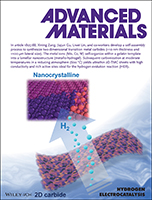
Xining Zang et al. develop a self‐assembly process to synthesize 2D transition metal carbides (TMCs). The metal ions (Mo, Co, W) self‐organize within a gelatin template into a lamellar nanostructure. Subsequent carbonization at moderate temperatures in a reducing atmosphere yields ultrathin 2D‐TMC sheets with high conductivity and rich active sites ideal for the hydrogen evolution reaction. Read more »