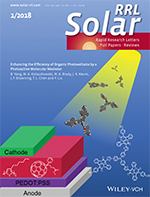
In the search for high-efficiency organic solar cells, additives often play an important role in improving the film morphology. Liquid additives, while often effective, evaporate or migrate over time. Herein, Liu et al. report a solid photoactive molecular mediator that could be employed to replace the liquid additives to tune the morphology of bulk heterojunction films for improved device performance. Read more »
Formation of a Photovoltaic Material from Precursor to Crystal
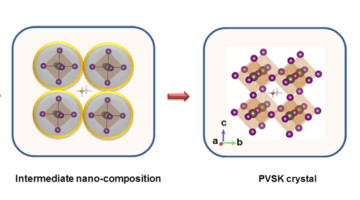
Lead halide perovskites have emerged as high-performance photovoltaic materials, demonstrating remarkably rapid improvements in efficiency. In situ printing and time-resolved x-ray characterization have provided new insights into the relationship between device efficiency, perovskite crystallinity, and film morphology. Read more »
On the Way to Unlimited Energy
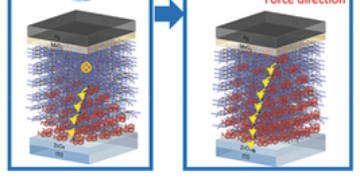
With the help of four different ALS beamlines, scientists were able to understand and improve the morphology of the main device structure in organic photovoltaic cells. Read more »
Following the Morphology Formation In Situ in Printed Active Layers for Organic Solar Cells

Time-resolved scattering measurements reveal the complete solidification process inside the photoactive layer of an organic solar cell. With an industrial slot-die coater integrated into the beamline, aggregation and crystallization processes can be tracked to reveal the structure-function relationships in the final thin film. Read more »
Custom Organic Electronics Out of the Printer
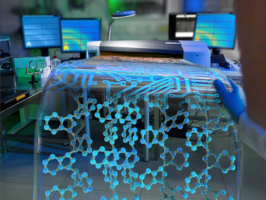
Using in situ x-ray characterization and a custom-made slot-die coater at Beamline 7.3.3, the cross-linking of polymer molecules in the active layer of an organic solar cell during the printing process could be observed.
Read more »