by Brooke Kuei
SCIENTIFIC ACHIEVEMENT
With the help of the Advanced Light Source (ALS), researchers revealed a two-stage structural evolution that enables stretchable conjugated polymers to dissipate stress while maintaining charge transport.
SIGNIFICANCE AND IMPACT
This work establishes a design framework for next-generation intrinsically stretchable organic photovoltaics and other deformable electronic devices.
The tradeoff between performance and stretchability
Conjugated polymers combine tunable optoelectronic properties with mechanical flexibility, making them attractive materials for deformable electronics like stretchable organic photovoltaics (OPVs) and wearable sensors. Efficient charge transport in these materials depends on strong π–π stacking, but this face-to-face alignment of conjugated backbones also makes materials more rigid, creating a fundamental trade-off between stretchability and electronic performance.
Intrinsically stretchable conjugated polymers have demonstrated the ability to maintain electronic functionality under strain, but how multiscale structural changes evolve in real time during stretching has not been directly observed. In a study published recently in Nature Communications, an international research team used X-ray techniques at the ALS and National Synchrotron Light Source II (NSLS-II) to track how stretchable conjugated polymers reorganize during deformation, revealing mechanisms that enable both mechanical resilience and efficient charge transport.
Multimodal, in situ X-ray techniques for understanding stretching
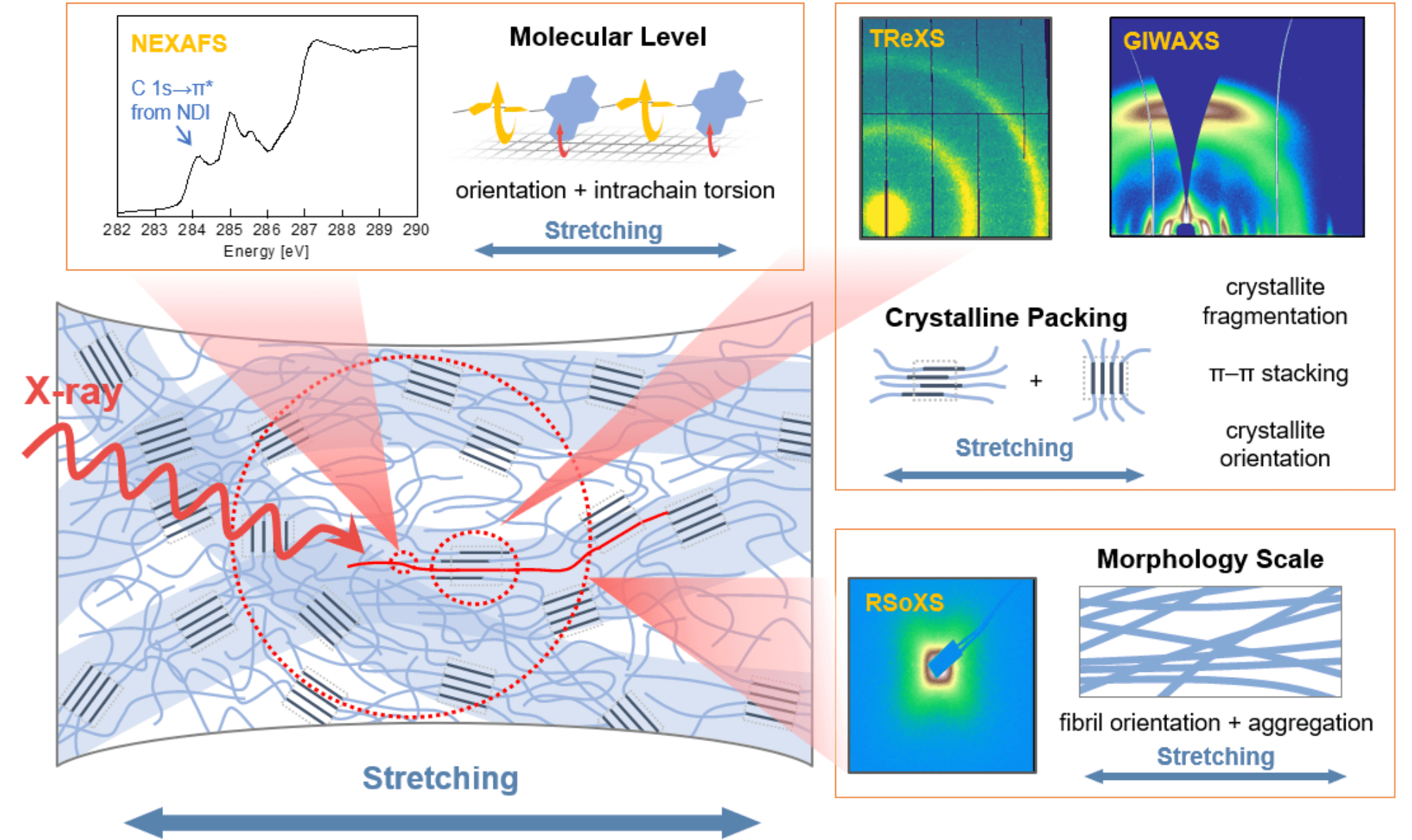
The researchers studied a model stretchable conjugated polymer, P(NDI2OD-TD), and employed a multimodal approach across complementary scattering and spectroscopy techniques to observe molecular rearrangements, nanoscale crystalline domain behavior, and larger mesoscale morphology evolution during deformation. To monitor structural changes under strain in real time, they used a custom in situ stage designed by the ALS.
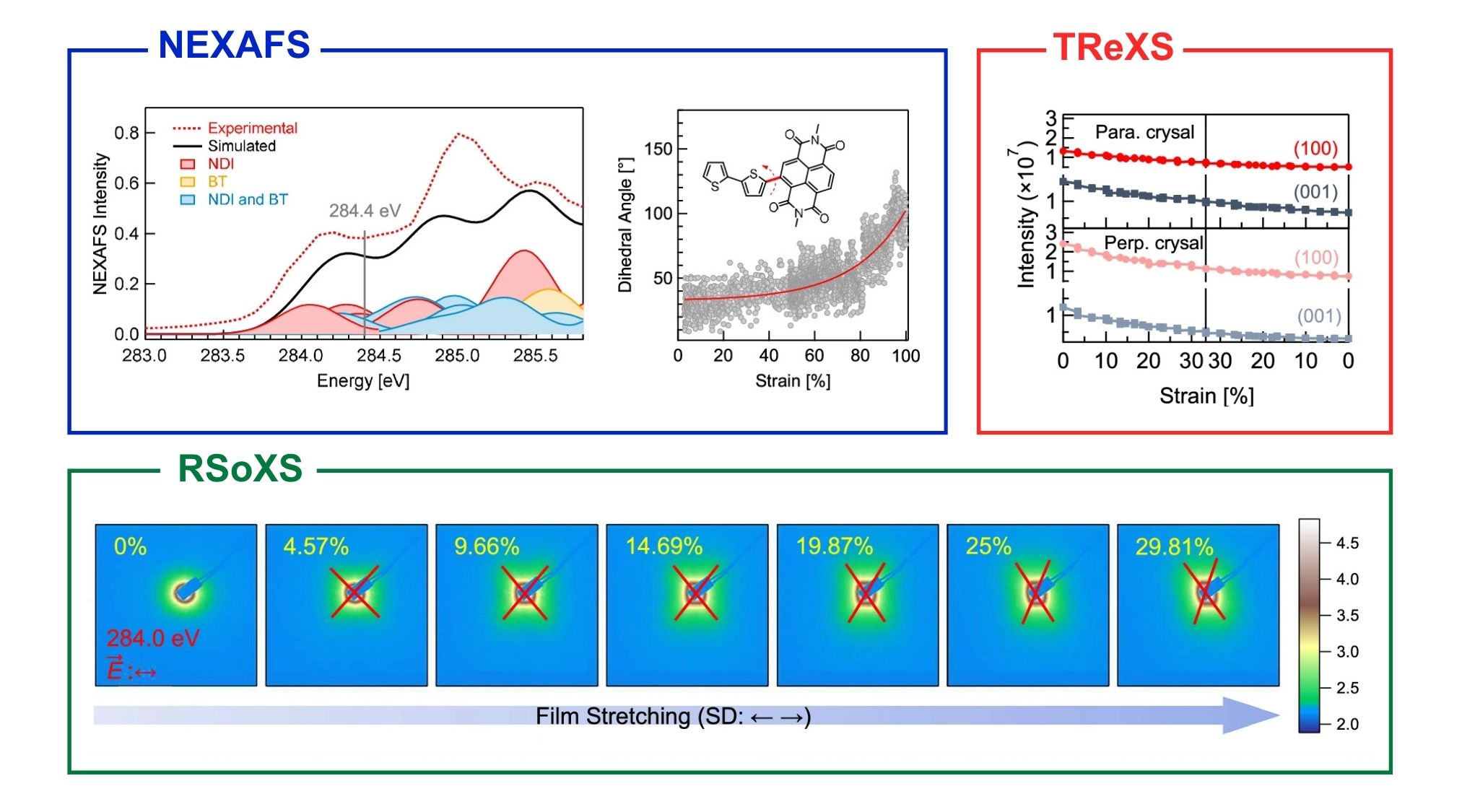
At the molecular scale, near-edge X-ray absorption fine structure (NEXAFS) spectroscopy at the ALS Beamline 11.0.1.2, combined with simulations by the Molecular Foundry uncovered changes in polymer backbone orientation and intrachain torsion—how the polymer chains align and twist—during stretching. At larger length scales, tender resonant X-ray scattering (TReXS) at NSLS-II tracked crystallite deformation, fragmentation, and orientation during stretching, while grazing-incidence wide-angle X-ray scattering (GIWAXS) of stretched films at ALS Beamline 7.3.3 revealed changes in π–π stacking and crystallite orientation. Resonant soft X-ray scattering (RSoXS) at ALS Beamline 11.0.1.2 further probed mesoscale morphology, tracking the alignment and reorganization of fibrillar domains during stretching.
Two-stage structural evolution during stretching
This multimodal approach revealed a previously unreported two-stage evolution, an initial phase of chain alignment and crystallite fragmentation followed by intrachain torsion, with structural changes occurring across molecular to mesoscale length scales throughout deformation. Coupled with device measurements showing that electronic performance is partially maintained under strain, these sequential adaptations explain how deformation is distributed across multiple length scales, enabling the material to dissipate stress while sustaining charge transport pathways.
These insights, which would not have been possible with ex situ or single-technique approaches, establish design principles for intrinsically stretchable polymer semiconductors that combine mechanical resilience with high optoelectronic performance for next-generation stretchable organic photovoltaics and other flexible electronics.
Contacts: Cheng Wang
Researchers: W. Zhong (South China University of Technology and Shanghai Jiao Tong University); G. Freychet (NSLS-II and Univ. Grenoble Alpes); G. M. Su (ALS and Berkeley Lab); S. Wang, X. Luo, X. Liu, W. Yang, L. Yu, Y. Li, L. Ying, and F. Huang (South China University of Technology); X. Wu (Berkeley Lab); T. J. Ferron and C. Wang (ALS); T. P. Russell (Berkeley Lab and University of Massachusetts Amherst); Y. Zhang and F. Liu (Shanghai Jiao Tong University).
Funding: The National Key R&D Program of China, National Natural Science Foundation of China, China Postdoctoral Science Foundation, and State Key Lab of Luminescent Materials and Devices, South China University of Technology. Operation of the Lawrencium computational cluster is supported by Berkeley Lab. Operation of the ALS, Molecular Foundry, and NSLS-II are supported by the US Department of Energy, Office of Science, Basic Energy Sciences program.
Publication: W. Zhong, G. Freychet, G.M. Su, S. Wang, X. Luo, X. Liu, W. Yang, L. Yu, X. Wu, Y. Li, T.J. Ferron, T.P. Russell, L. Ying, F. Huang, Y. Zhang, C. Wang, and F. Liu, “Correlative molecular-to-mesoscale evolution in conjugated polymers for intrinsically stretchable organic photovoltaics,” Nat. Commun. 17, 2980 (2026), doi:10.1038/s41467-025-68265-4.
ALS SCIENCE HIGHLIGHT #541