by Rachel Berkowitz
SCIENTIFIC ACHIEVEMENT
Machine learning tools combined with experiments at the Advanced Light Source (ALS) enabled the identification of defect-rich regions in single-crystalline Co3Sn2S2 that link to how surface electrons move.
SIGNIFICANCE AND IMPACT
Atom-level understanding of how the surface electronic properties of a magnetic semimetal can be tuned could guide its use in advanced technologies like spintronics and catalysis.

Electronic function is skin deep
Topological materials exhibit different electronic behaviors in their bulk and on their surface. These differences can enable new functionality, for example in spintronics and catalysis. To discover how to harness this functionality, researchers are developing quantitative frameworks to connect surface chemistry to surface electronic structure in model systems such as Co3Sn2S2.
Co3Sn2S2 represents a class of materials called Weyl semimetals. They are defined by strange electronic surface structures called “Fermi arcs,” whose appearance depends on exactly what atoms terminate the crystal structure. Ideal Fermi arcs can provide superior charge transport, but how close to ideal they are depends on these terminating atoms.
In this study, a group of researchers led by UC Davis in collaboration with ALS scientists, set out to reveal systematically how surface atoms influence electronic band structures in Co3Sn2S2.
Simultaneous spectroscopies show surprises
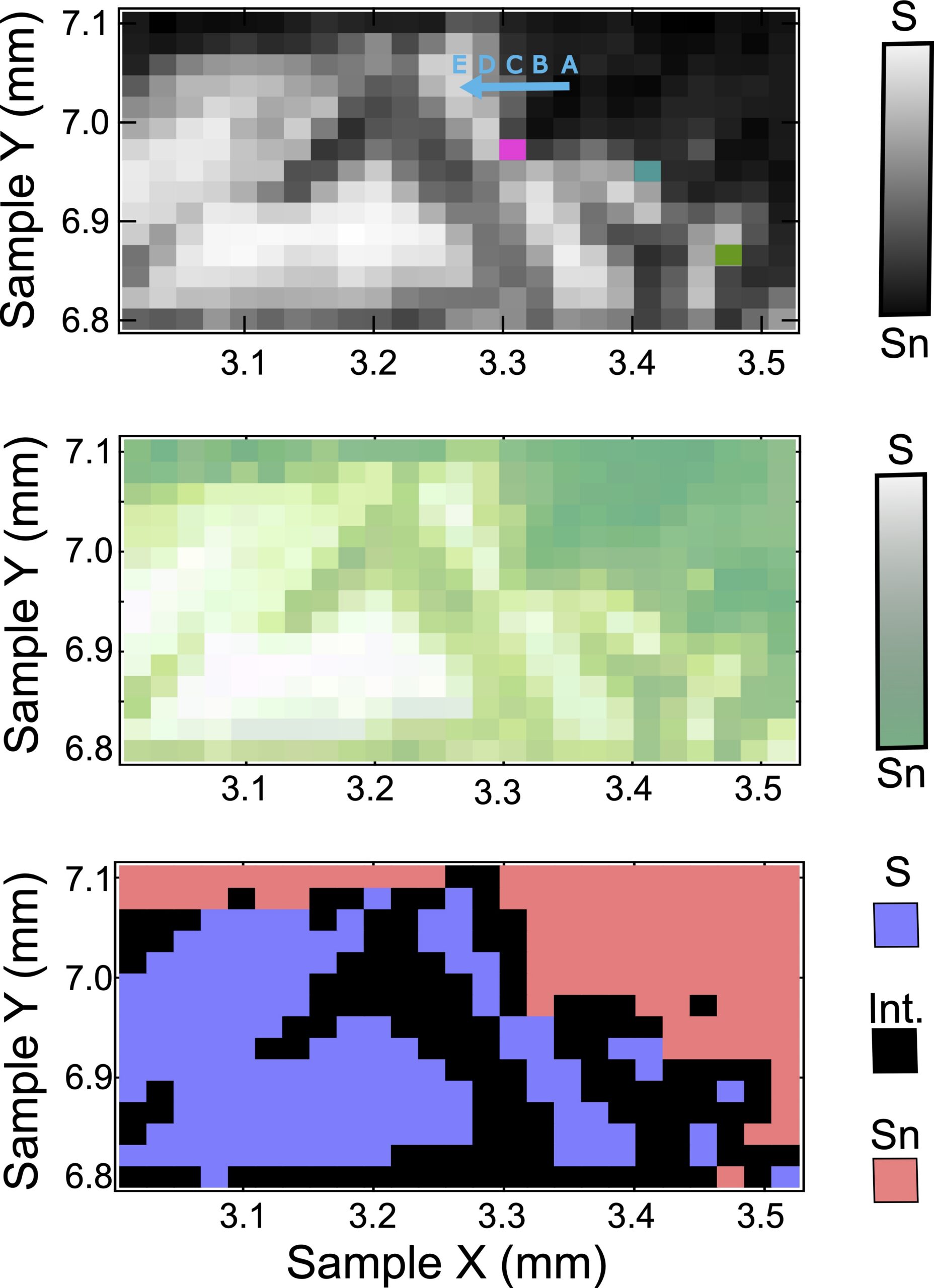
The team’s previous work at the ALS had established that this material’s identity as a Weyl semimetal was tied to its magnetism. Additionally, earlier data showed spectroscopic signatures of pure terminations—bulk chemistry arrangements culminating in a sulfur (S) or a tin (Sn) atom at the material’s surface. But the observed variability outside of pure S- and Sn-termination regions remained largely unexplored.
To understand this surface variability, two UC Davis graduate students stationed at the ALS through the ALS Doctoral Fellowship in Residence program used spatially resolved angle-resolved photoemission spectroscopy (ARPES) and x-ray photoelectron spectroscopy (XPS) at the ALS MAESTRO Beamline 7.0.2. ARPES and XPS are two techniques that give information about how electrons move and bulk chemistry, respectively. These complementary information streams can be measured sequentially without moving the sample.
Using artificial intelligence (AI) and machine learning (ML) tools to peer at the ALS data revealed a surprise. Not only did these tools automatically identify distinct spectral features corresponding to known S and Sn terminations, but they also identified additional distinct areas that were not previously known. The researchers used the spatially resolved ARPES/XPS data to show that these new “intermediate” areas had distinct electronic structures that arose from variable disorder on the material’s surface. The finding is an interesting result for Co3Sn2S2 itself, but it has a much larger potential impact, laying the foundation for using these ML methods for discovery in wider materials systems.
ALS-U will add finesse
The results show how local disorder can manipulate electronic surface states in a topological material, tuning its physics. Co3Sn2S2‘s magnetism can be adjusted by substituting any atom in its chemical formula, and its surface states may be useful in catalysis applications. As such, the team envisions ample future study.
Future study will benefit from ALS facilities. The microARPES endstation at the MAESTRO beamline balances a small spot size with an extremely flexible and robust experiment. This combination, along with ML tools, allowed the researchers to correlate the rich information streams from two techniques in a spatially resolved manner.
The researchers attribute the impressive ability for mesoscale XPS data to capture the effects of nanoscale defects to the fact that tiny defects can have a strong effect on core electrons measured by XPS. Each spot measurement captures many copies of the same defect.
Looking forward, the ALS Upgrade (ALS-U) project will allow the spot size of ARPES experiments to be reduced even further. This may enable the observation of more mesoscale structure in the ARPES or XPS spectra of this and related materials.
Contact: Inna Vishik
Researchers: S.A. Sreedhar, M. Staab, M. Chen, R. Prater, Z. Shen, V. Taufour, S.Y. Savrasov, and I.M. Vishik (UC Davis); G. Conti, E. Rotenberg, A. Bostwick, and C. Jozwiak (ALS); S. Nemsak (ALS and UC Davis); H. Soifer and I. Sidilkover (Tel Aviv University); Z. Wu (Carnegie Mellon University); and V. Ivanov (Virginia Tech).
Funding: United States–Israel Binational Science Foundation, US National Science Foundation, and the ALS Doctoral Fellowship in Residence program. Operation of the ALS and SSRL are supported by the US Department of Energy, Office of Science, Basic Energy Sciences program.
Publication: S.A. Sreedhar, M. Staab, M. Chen, R. Prater, Z. Shen, G. Conti, I. Sidilkover, Z. Wu, E. Rotenberg, A. Bostwick, C. Jozwiak, H. Soifer, S. Nemsak, S.Y. Savrasov, V. Ivanov, V. Taufour, and I.M. Vishik, “Mesoscale variations of the chemical and electronic landscape on the surface of the Weyl semimetal Co3Sn2S2 visualized by ARPES and XPS,” Phys. Rev. B 112, 245154 (2025), doi:10.1103/4mfg-c79j.
ALS SCIENCE HIGHLIGHT #538
