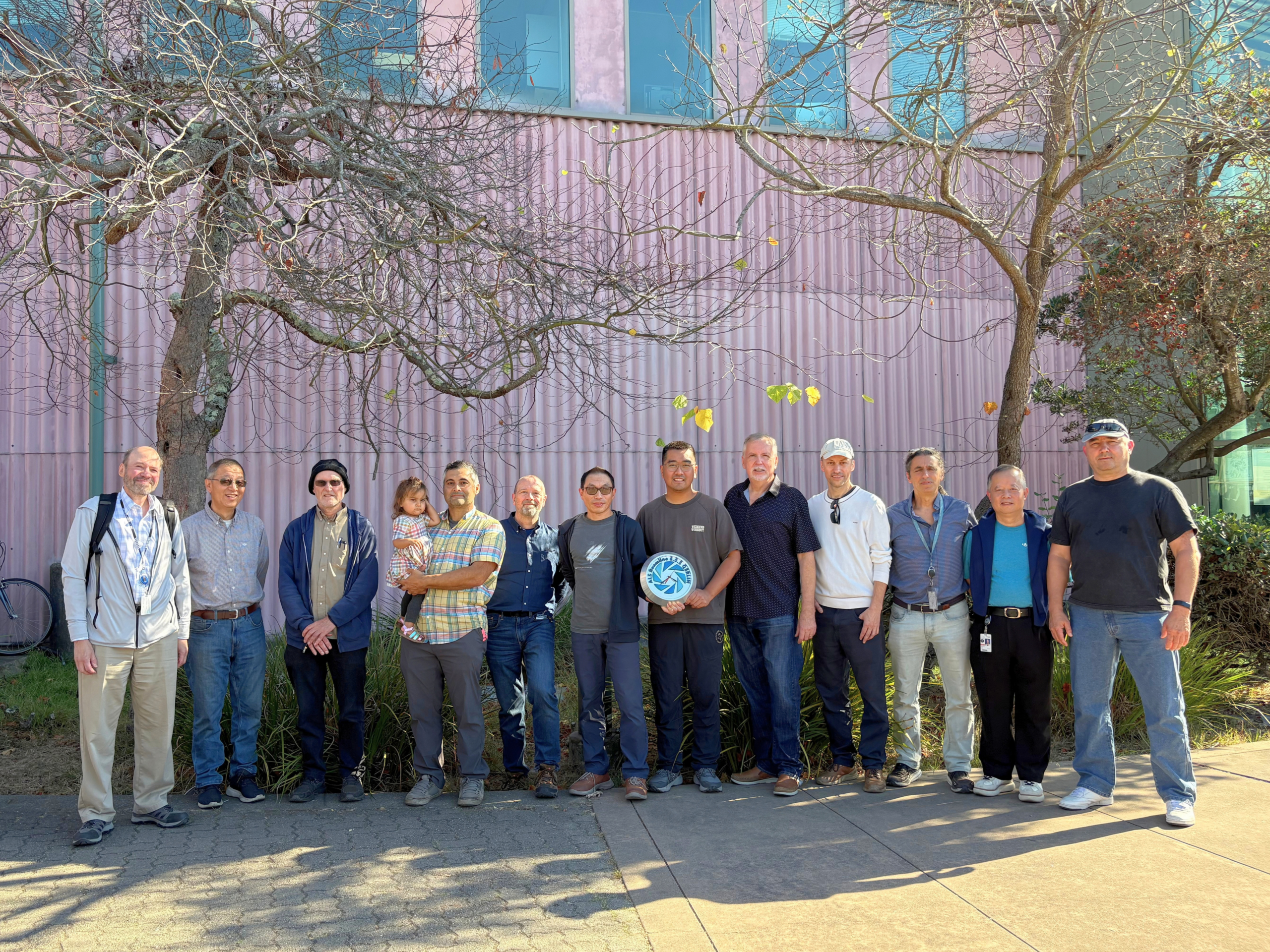
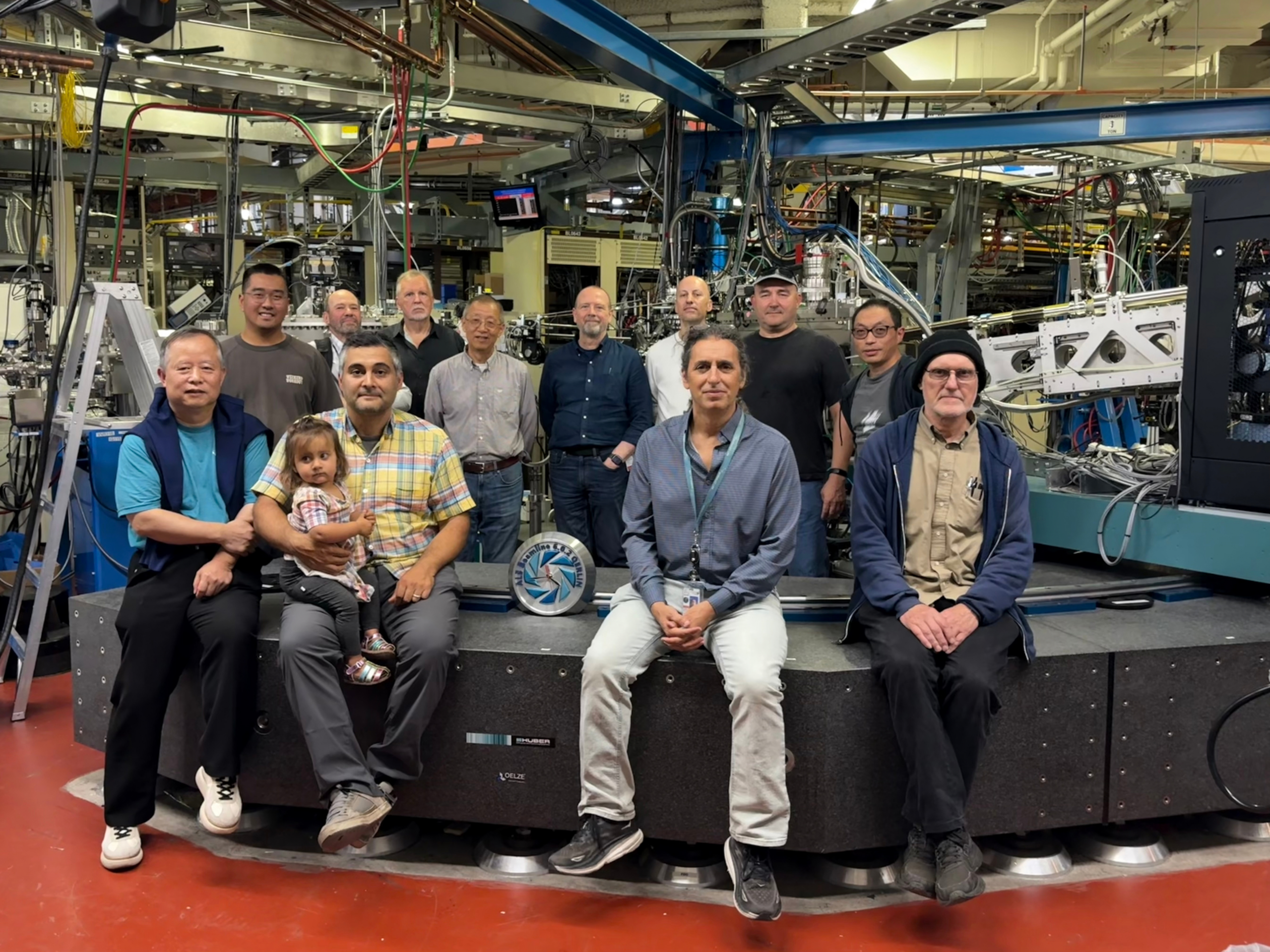
The QERLIN Imaging RIXS team received the 2026 Klaus Halbach Award for Innovative Instrumentation at the Advanced Light Source (ALS) at the 2026 Bay Area Light Sources Joint Users’ Meeting. The honored members include Wanli Yang, Yi-De Chuang, Yujian Xia, Alastair MacDowell, Harold Barnard, Howard Padmore, Zahid Hussain, Tony Warwick, Dmitriy Voronov, Peter Denes, Azriel Goldschmidt, Martin Keller, Earl Cornell, Yunian Lou, and Damon English.
The Advanced Light Source Users’ Executive Committee (UEC) recognized the team for their pioneering instrumentation design, innovative optical engineering, and advanced detector integration at the QERLIN Imaging RIXS endstation.
“Building on the legacy of impactful instrument development for this award, the QERLIN team represents an innovative approach to resonant inelastic X-ray scattering (RIXS) instrumentation,” said Shan Wu, UEC chair. “By greatly improving measurement efficiency and energy resolution, QERLIN demonstrates the potential to enable new scientific opportunities with the ALS Upgrade (ALS-U) project.”
The QERLIN difference
When X-ray light interacts with a material, energy changes in the scattered light reveal subtle details of the material’s electronic structure. Researchers use a technique called resonant inelastic X-ray scattering (RIXS) to map the elemental, chemical, and electronic makeup of materials, helping them understand novel physics and improve batteries, microelectronics, and other materials fundamental to modern life.
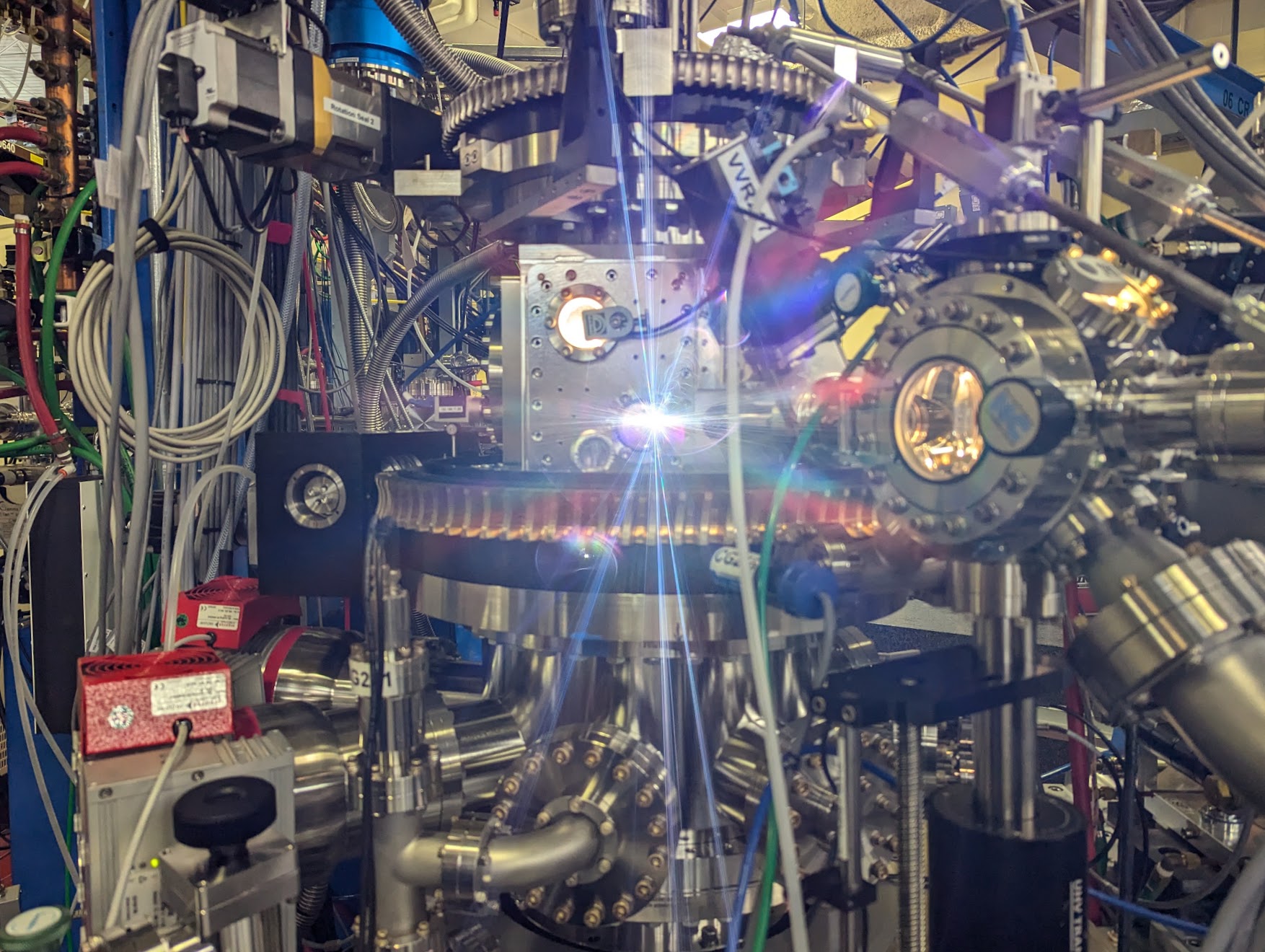
In 2024, the QERLIN team started commissioning the world’s first instrument able to capture RIXS maps across a full characteristic energy range—known as the X-ray absorption edge of a given element—in a single shot. Conventional spectroscopy, including RIXS, works with one X-ray photon energy at a time. A narrow sliver of the synchrotron’s spectrum is selected by a monochromator and a slit, data are recorded,, and the incident energy is adjusted for the next scan. This process is repeated tens or hundreds of times to achieve a full spectroscopy dataset. QERLIN takes a different approach. It uses a wider spectrum of incident light, spanning 10–15 electron volts along a 2 millimeter strip of the sample. An innovative spectrometer then images that strip along one axis of the detector and measures the conventional RIXS spectrum along the other axis. The result is a full 2D RIXS map in one go.
For scientific users, this changes the paradigm of how full-range RIXS maps are collected, and how quickly. Compared with conventional RIXS instruments, QERLIN offers single-shot, full-RIXS mapping of uniform samples, as well as spatially resolved RIXS mapping of non-uniform samples through sample scanning. By greatly enhancing measurement speed and throughput, QERLIN empowers researchers to study statistically demanding measurements on beam-sensitive materials and low-energy excitation physics, microelectronics, energy and chemical systems.
Two generations, one design
The design for QERLIN was outlined in a 2014 paper by Warwick, Chuang, Voronov, and Padmore. Executing that design took years of determination, innovation, and creativity.
“This accomplishment was made possible by two generations of researchers—those who really conceptualized the design and built the beamline, and those who carried it through commissioning and first experiments,” said Yang, ALS senior scientist who led the team since 2024. “I’m leading only the scientific commissioning stage, but so much incredible work has gone into this project for more than a decade.”
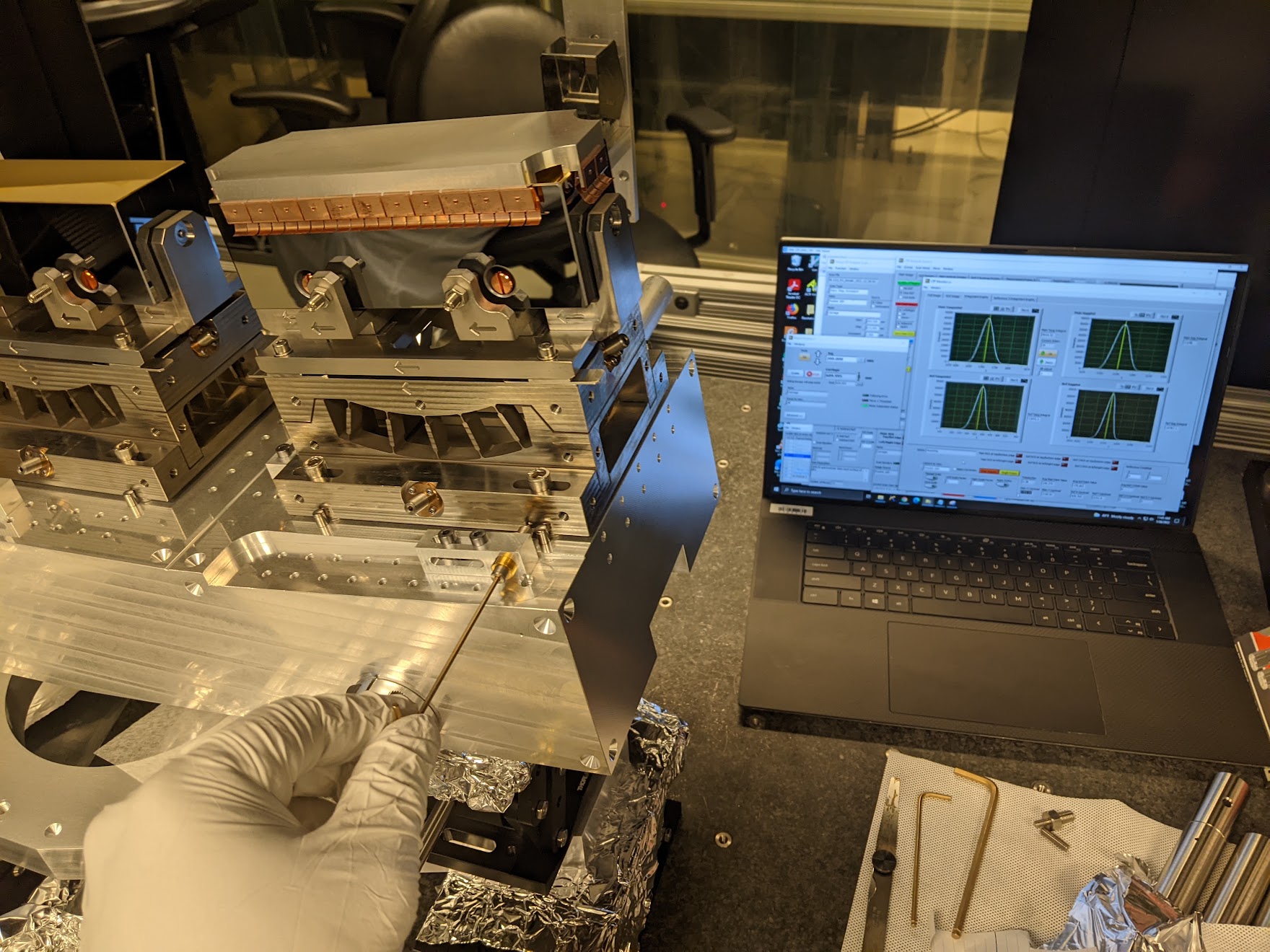
The central obstacle was realizing a technique known as “double dispersion”: spreading the incoming light so different energies strike different positions on the sample, then ensuring the X-rays emitted by the sample reach the detector with both their spatial and energy information intact. The team’s solution combined ALS-fabricated gratings—which spread the scattered X-rays into their respective energies—with a set of curved mirrors arranged as a Wolter mirror pair—a configuration borrowed from deep-space X-ray telescope design. A new detector system captures the result with high fidelity and resolving power.
“QERLIN is one of the most complex optical systems at the ALS,” said Barnard, ALS research scientist who led the installation effort, often working alone due to safety protocols during the COVID-19 pandemic. “The beamline and the spectrometer are two enormous precision instruments that have to work together while being focused on the same micron-sized target on the sample to produce a high-resolution spectroscopic image on the detector.”
A particularly challenging part of the project was the installation of the spectrometer optics: The optics have many degrees of freedom and must be aligned within thousandths of a degree using precision instruments in ALS’s Optical Metrology Lab. Once they are installed in the beamline’s vacuum chamber, the researchers can no longer access them for minor tweaks or corrections, so they had to get it right the first time. “That process took a lot of clever engineering and collaboration with the metrology group,” Barnard said.
“Fine-tuning the system is also challenging, because there are no diagnostics sensitive enough to measure QERLIN’s performance,” Barnard said. “We have to use measurements of features in the RIXS spectrum created by atomic excitations to understand the instrument’s performance.”
The team was also commended for overcoming the engineering challenge of designing the instrument in a tightly constrained space on the ALS floor.
Putting QERLIN to work
The UEC noted that QERLIN’s impact is already visible in how quickly the user community adopted the instrument. During the 2026 commissioning cycle, multiple user groups completed high-quality RIXS experiments, with more proposals and measurements underway.
These early experiments have yielded exceptionally rich data. “In every pixel on this detector, we can pull out five dimensions of information: emission photon intensity, emission photon energy, momentum transfer, excitation photon energy, and spatial resolution, plus even some degree of time-sensitivity RIXS mapping through clustering,” Yang said. “It’s an unprecedented level of information, and it comes every couple of seconds.”
The team is exploring opportunities to improve QERLIN’s performance with the ALS-U project and to leverage AI in processing the instrument’s unprecedented amount of data with rich information.
“The team’s achievement has established a new global benchmark for soft X-ray RIXS instrumentation and significantly expanded the scientific opportunities available at the ALS,” said Jinghua Guo, senior scientist and program lead of the Resonant Elastic & Inelastic X-Ray Scattering Program at ALS.