Scientific Achievement
Using tunable vacuum ultraviolet light at the Advanced Light Source (ALS), researchers found that ionizing CO₂–H₂O clusters forms new oxygen–oxygen bonds, especially in water-rich clusters.
Significance and Impact
These findings provide a molecular pathway to understanding how radiation produces peroxide on the icy surfaces of moons, which may shed light on how complex molecules originate.
Research Details
- Ionized CO₂–H₂O clusters with VUV light.
- Identified chemical products using photoionization mass spectrometry at ALS beamline 9.0.2, systematically varying water content, gas composition, and pressure.
- Calculated reaction pathways showing that water-rich clusters stabilize the ionized cluster and promote O–O bond formation.
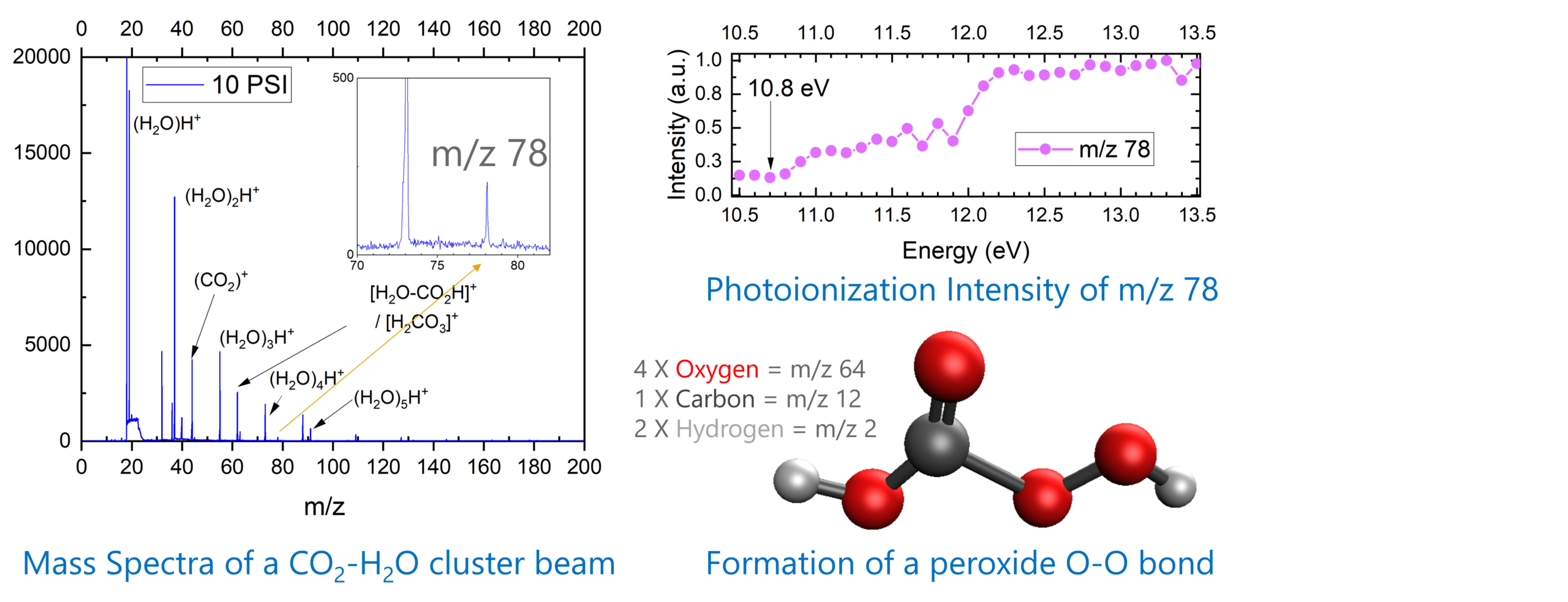
Research Summary
Radiation usually fragments isolated molecules. Here, it helped build them.
Water, carbon dioxide (CO₂), and peroxide are abundant in the cold outer Solar System, including on comets and the icy crusts of moons like Europa, Ganymede, and Charon. Telescopes such as the James Webb Space Telescope have detected peroxide on these moons, particularly where radiation, such as cosmic rays, continuously bombards the ice.
As an oxidant, peroxide can release chemical energy when it reacts with other compounds. Scientists think oxidants made at the surface of icy moons like Europa could be carried into the ocean beneath, where they could help fuel life. Yet how radiation turns water and CO₂ into hydrogen peroxide (H₂O₂) has remained unanswered, because H₂O₂ contains an oxygen–oxygen (O–O) bond that neither starting molecule has.
In this study, researchers discovered how a single ionizing event could form this bond. Instead of examining isolated molecules or bulk ice itself, they created conditions similar to those on these far-away planets. They generated CO₂–H₂O clusters in a supersonic molecular beam and ionized them with vacuum ultraviolet (VUV) light tunable at ALS beamline 9.0.2.
Water was the driver. When seven or more water molecules surrounded the CO₂, the reaction occurred, demonstrating microsolvation: how a few solvent molecules can change a reactant’s chemistry. Small changes in pressure and composition strongly changed its energy intensity, with water-rich conditions favoring peroxide formation. The local solvation environment, not just the deposited ionization energy, controls whether this pathway becomes accessible.
VUV light both starts the reaction and probes it, so the team watched the products appear at specific photon energies. Plotting product counts against photon energy produces a photoionization-efficiency curve. Surprisingly, it showed that a key product, with a mass-to-charge ratio of 78 (m/z 78), does not exist at lower energies and suddenly “turns on” at 10.8 electron volts (eV). Theoretical calculations performed by the team predicted about 10.9 eV, and this match confirmed the reaction mechanism.
The results demonstrate that local microsolvation turns simple ionization into complex molecular growth, offering a plausible molecular pathway for the peroxide and oxidant chemistry observed on icy moons.
Contacts: Musahid Ahmed
Affiliations and Institutions: Lawrence Berkeley National Laboratory: Chemical Sciences Division; University of California, Berkeley.
Funding: Gas Phase Chemical Physics Program, Chemical Sciences, Geosciences, and Biosciences Division, US Department of Energy (DOE), Office of Science, Basic Energy Sciences (BES) program; This project used the resources of the ALS and National Energy Research Scientific Computing Center, which are supported by DOE BES and the DOE Advanced Scientific Research Computing program, respectively. Operation of the ALS is supported by the US Department of Energy, Office of Science, Basic Energy Sciences program.
N. Dias, Z. Zhang, A. K. Lemmens, A. Wannenmacher, J. Qian, M. Head-Gordon, and M. Ahmed, “Ionization-driven oxygen–oxygen bond formation in mixed CO2–H2O clusters: The role of solvation and cluster composition,” J. Am. Chem. Soc. 148, 35681 (2026), doi:10.1021/jacs.6c07627.