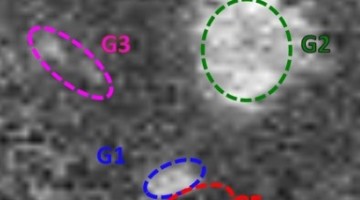
The amyloid plaques that accumulate in Alzheimer’s disease contain stores of iron. Using scanning transmission x-ray microscopy, researchers have characterized the iron’s chemical states in unprecedented detail. Their nanoscale analysis revealed excessive chemical reduction of the iron, which can release damaging free radicals. Read more »
From Moon Rocks to Space Dust: Berkeley Lab’s Extraterrestrial Research

Berkeley Lab has a well-storied expertise in exploring samples of extraterrestrial origin. This research—which has helped us to understand the makeup and origins of objects within and beyond our solar system—stems from long-standing core capabilities in structural and chemical analyses and measurement at the microscale and nanoscale. Read more »
A Path to a Game-Changing Battery Electrode
If you add more lithium to the positive electrode of a lithium-ion battery, it can store much more charge in the same amount of space, theoretically powering an electric car 30 to 50 percent farther between charges. But these lithium-rich cathodes quickly lose voltage, and years of research have not been able to pin down why—until now. Read more »
X-Rays Provide Key Insights on Path to Lithium-Rich Battery Electrode
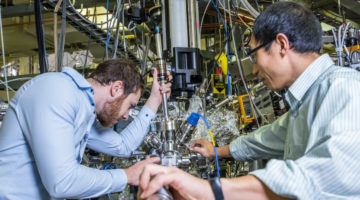
If you add more lithium to the positive electrode of a lithium-ion battery, it can store much more charge in the same amount of space, theoretically powering an electric car 30 to 50 percent farther between charges. But these lithium-rich cathodes quickly lose voltage, and years of research have not been able to pin down why—until now. Read more »
Ptychography of a Bacterium’s Inner Compass
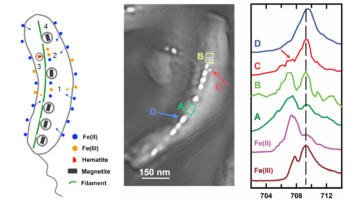
Magnetotactic bacteria (MTB) synthesize chains of magnetic nanocrystals (magnetosomes) that interact with the Earth’s magnetic field like an inner compass needle, simplifying their search for optimum environments. Ptychographic spectra of magnetosomes from a marine MTB provides insight into how these inner compasses form. Read more »
Industrial-Academic Collaboration Gives Nanoscale Insight into Batteries

An industrial collaboration between Hummingbird Scientific and a team of researchers from the ALS, SLAC, Berkeley Lab, Stanford University, and other institutions has resulted in a new x-ray microscopy platform that gives scientists the ability to image nanoscale changes inside lithium-ion battery particles in real time as they charge and discharge. Insights obtained from the imaging platform have already provided surprising new insights and could help researchers improve batteries for electric vehicles as well as smart phones, laptops, and other devices. Read more »
A Cleansing Rain Falls; a Soil-Filled Mist Arises

Rain’s reputation for cleansing the air may come with a caveat after new findings, including STXM and NEXAFS data, show that raindrops play a role in generating airborne organic particles. The findings could influence how scientists model our planet’s climate and future. Read more »
Hewlett Packard Labs Gains Insights with Innovative ALS Research Tools
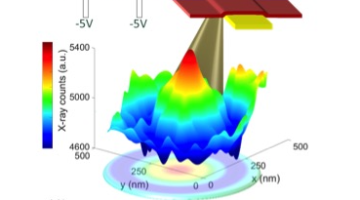
For the past eight years, Hewlett Packard Labs, the central research organization of Hewlett Packard Enterprise, has been using cutting-edge ALS techniques to advance some of their most promising technological research, including vanadium dioxide phase transitions and atomic movement during memristor operation. Read more »
X-Ray Microscopy Reveals How Crystal Mechanics Drive Battery Performance
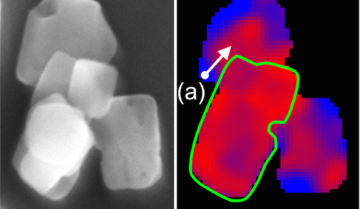
Recent findings at the ALS show that small crystal size is key to maintaining a battery’s performance and establish soft x-ray ptychography as an essential tool for studying chemical states in nanoparticles.
Read more » 
Decoding Ancient Ocean Acidification Signals from Plankton Shells
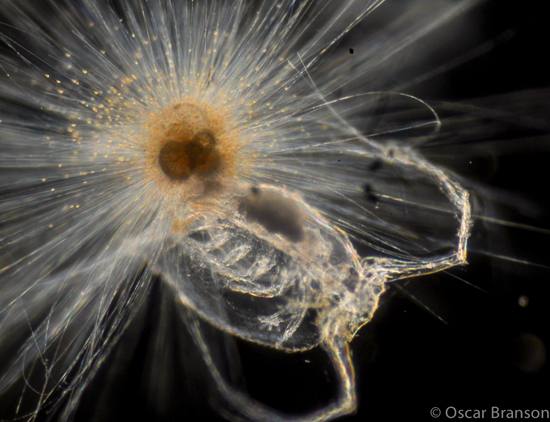
Ancient plankton shells can record the physical and chemical state of the ocean in which they grew. Decoding these signals can reveal changes in global climate, atmospheric CO2, and the acidity of the oceans in deep geologic time.