by Rachel Berkowitz
SCIENTIFIC ACHIEVEMENT
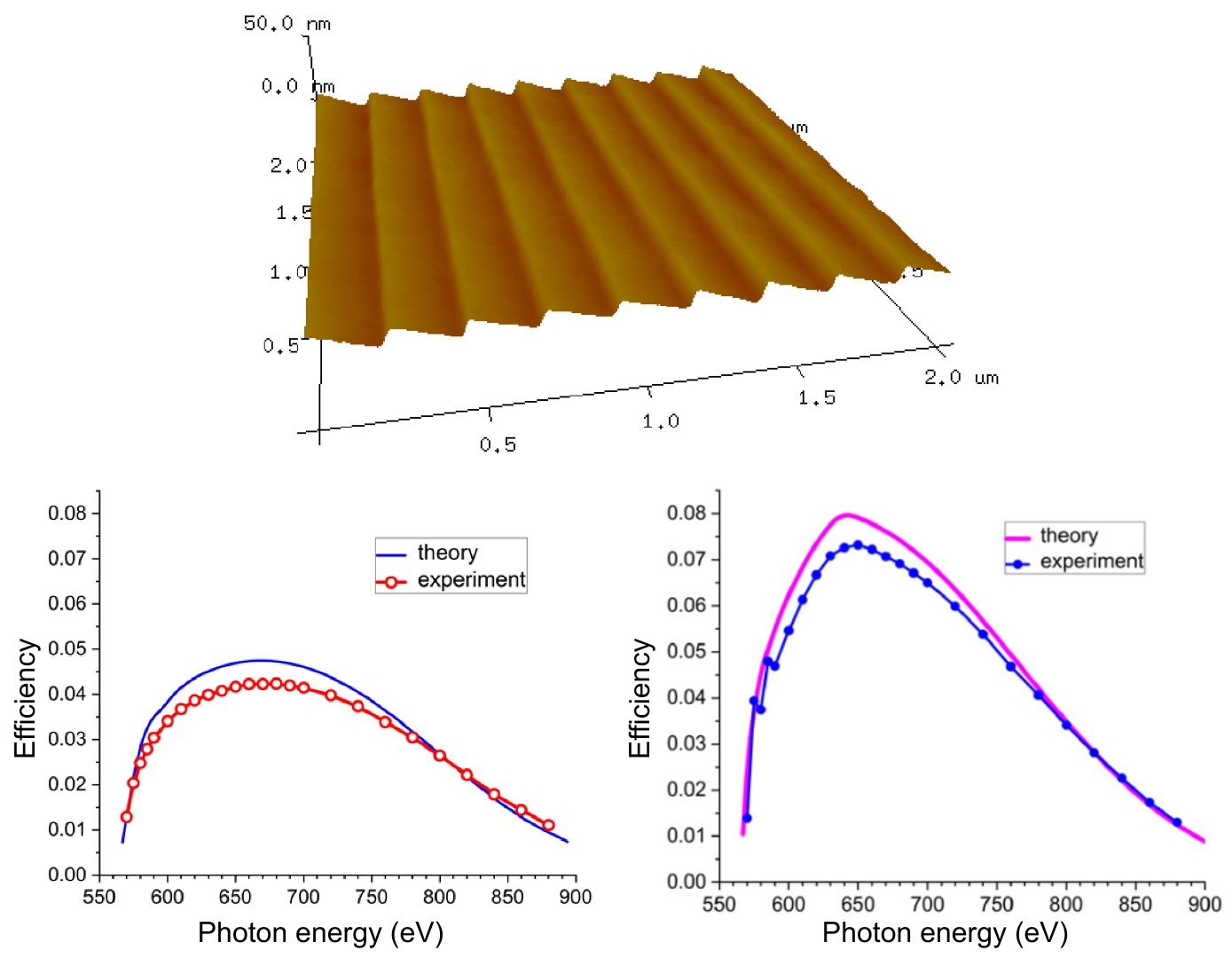
Researchers developed optimized coatings for diffraction gratings at the Advanced Light Source (ALS) that use thin-film interference to double the light reaching the sample, capturing power otherwise lost to absorption.
SIGNIFICANCE AND IMPACT
Every soft x-ray beamline monochromator uses gratings and can benefit from increased diffraction efficiency.
How to win back lost x-rays
Soft x-rays allow us glimpses into the most fundamental properties of many materials by revealing what electrons are doing in a solid. But, the gratings that separate and bend x-rays in these studies struggle to deliver more than a small fraction of an incoming beam’s energy to its target. This has led researchers on a quest to improve the efficiency of gratings, without compromising the resolution of the output data.
Gratings are the key technology for soft x-ray experiments and most spectroscopy tools. Their periodic structures parse light into separate wavelengths, which are then either selected individually or dispersed across a detector. To achieve high resolution, these metal-coated gratings need an extremely high number of closely packed grooves. The grooves, however, are a double-edged sword: they deflect incoming x-rays toward the sample, but some x-rays are absorbed by the coating and cannot usefully contribute.
In this study, researchers sought to win back some of the x-rays that are lost. They examined how very thin metal coatings impacted a grating’s performance. The team, led by ALS Staff Scientist Dmitriy Voronov, tested gratings coated with atoms-thick layers of chromium (Cr) and gold (Au) and showed that an optimized configuration doubled the efficiency compared with standard designs.
Thinner layers are the golden ticket
In the last decade, the Berkeley Lab team has developed world-leading nanoscale engineering techniques for making gratings to use in ALS experiments. Using Berkeley Lab’s Molecular Foundry, they first fabricated a silicon grating with 4,444 grooves per mm for a total of half a million grooves over the entire element—itself a nanoscale engineering feat.
The team prepared two versions of grating. First, they coated the silicon with a reflective layer of 5-nm-thick Cr and 30-nm-thick Au, the standard design for inhibiting direct absorption by the silicon. Then, they replaced the coating with a layer of 1-nm-thick Cr and 4-nm-thick Au, a combination that their simulations indicated would double the grating’s efficiency.
The researchers tested the gratings at Berkeley Lab’s Center for X-Ray Optics (CXRO) Beamline 6.3.2 at the ALS, which Voronov called “an invaluable resource for work on soft x-ray optics.” They found that their new design delivered up to 8% of incoming soft-x-ray energy to its target, a doubling of performance in perfect agreement with simulations. “This implies that our gratings are almost perfect at the atomic scale over very large areas,” said Howard Padmore, a paper co-author and retired senior scientist who initiated grating research at the ALS more than 20 years ago.
Reflected x-rays boost themselves
The measurements and simulations indicated that the part of the wave that normally gets absorbed by the grating is instead partially reflected at the interface between coating and silicon. It gets added coherently to the reflected part, boosting the signal by up to 100%.
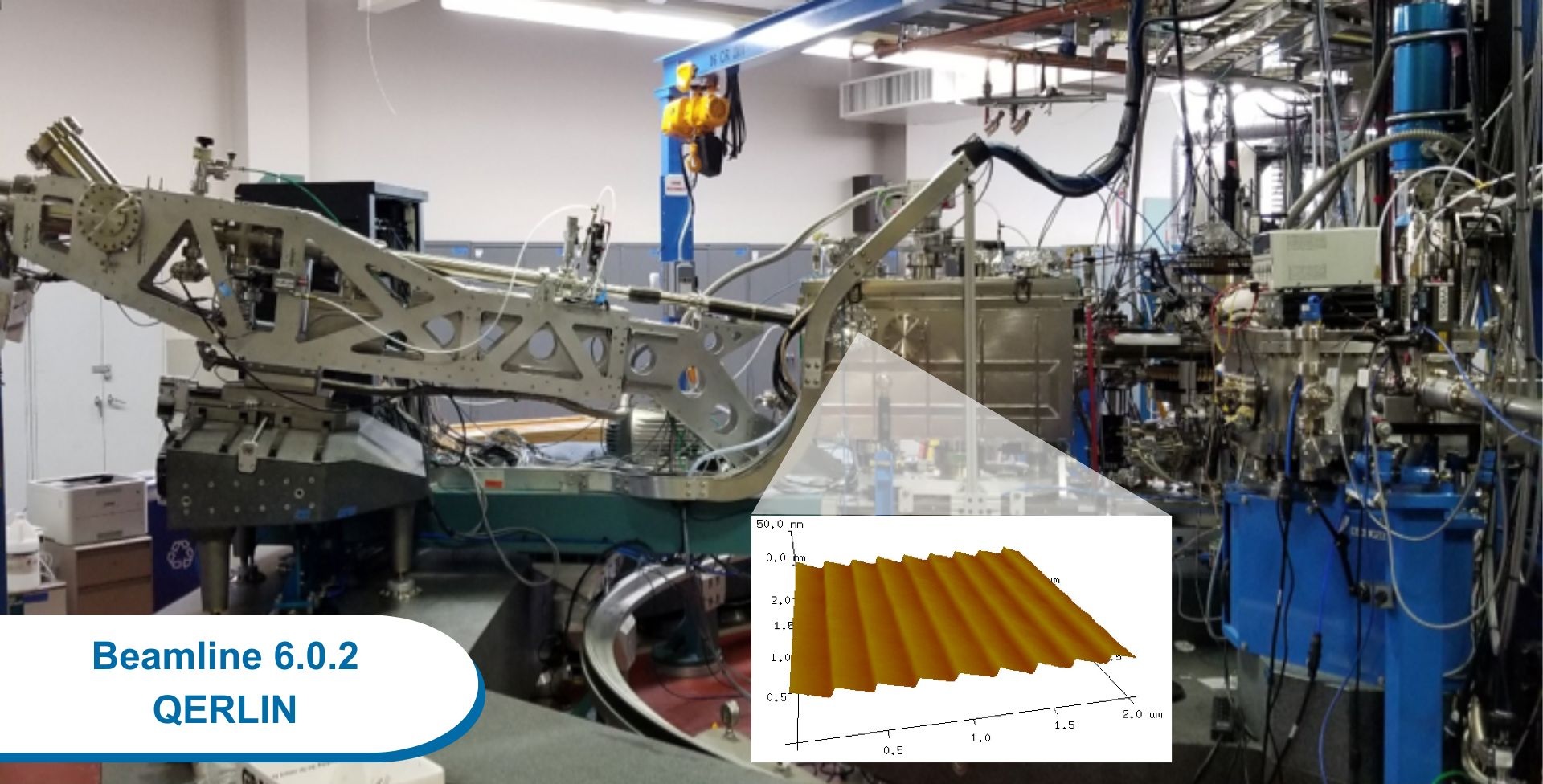
Thin-film interference effects similar to this could be used across many areas of high-resolution spectroscopy. The researchers plan to experiment with multilayer coatings to enhance the efficiency of gratings used on the ALS Double-Dispersion Resonant Inelastic X-Ray Scattering (RIXS) system (QERLIN, Beamline 6.0.2).
ALS Senior Scientist Wanli Yang explained that the multilayer gratings could greatly improve the RIXS detection efficiency and make it possible to employ higher-order diffraction. “These higher orders provide much higher energy resolution in RIXS spectroscopy,” said Yang. Higher energy resolution could, in turn, lead to RIXS with both high resolution and high efficiency.
“Our hope is that with efficiency optimization, we can enable a new generation of experiments to be performed,” said Voronov.
Contacts: Dmitriy Voronov and Howard Padmore
Researchers: D.L. Voronov and S. Park (ALS, Berkeley Lab); E.M. Gullikson and F. Salmassi (Center for X-Ray Optics, Berkeley Lab); and H.A. Padmore (Arizona State University).
Funding: US Department of Energy, Office of Science, Basic Energy Sciences program (DOE BES). Operations of the ALS and Molecular Foundry are supported by DOE BES.
Publication: D.L. Voronov, E.M. Gullikson, F. Salmassi, S. Park, and H.A. Padmore, “Doubling the efficiency of high-resolution X-ray gratings via thin-film interference,” Opt. Lett. 50, 5929 (2025), doi:10.1364/OL.573022.
ALS SCIENCE HIGHLIGHT #535
