By Maritte O’Gallagher
SCIENTIFIC ACHIEVEMENT
Researchers designed a new protein with artificial intelligence (AI) and used the Advanced Light Source (ALS) to validate that it could precisely recognize a key therapeutic target for cancer.
SIGNIFICANCE AND IMPACT
This research demonstrated how AI accelerated the configurable design of tumor-targeting agents previously difficult to develop for clinical applications.
The challenge: Harnessing the body’s built-in cancer detector
Major histocompatibility complex (MHC) molecules are crucial proteins on most cells, acting as the immune system’s ID tags to distinguish healthy cells from infected or cancerous ones. These proteins present short peptide fragments on the cell surface, providing a snapshot of each cell’s internal state. T cells recognize cancerous cells by binding these surface peptides through their receptors, signaling the immune system to target cancerous cells for destruction.
Developing drugs that supplement this native defense could be a major opportunity in cancer therapeutics, but identifying T-cell receptors (TCRs) with the right chemical features and adapting them into practical drugs is cumbersome and often fruitless.
To address these difficulties, scientists are now engineering mimics of TCRs that recognize peptide-MHC in much the same way. Although these designer mimics can be more suitable as drugs, they can still take years of trial and error to develop and sometimes bind features on healthy cells, creating risky off-target effects. Thus TCR mimics must be extremely precise, binding tightly to disease-related peptides while avoiding unintended interactions.
In this work, researchers used an AI-driven approach to design a new TCR mimic and confirmed its precision for fighting cancer cells using protein x-ray crystallography at the ALS.
Iterating on nature’s defenses with generative AI
Researchers at Stanford University applied AI to this highly constrained problem to design a new protein and, in a matter of weeks, created a TCR mimic that tightly binds to ID-tag peptides on tumor cells.
To do this, they restricted their design space to α-helical proteins, which maintain a more rigid scaffold structure than conventional TCRs or antibodies, positing that reduced flexibility could enhance computational accuracy and minimize off-target interactions.
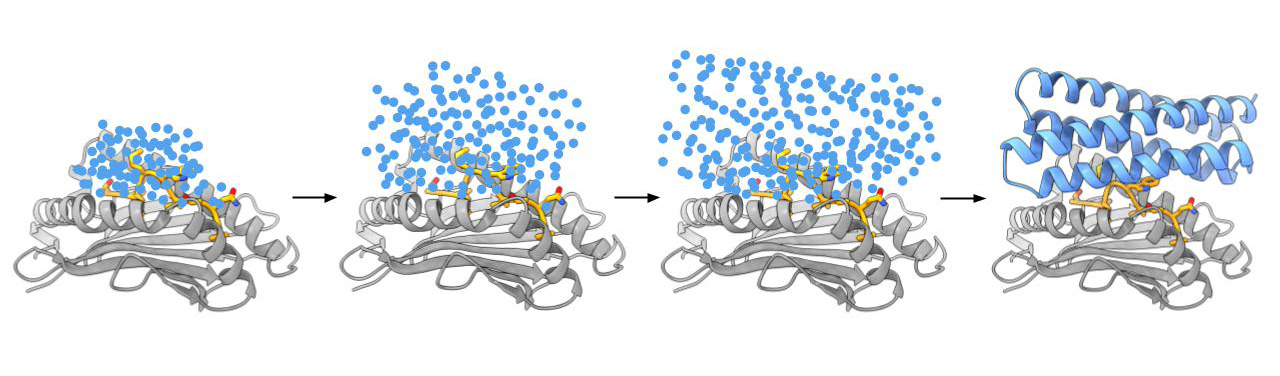
The AI tools offered a supercharged iterative process, allowing the researchers to generate 2,600 novel designs in 30 hours and identify several promising candidate binders in less than two weeks—a process that, if performed by trial-and-error experiment, would take years. The team then tested how these scaffolds functioned in cell-based experiments, and selected one candidate that strongly bound the target peptide while displaying minimal off-target effects.
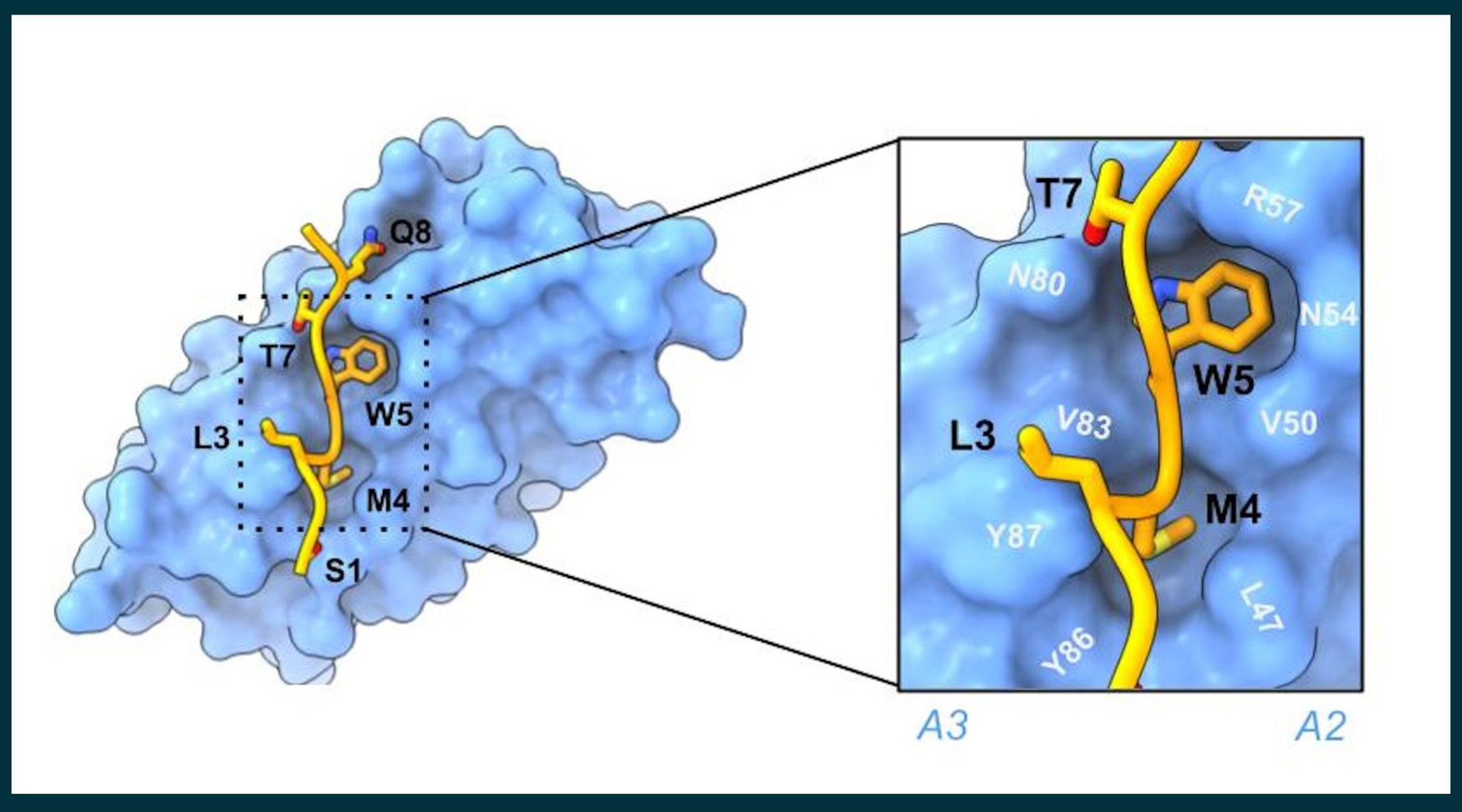
To validate these results and observe how the two proteins were interacting at the angstrom scale, the researchers studied their synthetic TCR protein bound to the target peptide using protein crystallography at ALS Beamline 8.2.1. Diffraction from the crystal complex provided detailed structural analysis that confirmed the designed TCR mimic and target peptide were locked together with high specificity. The resolved structure of the crystal complex also served as a blueprint for experiments confirming the new molecule’s selectivity, activity against cancer cells, and its higher binding affinity compared with previously developed TCRs and synthetic mimics.
A streamlined, customizable platform for designing cancer-targeting proteins
The researchers fine-tuned a fast, scalable approach for generating proteins designed to tightly bind peptides on the surface of cancer cells. ALS data showed that the experimental structure closely matched the AI-predicted model, demonstrating that AI-based protein design can accurately produce TCR mimics with the intended structure and binding mode.
Such AI-designed TCR mimics could be used as precision probes for cancer diagnostics, enabling faster clinical assessment and more tailored treatment plans. With appropriate controls to eliminate off-target effects, TCR mimics could also support personalized cancer therapies, where tumor peptide sequences guide therapeutic engineering in weeks to months.
Contacts: Karsten D. Householder and Christopher Garcia
Researchers: K.D. Householder, X. Xiang, K.M. Jude, M. Obenaus, Y. Zhao, S.C. Wilson, X. Chen, N. Wang, and K.C. Garcia (Stanford University School of Medicine) and A. Deng (Stanford University).
Funding: National Institutes of Health; Yosemite Fund; Parker Institute for Cancer Immunotherapy; Cancer Research Institute; Cancer Research UK, Mark Foundation for Cancer Research. Operation of the ALS is supported by the US Department of Energy, Office of Science, Basic Energy Sciences program (DOE BES).
Publication: K.D. Householder, X. Xiang, K.M. Jude, A. Deng, M. Obenaus, Y. Zhao, S.C. Wilson, X. Chen, N. Wang, and K.C. Garcia, “De novo design and structure of a peptide-centric TCR mimic binding module,” Science 389, 375 (2025), doi:10.1126/science.adv3813.
ALS SCIENCE HIGHLIGHT #537
