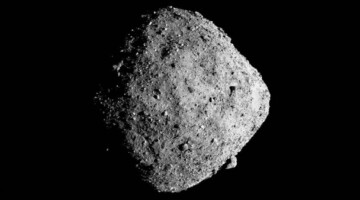
Researchers traced the evolution of minerals (“salts”) in an ancient brine, as recorded in samples from the asteroid Bennu, returned to Earth by NASA’s OSIRIS-REx mission. The results support the idea that asteroids like Bennu may have delivered water and essential chemical building blocks of life to Earth in the distant past. Read more »

All News & Updates
Reaction Mechanism of Commercial Lithium-Ion Battery Cathodes
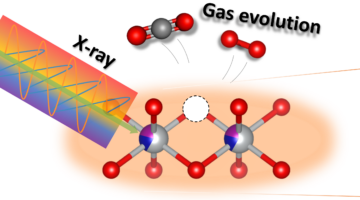
Researchers used soft x-ray resonant inelastic x-ray scattering at the ALS to understand the role of aluminum doping in improving the stability of commercially used cathode materials for lithium-ion batteries. Read more »
Mind-Blowing Materials: Mimicking Neurons for Faster Computing
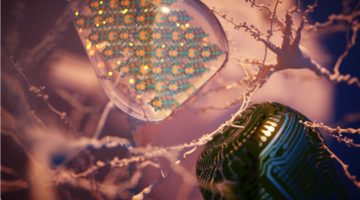
Researchers used x-ray absorption spectroscopy and resonant inelastic x-ray scattering at the ALS to uncover the atomic-level mechanism of conductance switching for a neuromorphic material that has the potential for energy-efficient computing. Read more »
Identification of Structurally Novel KRASG12C Inhibitors through Covalent DNA-Encoded Library Screening
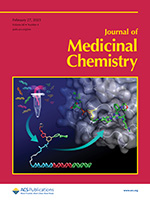
DNA-encoded library (DEL) technology was used to prepare a ~1.6 × 10⁷-compound cysteine-reactive library (representative component shown at bottom, cysteine-reactive site indicated). Screening this library against the KRASG12C oncoprotein identified multiple structurally novel inhibitors of this challenging-to-drug target (e.g., frontmost green compound in the X-ray structure at right, covalent bond to KRASG12C indicated). Read more »
Berkeley Lab Helps Explore Mysteries of Asteroid Bennu
The Advanced Light Source and Molecular Foundry provided powerful tools to study asteroid samples returned by NASA’s OSIRIS-REx mission to the asteroid Bennu. Researchers found a telltale set of salts formed by evaporation that illuminate Bennu’s watery past. Read more »
2025 ALS-United New Year’s Message

Interim ALS Director, Andreas Scholl and Interim ALS-U Project Director Dimitri Argyriou usher in 2025 with a message for you on the ALS-U project and the priorities for the new year. Watch their conversation or access the full transcript. Read more »
Autonomous Beamlines: Harnessing Bayesian Optimization to Revolutionize Accelerator Science
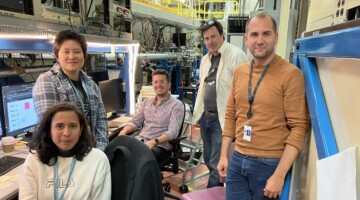
Scientists at the Advanced Light Source are developing automated beam optimization systems, collaborating with other light sources to deploy common controls across facilities. Using machine learning, they demonstrated automated beamline alignment that optimizes beam size and flux at the push of a button. Read more »
CU*IP ALS Tours
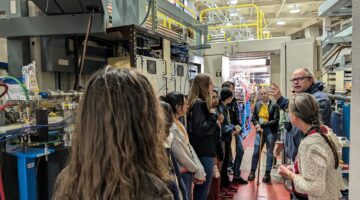
The American Physical Society holds an annual Conference for Undergraduate Women and Gender Minorities in Physics (CU*IP). This year’s Northern California edition was hosted at UC Berkeley with support from Berkeley Lab and LLNL. After the end of the conference on Sunday, January 26, about 60 participants visited the Lab and got to see NERSC and the ALS. Tour guides for the ALS were Hendrik Ohldag and Ina Reichel, who were also on the local organizing committee of the conference.
New UEC Members for 2025
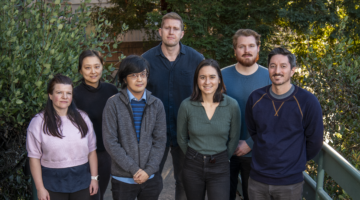
Welcome to new 2025 members Joshua Del Mundo, Wei He, Matt Landsman, Lowell Miyagi, and Brandy Toner. Special thanks to the outgoing members, Inna Vishik, Connor Bischak, Sharon Bone, Devin Grabner, Yu He, and Grant Shoffner for their service. Read more »
Understanding the Role of Manganese in Fuel Production Catalysts
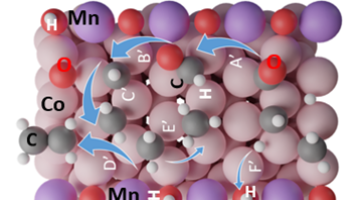
Using specialized equipment at the Advanced Light Source (ALS), including a custom-built reaction cell, researchers uncovered the role of manganese in cobalt manganese oxide catalysts used for fuel production. Read more »
- « Previous Page
- 1
- …
- 11
- 12
- 13
- 14
- 15
- …
- 145
- Next Page »