by Cindy Lee
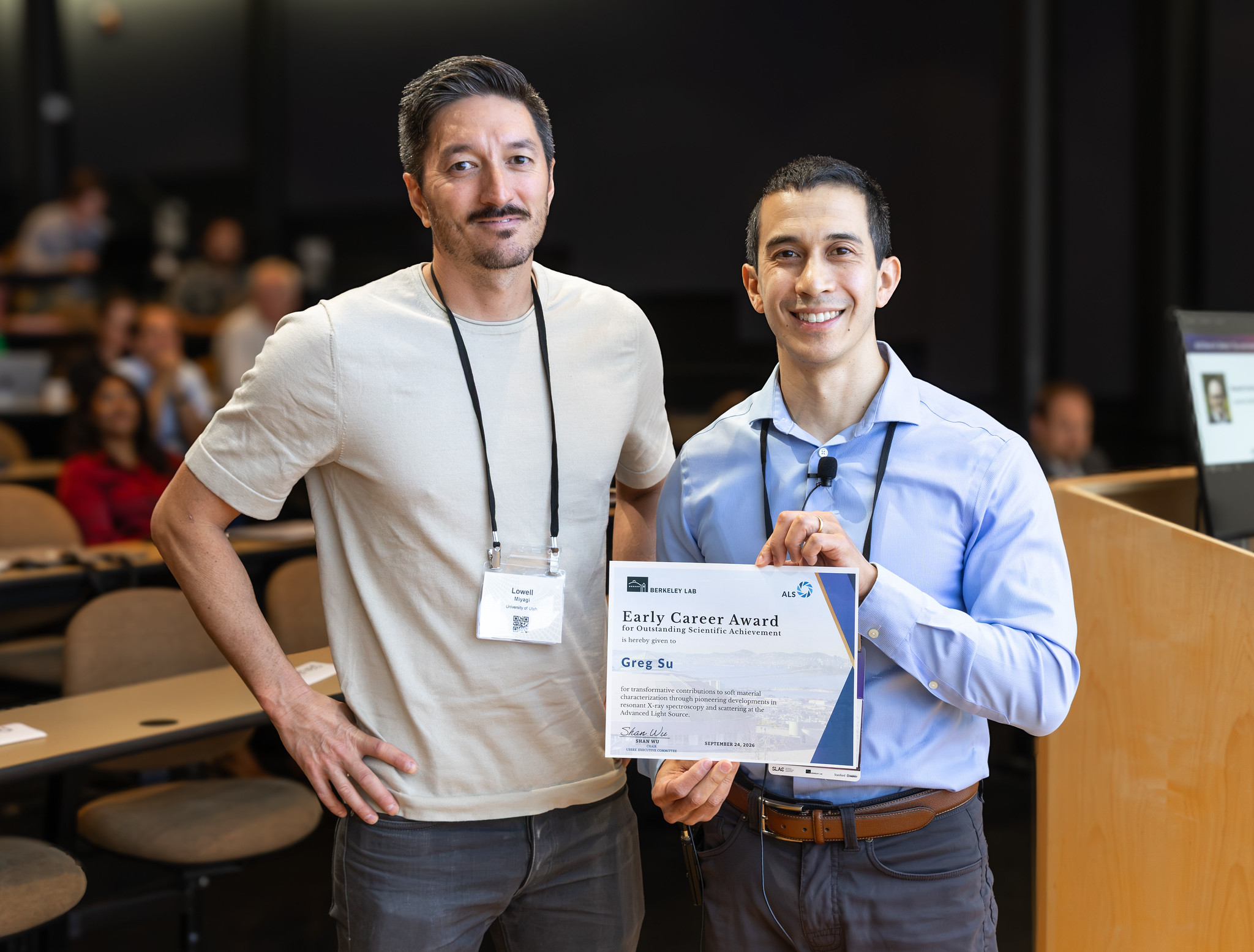
Greg Su, a staff scientist at the Advanced Light Source (ALS), received the 2026 Early Career Award for Outstanding Scientific Achievement at the 2026 Bay Area Light Sources Joint Users’ Meeting. His selection by members of the ALS Users’ Executive Committee (UEC) recognizes his transformative contributions to soft material characterization through pioneering developments in resonant X-ray spectroscopy and scattering at the ALS.
Mentorship is central to Su’s work. He credits the mentors who have guided his career path, and he also finds mentoring students and postdoctoral researchers to be a rewarding experience. As a graduate student at the University of California, Santa Barbara, he worked with professors Michael Chabinyc and Ed Kramer on organic semiconductors for flexible electronics. Because he sought to understand the material at the nanoscale, this research opened the door to the national lab world, where light and neutron sources empower researchers to capture the nanoscale with precision.
Su became a user facility devotee, conducting experiments at ALS beamlines for resonant soft X-ray scattering (RSoXS) with Cheng Wang and scanning transmission X-ray microscopy (STXM) with David Kilcoyne. He also had beamtime at the Stanford Synchrotron Radiation Lightsource (SSRL) and National Synchrotron Light Source (NSLS) and collaborated with Lawrence Berkeley National Laboratory’s (Berkeley Lab) Molecular Foundry researchers like David Prendergast. All of these experiences showed Su the kind of mentorship and working environment he would want after graduate school, and he specifically sought national lab postdoctoral opportunities.
When Su joined Wang’s team at the RSoXS beamline, he continued building on the relationships from his graduate studies while forming a clearer vision for his career path. He began collaborations with Berkeley Lab scientists Walter Drisdell and Ahmet Kusoglu and pivoted his research focus to nanoporous metal-organic frameworks (MOFs), and ion-conducting polymer membranes.
“I hadn’t worked on membranes before that time,” said Su, “but I became interested because they are important to so many technologies and industries.”
Contributing to a thriving polymer research community
“Greg decisively expanded the scope of resonant X-ray methods in studies of proton exchange membranes,” said Dean DeLongchamp, who leads the Polymer Processing Group at the National Institute of Standards and Technology.
He described how Su developed tender resonant X-ray scattering (TReXS) methods to probe hydration state and local chemical environments within membranes. TReXS revealed unexpected structural changes caused by subtle chemical modifications, previously undetected by practices that relied on dye-labeling techniques.
“His insights helped establish TReXS as a powerful approach for probing membranes in conditions approaching operational conditions, adding a needed method to the global synchrotron community’s toolkit,” said DeLongchamp. “This also forced the broader membrane community to reconsider common measurement strategies.”
DeLongchamp traced Su’s impact on the field from his postdoctoral research to his current role as a research group leader who is advancing membranes for energy and water applications. Su has established industrially relevant setups at ALS beamline 7.3.3. He has also pushed resonant and grazing-incidence X-ray methods into the environments where polymer membranes are made and used.
“His liquid-phase RSoXS work at beamline 11.0.1.2, coupled to simulations, addresses a long-standing debate in isoporous membrane formation,” DeLongchamp explained. “It showed how solvent selectivity dictates core-shell micelle morphology.”
Benny Freeman expanded on how challenging this achievement was. “These are exceptionally challenging measurements: soft X-rays have limited penetration depth, the liquid environment requires specialized cells, and the organic solvents themselves strongly absorb in the relevant energy range.”
As the director of the Center for Materials for Water and Energy Systems (M-WET), an Energy Frontier Research Center, Freeman has seen firsthand how Su is expanding the expertise in the membrane field.
“Greg’s work overcame these challenges and enabled, to my knowledge, the first successful demonstration of liquid RSoXS on polymers in organic solvents,” said Freeman. “More broadly, it opened a new experimental frontier for RSoXS by demonstrating how chemically sensitive scattering can be used to interrogate soft materials in realistic solvent environments.”
He also lauded Su’s work on membrane formation, which has been central to Su’s activities with M-WET.
“During membrane formation, the polymer starts to concentrate,” explained Su. “The nanostructures that form at this stage are very important to what the final membrane will look like.”

To study the process, Su and his M-WET collaborators built an experimental stage that meant they could put the building blocks of a membrane inside the beamline hutch before using X-rays to collect scattering patterns as the membrane formed.
“That allowed us to understand what’s happening with the morphology during solvent evaporation,” said Su. “Before, you had to let the mixture dry for a certain amount of time and then quench it by dunking it in water. But without knowing how long the membrane took to form, you had to do all these trials—does it take five seconds? Thirty seconds?”
Now, they can continuously collect data throughout the drying process and understand membrane formation.
“When these micelles start to come together, they pack nicely into ordered arrangements. It helped us understand why certain drying times lead to the best membranes,” Su said.
The micelle arrangement is but one piece of Su’s contribution to the field. He has also been able to study the membranes while they’re in use, an additional step that Freeman described.
“Greg’s operando approach allows researchers to connect water quality, fouling-layer composition, membrane structure, and performance in a way that was previously inaccessible,” Freeman said.
Both DeLongchamp and Freeman recognized Su for sharing his developments with facilities beyond the ALS. They noted that his experimental setups have now been implemented at NSLS-II and SSRL. In fact, the team will continue their efforts at SSRL during the upcoming dark time for the ALS upgrade.
Looking to the future
In addition to growing his current scientific program, Su is a thought leader for science enabled by the ALS upgrade.
ALS Science Deputy Andreas Scholl has already observed the preparations Su is making for the scattering branch of a proposed flagship beamline. This beamline will use the full coherence of the upgraded ALS to study chemical and materials dynamics using tender scattering and X-ray photon correlation spectroscopy.
“The particular sensitivity to elements such as sulfur and phosphorus offers unique opportunities to study materials dynamics, complementary with light element studies at ALS soft X-ray beamlines,” said Scholl. He noted that Su’s benchmarking experiments now are informing ALS decisions in regard to the planned beamline specifications. “Greg is a key member of the team devising the long-range science and beamline strategy for scattering at the ALS,” Scholl added.
Scholl also credited Su for substantial outreach and mentoring efforts, including Su’s role as the Berkeley Lab lead for a RENEW grant with Navajo Technical University.
“The ALS strongly supports this outreach, which broadens our impact,” said Scholl, “but it requires a high degree of investment in time in order to mentor external Pls who are less familiar with DOE proposal processes and user facility peer review.”
The time and effort is well worth it to Su.
“Through mentorship and collaboration, we’ve been able to accomplish more than what I could have done on my own,” Su said. “It’s really rewarding to help people grow in their scientific careers.”
For instance, he mentored postdoctoral researcher Matt Landsman, who began his time with M-WET not expecting to use synchrotrons. Landsman has since become a regular user and is now an assistant professor at Arizona State University. Other team members have similarly become expert users at various light sources.
To Su, these relationships and interactions are intrinsically tied to scientific achievement. He views the Early Career Award as a recognition of both components, and his work will continue to be guided by a “team science” mentality.
“His mentees have gone on to positions in academia and industry, and his leadership has helped broaden participation in synchrotron and membrane science,” Freeman explained. “Greg is not only advancing the field himself, he is building the community that will carry it forward.”