by Cindy Lee
Scientific Achievement
Microscopy at the Advanced Light Source (ALS) revealed that nanocrystal misorientation in tooth enamel tracked major dietary shifts in primates, contributing to enamel’s resilience.
Significance and Impact
These structural details provide a blueprint for developing tougher, crack-resistant materials—including bioinspired composites, next-generation structural ceramics, and coatings.
Research Details
- Researchers compared the tooth enamel of pre- and post-agriculture humans as well as primates with markedly different diets
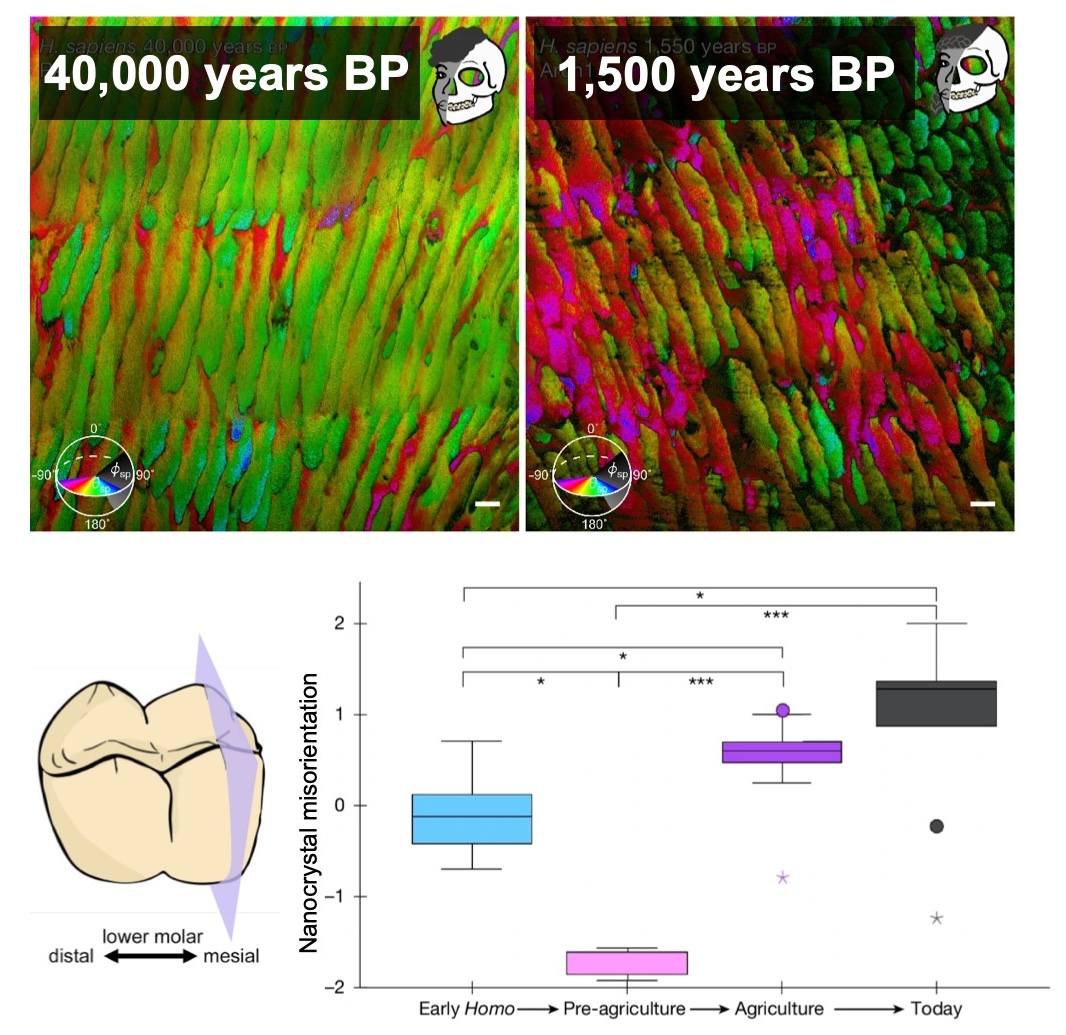
- X-ray photoemission electron microscopy at ALS beamline 11.0.1.1 revealed that enamel nanocrystal misorientation increased with diet hardness after humans transitioned to meat eating and an agricultural lifestyle
Research Summary
Primates in varying biomes have access to different types of food. This dietary range is reflected in primates’ bodies, down to tooth size. Similarly, evolutionary adaptations occurred in the nanocrystals of the tooth enamel, imperceptible to the naked eye.
At the ALS, researchers have uncovered the details of these adaptations, distinguishing between the tooth enamel nanocrystals of different species that track with their different diets. Crystal misorientation is a well-known toughening mechanism, but how it works at the nanoscale was previously unknown.
The team performed photoemission electron microscopy (PEEM) at ALS beamline 11.0.1.1 on teeth from different primate species, including hominins before and after the introduction of meat and agriculture. They developed a method, Polarization Enabled Large Input of Crystal Angles at the Nanoscale (PELICAN), to interpret the PEEM data and reveal the arrangement of the tooth enamel nanocrystals.
A chimpanzee that eats ripe fruit had the least nanocrystal misorientation in the tooth enamel; a monkey that cracks nuts had the most misorientation. PELICAN demonstrated such a difference in humans with divergent diets, too. In an individual from Spain, 40,000 years before present (BP), the tooth enamel had very little nanocrystal misorientation. Samples from British agricultural populations, 1,500 and 700 years BP, had almost double the level of misorientation.
Through PELICAN, the team traced the relationship between dietary requirements and nanocrystal misorientation in tooth enamel. Primates that consume soft foods have very little misorientation in their enamel, whereas teeth with greater misorientation could withstand the forces required to chew through seed casings and grain-based food. Still, the misorientation angles are small, indicating that tens of degree differences are sufficient to toughen enamel.
Not only do these findings show how primate teeth fit their diets, but they also have applications in designing coatings, structural ceramics, and other materials. This nanocrystal basis for tooth enamel resilience could shape bio-inspired materials of the future.
Contacts: Pupa U. P. A. Gilbert and Barat Achinuq
Affiliations and Institutions: Lawrence Berkeley National Laboratory: Advanced Light Source, Chemical Sciences Division, Energy Geosciences Division. University of Wisconsin, Madison. Harvard University. University of Kent. Ohio State University. National Museum of Kenya. Musee de l’Homme, UCite Paris. University of California, Berkeley. Ball State University.
Funding: US Department of Energy, Basic Energy Science, Chemical Sciences, Geosciences, Biosciences, Geosciences (DOE–BES–CSGB-Geosciences) program; National Science Foundation (NSF), Biomaterials; European Union Horizon 2020 Research and Innovation programme; Turkana Basin Institute; Columbia University, Lamont-Doherty Earth Observatory, Climate Center Grant; Harvard University American School of Prehistoric Research. Operation of the ALS is supported by DOE BES.
P.U.P.A. Gilbert, D.R. Green, P. Mahoney, D. Guatelli-Steinberg, W.S. McGraw, E. Lagan, F.K. Manthi, S. Muteti, E. Ndiema, F. Ramirez Rozzi, C.A. Stifler, C.A. Schmidt, B. Achinuq, A. Scholl, B. Gilbert, and M.C. O’Hara, “Enamel nanocrystal misorientation increased with meat-eating and agriculture,” Nature 654, 76 (2026), doi:10.1038/s41586-026-10583-8.
ALS SCIENCE HIGHLIGHT #548
