by Gianna FazioLiu
Scientific Achievement
Using the Advanced Light Source (ALS), researchers confirmed that a radially graded, low-nickel cathode sustains reversible oxygen redox across repeated cycling, enabling high capacity with minimal degradation.
Significance and Impact
This new cathode can cut nickel usage in electric vehicle batteries, lowering supply risk and financial and environmental costs, while preserving energy density and lifespan.
Research Details
- Built a low-nickel cathode (content below 60%) with a radial phase integration design: a manganese-rich, lithium-rich outer shell that grades smoothly into a nickel-rich core.
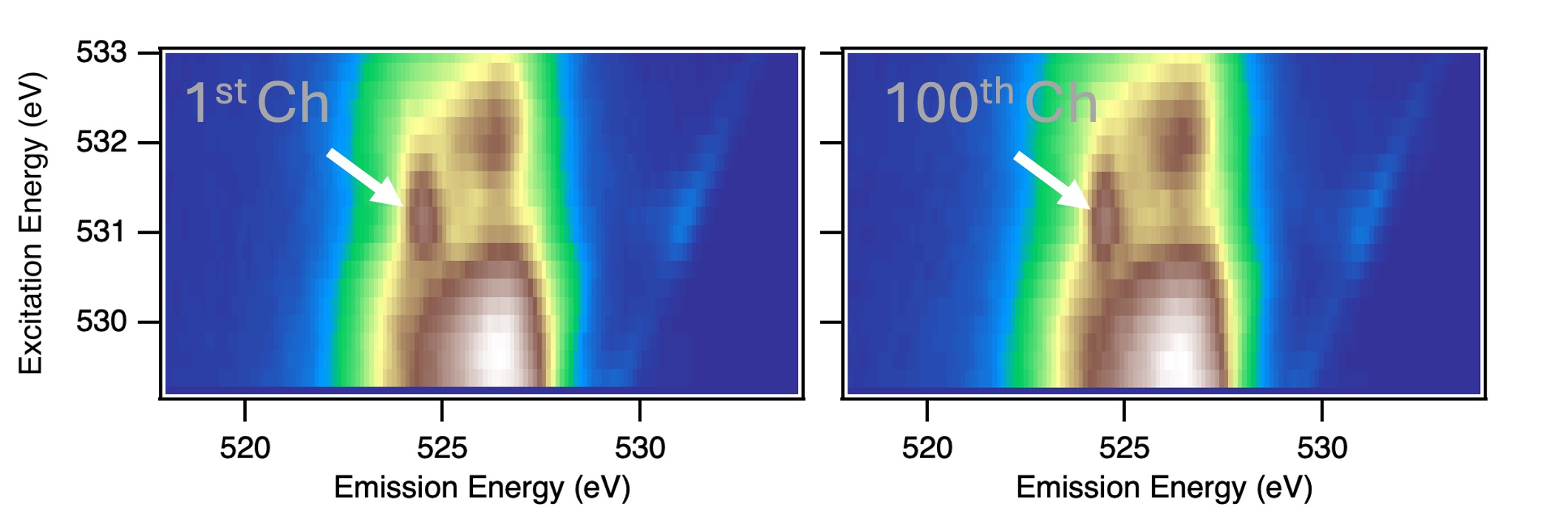
- Used resonant inelastic X-ray scattering (RIXS) at ALS beamline 8.0.1.1 to track oxidized oxygen in the cathode through charge and discharge states over 100 cycles, showing the oxygen redox reaction was reversible rather than degrading.
- Paired ALS spectroscopy with X-ray diffraction and microscopy at APS and NSLS-II to connect atomic-scale chemistry to particle-level stability.
Research Summary
Electric vehicles rely on batteries that pack in more energy without leaning heavily on nickel—the metal that has conventionally boosted a cathode’s energy storage, but comes at a cost. Nickel mining is costly, geopolitically concentrated, and environmentally damaging.
Cathodes with less nickel typically make up for the lost capacity by tapping anionic redox, which is the extra charge stored in the material’s oxygen atoms rather than its metal atoms. The catch is that this oxygen chemistry usually degrades quickly, causing capacity and voltage to fade.
In this study, researchers designed a low-nickel cathode with a radial phase integration structure—a manganese-rich, lithium-rich outer shell built around a nickel-richer core. This graded architecture stabilizes the oxygen redox reaction that the cathode depends on, allowing it to store extra charge repeatedly without destabilizing.
To confirm the anticipated performance, the team worked with ALS scientists to map the oxygen state within the cathode particles using resonant inelastic X-ray scattering mapping (mRIXS) at different stages of charging and after repeated cycling. The technique isolates the signal of oxidized oxygen from the much stronger signal produced by surrounding metal atoms—a distinction few other methods can make. The mRIXS data showed the oxidized-oxygen signal appearing on first charge and disappearing on discharge, a reversible pattern that held largely steady after 100 cycles. This confirmed the oxygen redox process remains structurally stable over extended use, without the destructive phase transitions or oxygen release that typically impact these materials.
Paired with X-ray and electron microscopy at the Advanced Photon Source (APS) and National Synchrotron Light Source II (NSLS-II), the team showed the cathode retained 90% of its capacity after 500 cycles in full cells, and nearly 97% after 400 cycles in pouch cells—outperforming today’s nickel-rich cathodes and offering a practical design strategy for high-performing, lower-nickel batteries.
Contacts: Tongchao Liu and Zengqing Zhuo
Affiliations and Institutions: Lawrence Berkeley National Laboratory: Advanced Light Source. Argonne National Laboratory: Advanced Photon Source, Center for Nanoscale Materials, Chemical Sciences and Engineering Division, Materials Science Division, and X-ray Science Division. Brookhaven National Laboratory: National Synchrotron Light Source II.
Funding: US Department of Energy, Office of Energy Efficiency and Renewable Energy, Vehicle Technologies Office. Operation of the ALS, the Center for Nanoscale Materials, APS, and NSLS-II is supported by the US Department of Energy, Office of Science, Basic Energy Sciences program.
W. Huang, Z. Zhuo, A. Dai, J. Huang, J. Wang, T. Zhou, X.-M. Lin, X. Xiao, L. Ma, R. Amine, G. Kwon, X. Huang, T. Li, H. Adhikari, J. Guo, S. Trask, J. Wen, K. Amine, and T. Liu, “Low-nickel cathode chemistry for sustainable and high-energy lithium-ion batteries,” Nat. Sustain. 9, 317 (2026), doi:10.1038/s41893-025-01704-8.