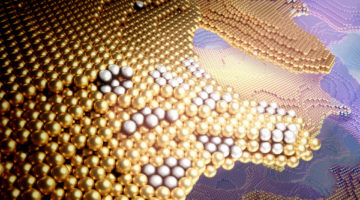
Researchers have structurally and chemically “visualized” the surface of a silver–gold alloy as it reorganizes itself during catalytic activation. The insights gained from this methodology can lead to improved catalysts for energy-intensive industrial applications, thereby increasing efficiency and reducing waste. Read more »

APXPS Finds Carbonate Reversal at Liquid Interfaces
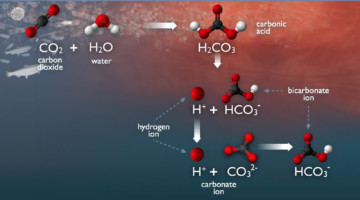
Aqueous carbonate systems are central to many processes essential to life, from the blood buffer system to the global carbon cycle. Using APXPS, researchers probed the concentration of carbonates near an interface, finding a surprising reversal in the expected abundances as a function of depth. Read more »
An Atomic-Level Understanding of Copper-Based Catalysts
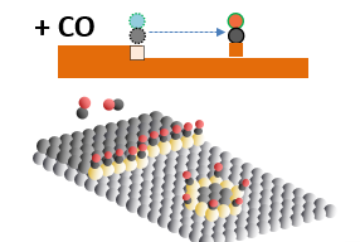
Copper-based catalysts are widely used in chemical industries to convert water and carbon monoxide to hydrogen, carbon dioxide, and methanol. There are theoretical models used to explain this reaction, but a complete understanding of the process has been lacking. However, recent research at the ALS has shed light on the process, giving scientists key data about how copper-based catalysts function at the atomic level. Read more »
ALS X-Rays Shine a New Light on Catalysis
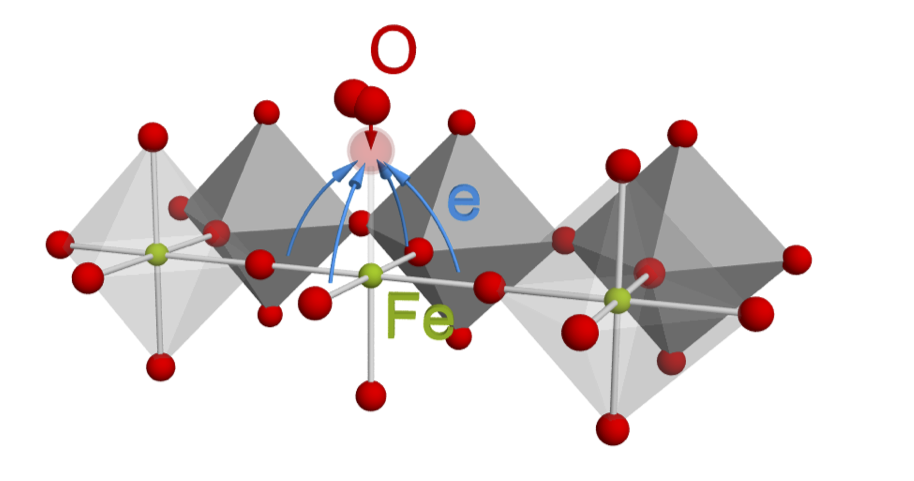
Recently a team of Stanford and Berkeley Lab researchers used x-rays at the ALS in a novel way to observe the behavior of electrons during technologically important chemical reactions in metal oxide electrocatalysts. What they learned has upended long-held scientific understanding of how these catalysts work. Read more »
New Technique Gives a Deeper Look into the Chemistry of Interfaces
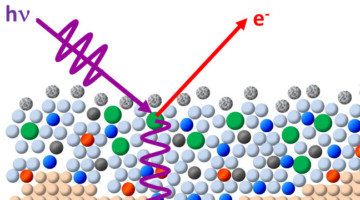
A new technique developed at the ALS offers sub-nanometer depth resolution of every chemical element to be found at heterogeneous interfaces, such as those in batteries and fuel cells. The technique has relevance to energy research, heterogeneous catalysis, electrochemistry, and atmospheric and environmental science. Read more »
Platinum Nanoclusters Out-Perform Single Crystals
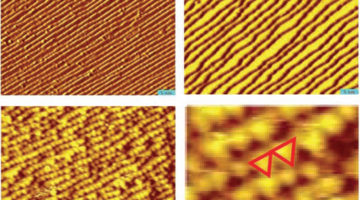
Researchers have found that under high pressure—comparable to the pressures at which many industrial technologies operate—platinum surfaces can change their structure dramatically in response to the presence of high-coverage reactants. Read more »