
A composite image of a rare form of kidney stone, illustrating extensive organic filamentous networks abundant with immune response-related proteins such as calprotectin (displayed in red), myeloperoxidase (in yellow), and DNA molecules (in blue). Originating from intricate host-microbe interplay, these organic networks promote the heterogeneous nucleation and precipitation of inorganic particulates. Read more »
ALS Work Using Scattering/Diffraction
These techniques make use of the patterns of light produced when x-rays are deflected by the closely spaced lattice of atoms in solids and are commonly used to determine the structures of crystals and large molecules such as proteins.
ALS Work on Roman Concrete Highlighted in German-French Documentary
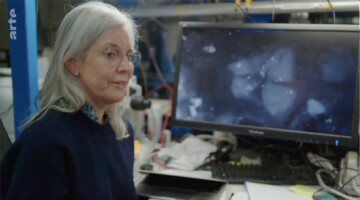
A study on the remarkable durability of 2000-year old Roman concrete, by ALS user Marie Jackson with ALS beamline scientist Nobumichi Tamura, was recently highlighted in “Miracle Materials,” a science documentary produced by a German-French company, Gruppe 5, for airing on the Eurpean public service channel, ARTE. Read more »
Making Renewable, Infinitely Recyclable Plastics Using Bacteria
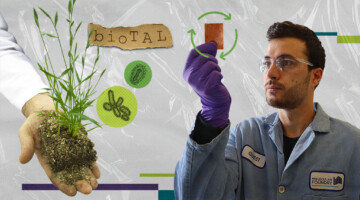
Scientists engineered microbes to make the ingredients for recyclable plastics—replacing finite, polluting petrochemicals with sustainable alternatives. The new approach shows that renewable, recyclable plastics are not only possible, but also outperform those from petrochemicals. Read more »
Keeping Water-Treatment Membranes from Fouling Out
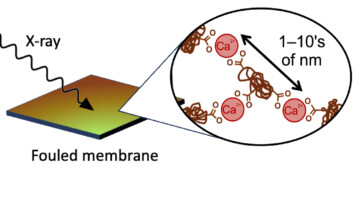
When you use a membrane for water treatment, junk builds up on the membrane surface—a process called fouling—which makes the treatment less efficient. In this work, researchers studied how membranes are fouled by interactions between natural organic matter and positively charged ions commonly found in water. Read more »
Coaxing Molecules to Stand Tall for Better Solar Cells
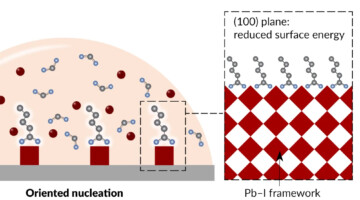
Multimodal probes revealed a way to prevent the formation of undesirable phases in a perovskite-type compound that shows promise for the efficient harvesting of light for solar cells. The work led to new fabrication protocols that resulted in devices with improved power-conversion efficiencies and operational stability. Read more »

Breaking Barriers in Drug Delivery with Better Lipid Nanoparticles
A collaboration between Berkeley Lab and Genentech, a member of the Roche Group, is working to break through some of the drug delivery bottlenecks by designing the most effective lipid nanoparticles (LNPs)—tiny spherical pouches made of fatty molecules that encapsulate therapeutic agents until they dock with cell membranes and release their contents. Read more »
Allosteric Tuning of Caspase-7: Establishing the Nexus of Structure and Catalytic Power

How can allosteric sites be more effectively targeted by small-molecule drugs? Using an integrated in vitro/in silico experimental workflow; we discovered novel allosteric inhibitors of caspase-7 and revealed new connections between the active site and the remote allosteric site (i. e., allosteric structure–activity relationships, ASARs) for this valuable disease target. Read more »
Plant Enzyme Builds Polymers That Fortify Cell Walls
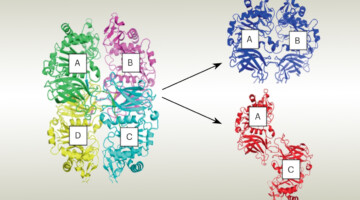
With data obtained at the ALS, researchers gained insight into how an enzyme orchestrates the synthesis of a pectin polymer that imparts strength and flexibility to plant cell walls. The work could lead to improved biofuel production and guide the design of polymers with tailored functionalities for industrial or biomedical applications. Read more »
Impact of Thermal Stress on Device Physics and Morphology in Organic Photodetectors

Implementing organic photodetectors (OPDs) into Si-based manufacturing process requires high thermal resistance. This work showcases a comprehensive picture of the impact of high thermal stress (at 200 °C, up to 2 hours) on photosensing performance, bulk and interfacial morphologies, and device physics. Read more »
Spiraling Beams Differentiate Antiferromagnetic States
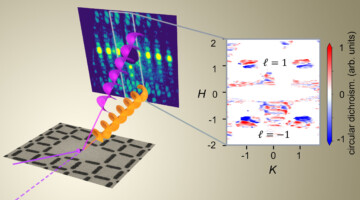
Using spiraling x-ray beams, researchers differentiated between energetically equivalent (“degenerate”) states in an antiferromagnetic lattice. The work shows the potential of these beams to probe properties that would otherwise be inaccessible, to better understand phenomena of fundamental interest and for applications such as spintronics. Read more »
- « Previous Page
- 1
- …
- 6
- 7
- 8
- 9
- 10
- …
- 40
- Next Page »