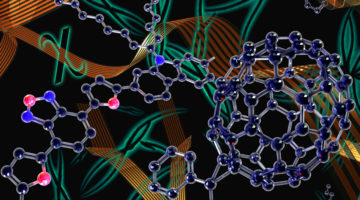
Researchers have established a new quantitative model that connects molecular interactions in organic solar-cell materials to device performance. The work suggests a way to quickly identify ideal material mixtures and processing methods, bypassing trial-and-error strategies and minimizing labor-intensive synthesis. Read more »

Enhancing the Efficiency of Organic Photovoltaics by a Photoactive Molecular Mediator

In the search for high-efficiency organic solar cells, additives often play an important role in improving the film morphology. Liquid additives, while often effective, evaporate or migrate over time. Herein, Liu et al. report a solid photoactive molecular mediator that could be employed to replace the liquid additives to tune the morphology of bulk heterojunction films for improved device performance. Read more »
Formation of a Photovoltaic Material from Precursor to Crystal
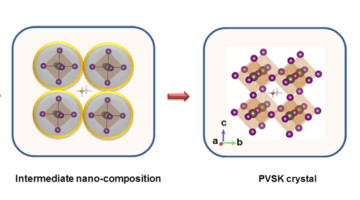
Lead halide perovskites have emerged as high-performance photovoltaic materials, demonstrating remarkably rapid improvements in efficiency. In situ printing and time-resolved x-ray characterization have provided new insights into the relationship between device efficiency, perovskite crystallinity, and film morphology. Read more »
The Smectic Phase of DNA “Nano-Nunchaku”
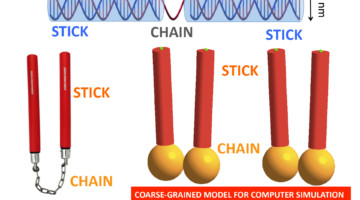
Researchers designed DNA sequences that self-assemble into a nanoparticle about 50 nm long, composed of two double-stranded DNA duplexes linked together by a single-stranded DNA filament. The nanoparticle resembles nunchaku—a traditional weapon of several martial arts—but 30 million times smaller. Read more »
Superlattices Patterned by Polymers

Scientists have shown that self-assembled superlattices, made up of nanoparticles with polymer chains grafted onto their surfaces (“hairy nanoparticles,” or polymer “brushes”), can be tailored to exhibit desired characteristics for applications ranging from nano- to biotechnology. Read more »
On the Way to Unlimited Energy
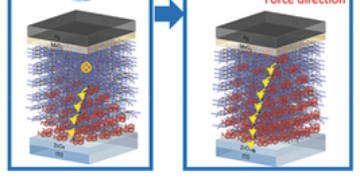
With the help of four different ALS beamlines, scientists were able to understand and improve the morphology of the main device structure in organic photovoltaic cells. Read more »
Porous-Framework Electrocatalysts Are Key to Carbon Dioxide Conversion
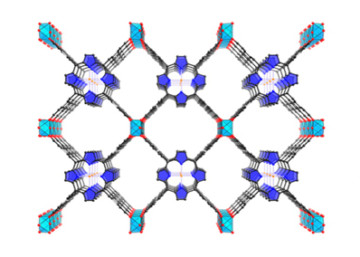
Researchers have made significant headway in the quest to convert CO2 into valuable chemical products such as fuels, pharmaceuticals, and plastics. Recent work at the ALS has shown MOFs and COFs as a valuable new class of CO2 reduction catalysts. Read more »
Weaving of organic threads into a crystalline covalent organic framework

Threads made from organic molecules linked by strong covalent bonds were used to weave a 3D covalent organic framework with unusual dynamical and mechanical properties. This molecular weaving method will enable the production of materials with increased precision and functionality. Read more »
Following the Morphology Formation In Situ in Printed Active Layers for Organic Solar Cells

Time-resolved scattering measurements reveal the complete solidification process inside the photoactive layer of an organic solar cell. With an industrial slot-die coater integrated into the beamline, aggregation and crystallization processes can be tracked to reveal the structure-function relationships in the final thin film. Read more »
Custom Organic Electronics Out of the Printer
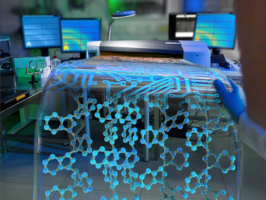
Using in situ x-ray characterization and a custom-made slot-die coater at Beamline 7.3.3, the cross-linking of polymer molecules in the active layer of an organic solar cell during the printing process could be observed.
Read more »
- « Previous Page
- 1
- …
- 4
- 5
- 6
- 7
- Next Page »