
Scientists have developed a conductive polymer coating—called HOS-PFM—that conducts both electrons and ions at the same time. This ensures battery stability and high charge/discharge rates while enhancing battery life. The coating also shows promise as a battery adhesive that could extend the lifetime of a lithium-ion battery from an average of 10 years to about 15 years. Read more »
How a Record-Breaking Copper Catalyst Converts CO2 Into Liquid Fuels
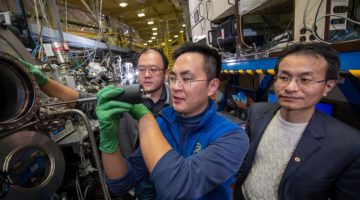
Scientists know that copper has a special ability to transform CO2 into valuable chemicals and fuels. But for many years, they struggled to understand how. Now, a research team has gained new insight by capturing real-time movies of copper nanoparticles as they convert CO2 and water into renewable fuels and chemicals: ethylene, ethanol, and propanol, among others. Read more »
Structural Investigation of Therapeutic Antibodies Using Hydroxyl Radical Protein Footprinting Methods

Well-known high-resolution structural methods are often used to characterize antibody structures, but many require specialized sample preparation that may perturb antibody structure. We describe here the relatively new method of hydroxyl radical protein footprinting, a solution-state method that can provide structural and kinetic information on antibodies or antibody–antigen interactions useful for therapeutic antibody design. Read more »
A Nano-IR Probe for Proteins in Liquid Environments
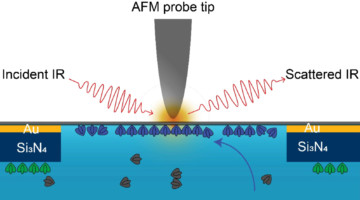
A new technique using infrared (IR) light revealed how the self-assembly of proteins is affected by environmental conditions in a surrounding liquid. This nanoscale probe of soft matter in a liquid matrix will facilitate advances in biology, plastics processing, and energy-relevant applications such as electrocatalysts and batteries. Read more »

A New Material System for Mixed-Plastic Recycling
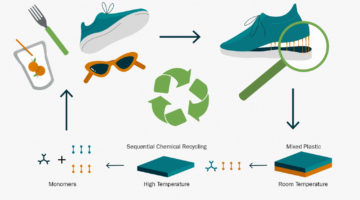
Scientists have designed a new material system to overcome one of the biggest challenges in recycling consumer products: mixed-plastic recycling. Their achievement will help enable a much broader range of fully recyclable plastic products and brings into reach an efficient circular economy for durable goods like automobiles. Read more »
Scientists Grow Lead-Free Solar Material With a Built-In Switch

A new ferroelectric material—grown in the lab from cesium germanium tribromide (CGB)—opens the door to an easier approach to making solar cell devices. Unlike conventional solar materials, CGB crystals are inherently polarized, where one side of the crystal builds up positive charges and the other side builds up negative charges, no doping required. Read more »
Multilayer Stack Opens Door to Low-Power Electronics
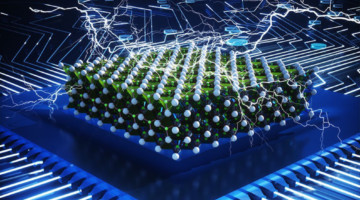
Researchers found that a multilayer stack of ultrathin materials exhibits a phenomenon called negative capacitance, which reduces the voltage required for transistor operation. The material is fully compatible with today’s silicon-based technology and is capable of reducing power consumption without sacrificing transistor size or performance. Read more »
Designer Materials to Keep Plastic Out of Landfills

Scientists have designed a new material system to overcome one of the biggest challenges in recycling consumer products: mixed-plastic recycling. Their achievement will help enable a much broader range of fully recyclable plastic products and brings into reach an efficient circular economy for durable goods like automobiles. Read more »
A Machine-Learning Approach to Better Batteries
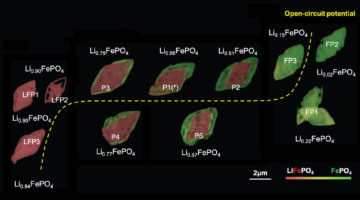
Researchers extracted the relationship between strain and composition in a battery material by applying machine-learning methods to atomic-scale images. The work could lead to more durable batteries and also highlights the potential of integrating microscopy techniques with machine learning to gain insights into complex materials. Read more »
Scientists Uncover Surprising New Clues to Exotic Superconductors’ Superpowers

Researchers studied a model material (CeCoIn5) that mimics a cuprate superconductor that can be switched on and off using high magnetic fields. In chemical compositions where the superconductivity is strongest, the number of free electrons jumps, signifying a transition point. The researchers attributed this transition to the behavior of electrons associated with the cerium atoms. Read more »
- « Previous Page
- 1
- 2
- 3
- 4
- 5
- 6
- …
- 11
- Next Page »