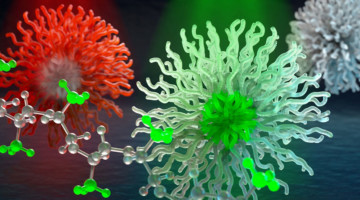
A technique developed at the ALS enables accurate characterization of organic nanocarriers (molecules that encapsulate other molecules) without the need for disruptive labeling. The method will enable faster, more precise development of exciting new technologies, ranging from targeted drug delivery to oil-spill remediation. Read more »

Designing Selective Membranes for Batteries Using a Drug Discovery Toolbox
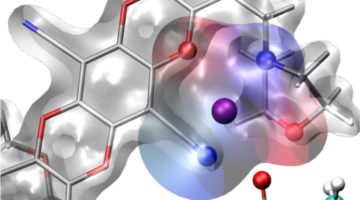
Researchers designed a polymer membrane with molecular cages built into its pores that hold positively charged ions from a lithium salt. These “solvation cages” increased lithium-ion flow by an order of magnitude and could allow high-voltage battery cells to operate at higher power and more efficiently, important for both electric vehicles and aircraft. Read more »
Coral Skeleton Reveals Hidden Structures under Multimodal Scrutiny
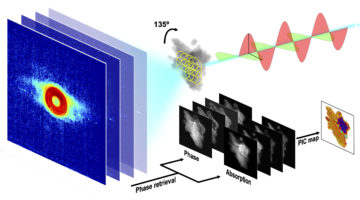
A powerful new microscope combining ptychography with x-ray linear dichroism provides nanoscale insight into the biomineral strength and resilience of a coral skeleton. The technique’s previously unachievable spatial resolution and contrast will open up new lines of research for users of x-ray microscopy at the ALS. Read more »
To Speed Discovery, Infrared Microscopy Goes “Off the Grid”

Researchers developed a highly efficient way to collect infrared microscopy data that avoids the use of slow, grid-based raster scans. The method substantially reduces image-acquisition times by autonomously increasing sampling density in regions of interest, facilitating infrared spectromicroscopy of biochemical processes in real time. Read more »
Stacking the Deck for Custom-Built Hybrid Materials
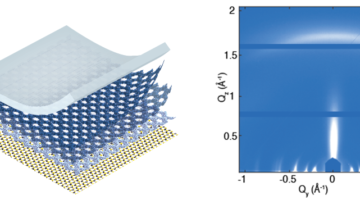
Researchers fabricated an electronically coupled heterostructure from a novel semiconducting 2D polymer and a 2D transition metal dichalcogenide. Dramatic optical and electronic changes emerged as polymer thickness decreased, underscoring the potential for the discovery of emergent phenomena in studies of hybrid heterostructures. Read more »
Molecular Complex Removes Copper Ions from Water
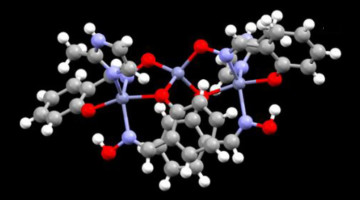
X-ray analyses provided key insights into the copper uptake mechanisms in a new organic-inorganic hybrid material that quickly and selectively removes copper ions from water. The material provides an efficient tool for copper remediation as well as a blueprint for creating other hybrid materials for removing toxic metals from water. Read more »
Speeding Toward Improved Hydrogen Fuel Production
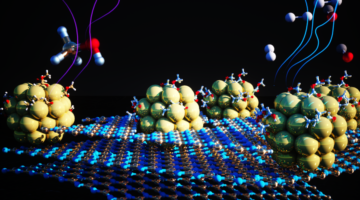
Researchers synthesized a material that speeds up one of the limiting steps in extracting hydrogen from alcohols. The catalyst cleanly and efficiently accelerates the removal of hydrogen atoms from a liquid chemical carrier. The material is robust, made from earth-abundant metals, and will help make hydrogen a viable energy source for a wide range of applications. Read more »
Super-Resolution Measurement of X-Ray Mirrors
ALS researchers, in collaboration with software and nanofabrication small businesses, developed a way to improve the accuracy of instruments that measure the surfaces of x-ray mirrors. The work significantly improves the quality of the data needed for the fabrication and optimal performance of advanced x-ray beamlines and space telescopes. Read more »
Scientists Design New Framework for Clean Water
A promising solution to water pollution from abandoned copper mines relies on materials that adsorb copper ions from wastewater, but commercially available products lack the required chemical specificity and load capacity. A team of scientists has designed a new crystalline material that targets and traps copper ions from wastewater with unprecedented precision and speed. Read more »
ALS and Molecular Foundry Funded to Lead the Development of New Artificial Intelligence and Machine Learning Tools
DOE recently awarded a combined $8.55 million to two Berkeley Lab-led teams to build new tools that harness the power of artificial intelligence and machine learning. Synchrotron and nanoscience users will benefit from Alex Hexemer’s MLExchange and Andrew Minor’s 4D Camera Distillery, both multidisciplinary projects involving multiple national labs. Read more »
- « Previous Page
- 1
- …
- 4
- 5
- 6
- 7
- 8
- …
- 11
- Next Page »