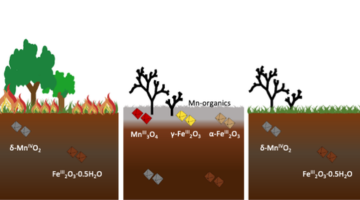
X-ray microscopy tools at the ALS and SSRL mapped the chemical changes inside wildfire ash particles, revealing that pyrogenic iron and manganese gradually disappeared as the soil recovered. These findings shed light on how wildfires drive transient mineral formation that impacts micronutrient cycling and soil resilience, with implications for landscape recovery strategies. Read more »
All News & Updates
Infrared Nanospectroscopy Reveals Behaviors of Ionic Liquids
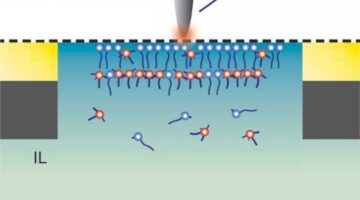
Researchers used infrared spectroscopy at the ALS to detect the molecular behaviors of ionic liquids—which serve as high performance electrolytes in energy storage devices—under varying charge bias conditions. Their insights define a direction for targeted design of ionic liquid-based electrolytes with optimized properties for energy storage applications. Read more »
Apply by April 30 for ALS Doctoral and Postdoctoral Fellowships
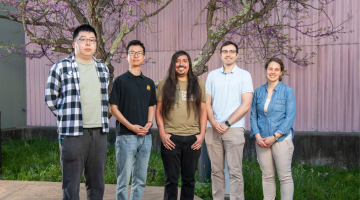
Applications for the next round of ALS Doctoral and Postdoctoral Fellowships are due April 30 for start dates this fall. Fellows spend a year in residence at the ALS conducting research and instrumentation development in collaboration with their home institution. Updated application instructions will be posted by April 6. Read more »
ALS-United: Thomas Gaucher, Raul Mascote, and Adrian Williams
ALS-United is an opportunity to meet the people collaborating at the Advanced Light Source and the ALS Upgrade Project. Hear firsthand how team science enables the cutting-edge research of today and builds the facility of the future. This month, we spoke with Thomas Gaucher (Manufacturing Engineer), Raul Mascombe (Engineering Technical Associate), and Adrian Williams (Engineering Technical Associate). Read more »
Accelerate UX Workshop Brings Global Expertise Together at the ALS
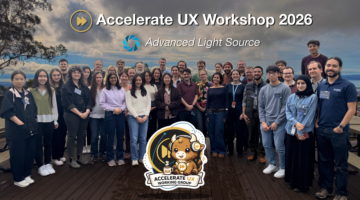
Staff from eleven different accelerator lab facilities gathered at the ALS to improve the user experience for operators, researchers, engineers, and more. Workshop participants learned from experts in the UX field and even took part in a hackathon that paired beamline scientists with interface developers. Read more »
Strength in Numbers: Nanopatterns Amplify X-Ray Signals from Buried Interfaces
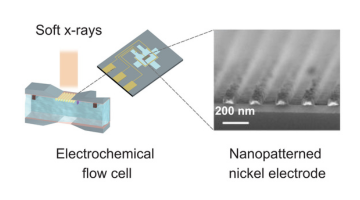
Berkeley Lab researchers developed a new x-ray technique that uses nanoscale patterns to amplify weak signals, allowing scientists to observe chemical reactions at buried solid–liquid interfaces that were previously challenging to study. Read more »
Local Disorder Impacts a Quantum Material’s Electronic States
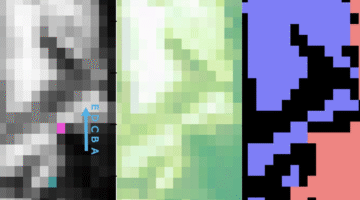
Machine learning tools and experiments at the ALS enabled the identification of defect-rich regions in single-crystalline Co3Sn2S2 that link to how surface electrons move. Atom-level understanding of how the surface electronic properties of a magnetic semimetal can be tuned could guide its use in advanced technologies like spintronics and catalysis. Read more »
2026 Winter Shutdown Recap
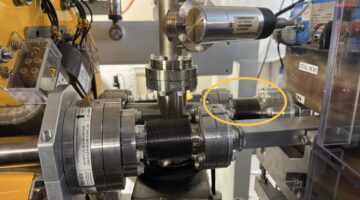
The 2026 winter shutdown started on January 2, and the ALS returned to user operations on Tuesday, February 3. It was the shortest shutdown the ALS has had since 2018; as a result, the current user run will be the longest one since 2018. One big accomplishment of the recent shutdown was the installation of the “golden bellows” connecting the accumulator ring vacuum with the rest of the ALS vacuum system. Read more »
Aerosol Chemistry Offers Clues to the Arctic’s Future
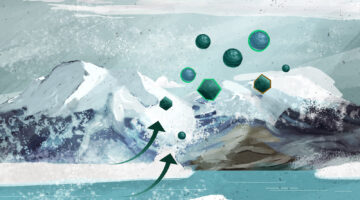
Researchers used scanning transmission x-ray microscopy to analyze Arctic aerosols, which strongly influence cloud formation and overall climate. Understanding what these particles are and how they change as they travel could help improve climate models and yield more accurate predictions of the changing Arctic environment’s global impact. Read more »
Disrupting Cancer’s Broken Molecular Switch
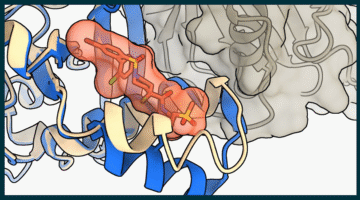
Researchers identified a compound that disrupts a hard-to-target tumor growth pathway in breast, lung, and other cancers and used the ALS to characterize the chemical interactions critical to its potency. This work contributed to the development of a similar compound currently undergoing clinical trials in cancer patients, and informs hypotheses for designing better drug candidates. Read more »
- 1
- 2
- 3
- …
- 142
- Next Page »