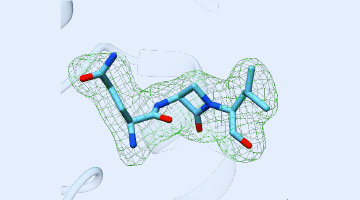
Using ALS beamlines, a new study revealed how CMX410 inhibits Pks13, a cell wall enzyme in Mycobacterium tuberculosis, the bacterium responsible for tuberculosis. CMX410 is effective against drug-sensitive and drug-resistant strains of the bacterium and has been proven safe in multiple animal models of infection. Read more »

All News & Updates
To Study Alien Atmospheres, ALS Fractures Nitrogen Gas
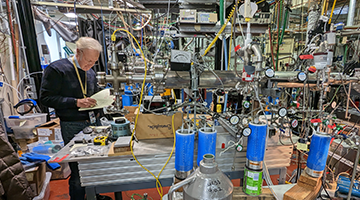
A research team used the ALS to recreate how the Sun breaks apart nitrogen to inform a new model that can be used to understand the fate of a variety of elemental isotopes to explain atmospheric evolution on planets across the solar system. Read more »
Beam Across the Bay: ALS Visits SSRL
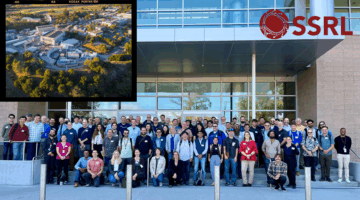
It is rare to find synchrotron light sources around the world, much less two within 50 miles of each other. Capitalizing on their proximity, the Stanford Synchrotron Radiation Lightsource hosted the Advanced Light Source for a day of introductions and reconnections, all in the name of science. Read more »
Call for 2024 and 2025 Publications

All publications resulting from work done in whole or in part at the ALS must be recorded by the User Office for the Department of Energy (DOE). To maintain accurate records and assess the productivity and scientific achievements of our beamlines, please report your ALS publications, especially those published in 2024 and 2025. Read more »
Nematic Magnetic Helices Fluctuate at Different Tempos
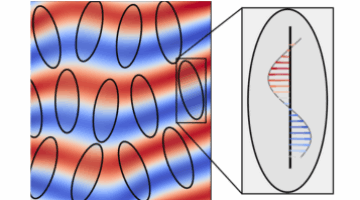
During a series of experiments at the ALS, researchers identified helical magnetic spins that fluctuate at different time scales during a phase transition as a function of temperature in a nematic iron germanium thin film. The results provide a framework for characterizing exotic phases, which may have interesting optical and transport properties for microelectronics and spintronics. Read more »
From Magnetite to Ammonia, A New Line of Production
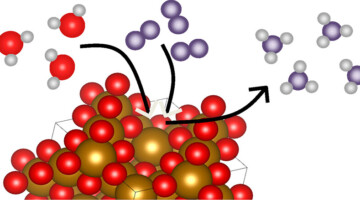
Ammonia is a critical ingredient in many important industrial and agricultural applications. The Haber–Bosch process is the primary process for large-scale ammonia production. A new study uses an experimental–theoretical approach to uncover how interfacial chemistry at the magnetite–water interface drives ammonia synthesis under ambient temperature and pressure. Read more »
The Quest for an Altermagnet
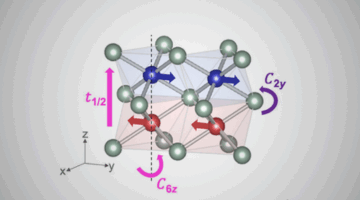
Researchers determine the unique electronic structure of altermagnets, which offers numerous benefits in creating energy-efficient devices based on spin-polarized electron currents. Understanding how altermagnetism works could contribute to the development of next-generation memory, logic, or sensing devices that are faster and consume less power. Read more »
Dula Parkinson Receives the 2025 Tim Renner User Services Award

In celebration of Dula Parkinson’s work, the ALS Users’ Executive Committee presented him with the 2025 Tim Renner User Services Award for his commitment to providing outstanding support at the ALS and helping users succeed in their research. Read more »
Characterizing Membrane Fouling with Operando Experiments
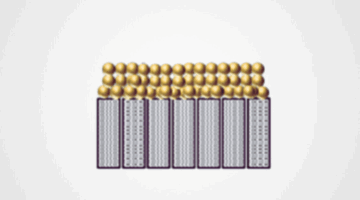
Membrane filtration offers a cost-effective, energy-efficient approach to purify and desalinate water, but fouling limits the performance of these devices. A new study explored the new experimental design that allows one to study the dynamic fouling process in real time to improve the field’s understanding of how materials deposit, accumulate, and/or crystallize on the membrane’s surface. Read more »
Sharks Shed Light on Origins of Adaptive Immune System
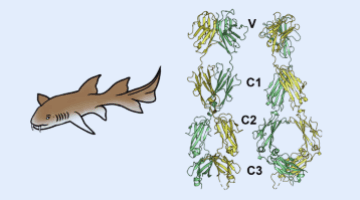
A team of researchers identified the three-dimensional structure of a protein expressed by a gene of a modern nurse shark that is proposed to be a close homologue to a gene that, more than 500 million years ago, gave rise to the adaptive immune system shared by all vertebrates. By understanding the emergence and evolution of the immune system, researchers may advance work in immunology, genetics, and biotechnology.
Read more »
- « Previous Page
- 1
- …
- 3
- 4
- 5
- 6
- 7
- …
- 142
- Next Page »