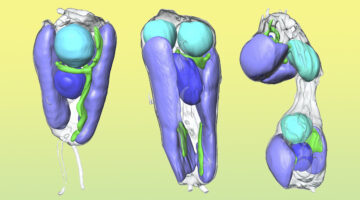
Researchers found that a symbiont capable of fixing nitrogen (turning it into a biologically usable form) has evolved into an organelle—an intrinsic part of the algae cells that host it. The discovery is of great interest for understanding organelle genesis and for efforts to engineer agricultural plants with built-in nitrogen-fixing capabilities. Read more »

ALS Work Using Microscopy/Imaging
These techniques use the light-source beam to obtain pictures with fine spatial resolution of the samples under study and are used in diverse research areas such as cell biology, lithography, infrared microscopy, radiology, and x-ray tomography.
Scientists Discover First Nitrogen-Fixing Organelle
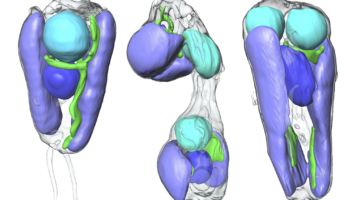
In two recent papers, an international team of scientists describe the first known nitrogen-fixing organelle within a eukaryotic cell. The organelle is the fourth example in history of primary endosymbiosis—the process by which a prokaryotic cell is engulfed by a eukaryotic cell and evolves beyond symbiosis into an organelle. Read more »
Nitrogen-fixing organelle in a marine alga

A nitrogen-fixing organelle, or “nitroplast,” has been identified in a marine alga on the basis of intracellular imaging and proteomic evidence. This discovery sheds light on the evolutionary transition from endosymbiont to organelle. The image depicts the cell architecture and synchronized cell division of the alga Braarudosphaera bigelowii with nitroplast UCYN-A (large brown spheres). Read more »
Shedding Light on Sea Creatures’ Secrets

Exactly how does coral make its skeleton, a sea urchin grow a spine, or an abalone form the mother-of-pearl in its shell? A new study at the ALS revealed that this process of biomineralization, which sea creatures use to lock carbon away in their bodies, is more complex and diverse than previously thought. Read more »
Watching the Enzymes that Convert Plant Fiber into Simple Sugars

Research from Lawrence Berkeley National Laboratory, Lawrence Livermore National Laboratory, and UC Davis sheds new light on how to access the sugars locked up in plants to produce petroleum-free fuels, chemicals, and medicines. The technique used combines a novel microfluidic device and infrared spectroscopy to study how a cellulose-degrading enzyme works in real time. Read more »
Magnetically Selective Versatile Transport of Microrobotic Carriers

Field-driven transport systems offer the possibility of biofunctionalized carriers for microrobotics, biomedicine, and cell delivery. Here, researchers show how magnetic fields may selectively manipulate and drive microrobotics along a patterned micromagnet. Different-sized magnetic carriers move in multiple directions, including selective rotation and bidirectional movement. Such steering systems can direct the delivery of drugs or cells into artificial microvascular channels. Read more »
How Processing Affects Structure in Composite Nanotube Yarns
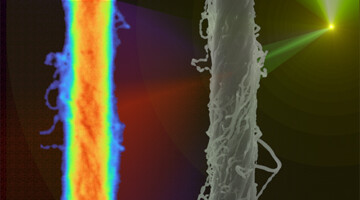
Using the ALS, researchers found quantitative correlations between processing parameters and the structure of ultrafine, polymer-reinforced carbon-nanotube fibers. The work will facilitate the production of high-strength materials, including those needed for positioning target capsules for fusion research at the National Ignition Facility. Read more »
Tracking Platinum Movement on Fuel-Cell Electrodes
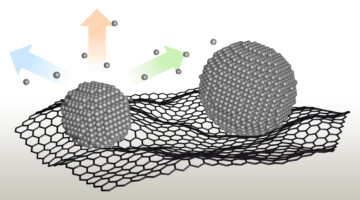
Researchers tracked the movement of the platinum nanoparticles that catalyze reactions in polymer electrolyte fuel cells (PEFCs) and correlated this movement with nanoparticle degradation. The results yielded solutions that can immediately reduce platinum waste in emission-free heavy-duty fuel-cell vehicles. Read more »
“Computer Vision” Review of X-Ray Movies Leads to New Insights
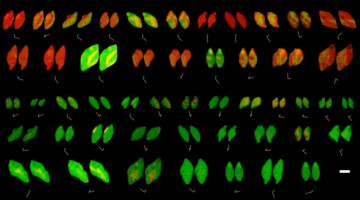
Using a type of machine learning called “computer vision” to mine data from x-ray movies, researchers made new discoveries about the reactivity of a material in rechargeable batteries. The results suggest that optimizing the carbon layer thickness on the electrode surface could help researchers to design more efficient batteries. Read more »
Why Do Batteries Sometimes Catch Fire and Explode?

In order to better understand how a resting battery might undergo thermal runaway after fast charging, scientists are using a technique called “operando x-ray microtomography” to measure changes in the state of charge at the particle level inside a lithium-ion battery after it’s been charged. Read more »
- « Previous Page
- 1
- 2
- 3
- 4
- 5
- …
- 20
- Next Page »