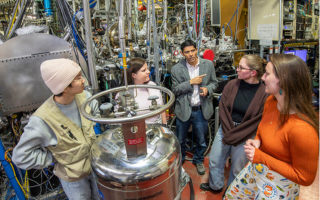
The Advanced Light Source Upgrade project will generate brighter beams of X-ray light, allowing researchers to push the boundaries of quantum materials research further by collecting data with far greater detail than has been possible before. Read more »
Planning a New Era of Discovery with ALS-U

The ALS is undergoing an ongoing upgrade that will increase our brightness by at least 100 times compared with the current accelerator and improve X-ray coherence. Read about how this leap in brightness will enable groundbreaking sensitivity and precision, empowering researchers to see our world like never before. Read more »
Burning Questions: How Heat Shield Materials Evolve Under Extreme Heat
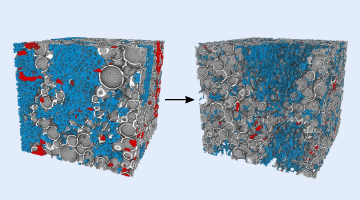
Superlight ablator materials are critical for protecting spacecraft under the extreme heat of atmospheric reentry. Researchers combined in situ X-ray microcomputed tomography at the ALS with super-resolution techniques to characterize the microstructural evolution of these materials during heating. Read more »
American Science and Security Cloud: A Platform for AI
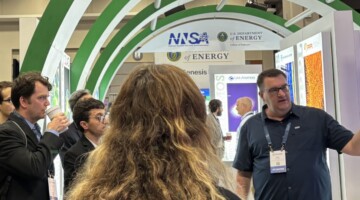
What is the American Science and Security Cloud? Data Platforms Program Lead Dylan McReynolds explains how the ALS is using this network of tools and helping build an even more robust platform. Read more »
Director’s Message on Beamtime in 2027

The ALS-U project plan has now been updated, and we have revised our proposal calls leading up to the dark time. Dark time remains on track to start no earlier than October 2027 (~22 months). With substantial user beamtime anticipated in 2027, we’ve added a new proposal call due September 2, 2026. Learn more about the details and contact alsproposals@lbl.gov with questions. Read more »
Multiscale X-Ray Measurements Reveal How Stretchable Polymer Semiconductors Dissipate Stress
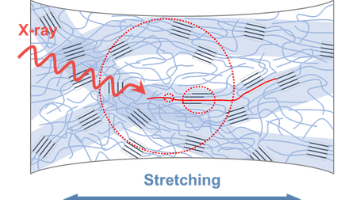
Using multimodal, in situ measurements at the ALS, researchers uncovered a two-stage process for how stretchable polymer semiconductors adapt their structure during stretching. The findings establish a multiscale design framework for conjugated polymers used in stretchable electronic devices. Read more »
Infrared Nanospectroscopy Reveals Behaviors of Ionic Liquids
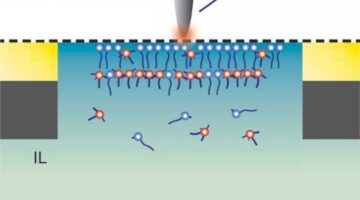
Researchers used infrared spectroscopy at the ALS to detect the molecular behaviors of ionic liquids—which serve as high performance electrolytes in energy storage devices—under varying charge bias conditions. Their insights define a direction for targeted design of ionic liquid-based electrolytes with optimized properties for energy storage applications. Read more »
Local Disorder Impacts a Quantum Material’s Electronic States
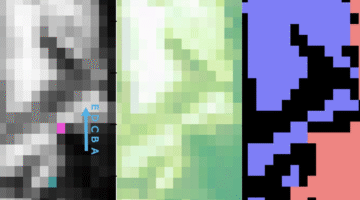
Machine learning tools and experiments at the ALS enabled the identification of defect-rich regions in single-crystalline Co3Sn2S2 that link to how surface electrons move. Atom-level understanding of how the surface electronic properties of a magnetic semimetal can be tuned could guide its use in advanced technologies like spintronics and catalysis. Read more »
AI Delivers Rapid, Precise Design of Tumor-Targeting Protein
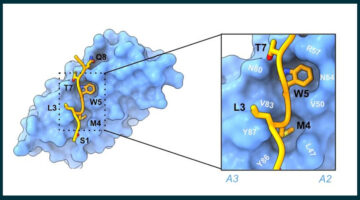
A new protein designed using AI can precisely recognize a key therapeutic target for cancer. X-ray crystallography data collected at the ALS confirmed the new protein’s specificity for its target, demonstrating a configurable and scalable approach to cancer therapy. Read more »
Ancient Asteroid Provides Evidence of Amino Acid Precursors

Researchers identified nitrogen-rich compounds in samples from the asteroid Bennu, returned to Earth by NASA’s OSIRIS-REx mission. The results support the idea that asteroids like Bennu may have delivered the essential chemical building blocks of life to Earth in the distant past. Read more » 
- 1
- 2
- 3
- …
- 14
- Next Page »