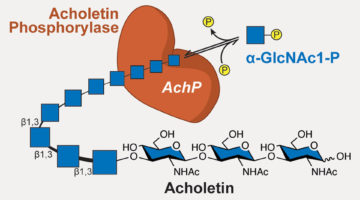
Researchers discovered a bacterial enzyme that synthesizes a biopolymer whose repeating units are linked together in way that had not been previously observed. The new polymer is biodegradable and may be biocompatible, with potential for applications ranging from medical therapeutics to eco-friendly plastic alternatives. Read more »

A Machine-Learning Approach to Better Batteries
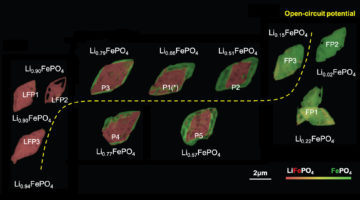
Researchers extracted the relationship between strain and composition in a battery material by applying machine-learning methods to atomic-scale images. The work could lead to more durable batteries and also highlights the potential of integrating microscopy techniques with machine learning to gain insights into complex materials. Read more »
Infrared Probe of Ultrahigh-Quality Nanoribbon Resonators

Researchers found that ribbon-like thin films, grown through a bottom-up, self-assembly approach, can act as ultrahigh-quality nanoscale resonators of lattice vibrations at infrared frequencies. These ultrathin nanostructures are ideal platforms for applications that harness infrared light, such as thermal emission and molecular sensing. Read more »
A Novel Insulating State Emerges in a 2D Material

Researchers found a unique insulating state in an atomically thin material, driven by the combined effects of lattice–charge interactions and atomic-bond formation. The work provides a better understanding of charge ordering in two-dimensional materials and opens up new possibilities for achieving designer electronic properties. Read more »
What Drives Electron–Hole Asymmetry in Graphene?

Using the ALS, researchers determined that interactions between electrons are what give rise to the divergent effects observed when graphene is doped with electrons versus holes. A better understanding of this electron–hole asymmetry could lead to new avenues for generating exotic material phases, including unconventional superconductivity. Read more »
Improving the Efficiency of Atmospheric Water Harvesting
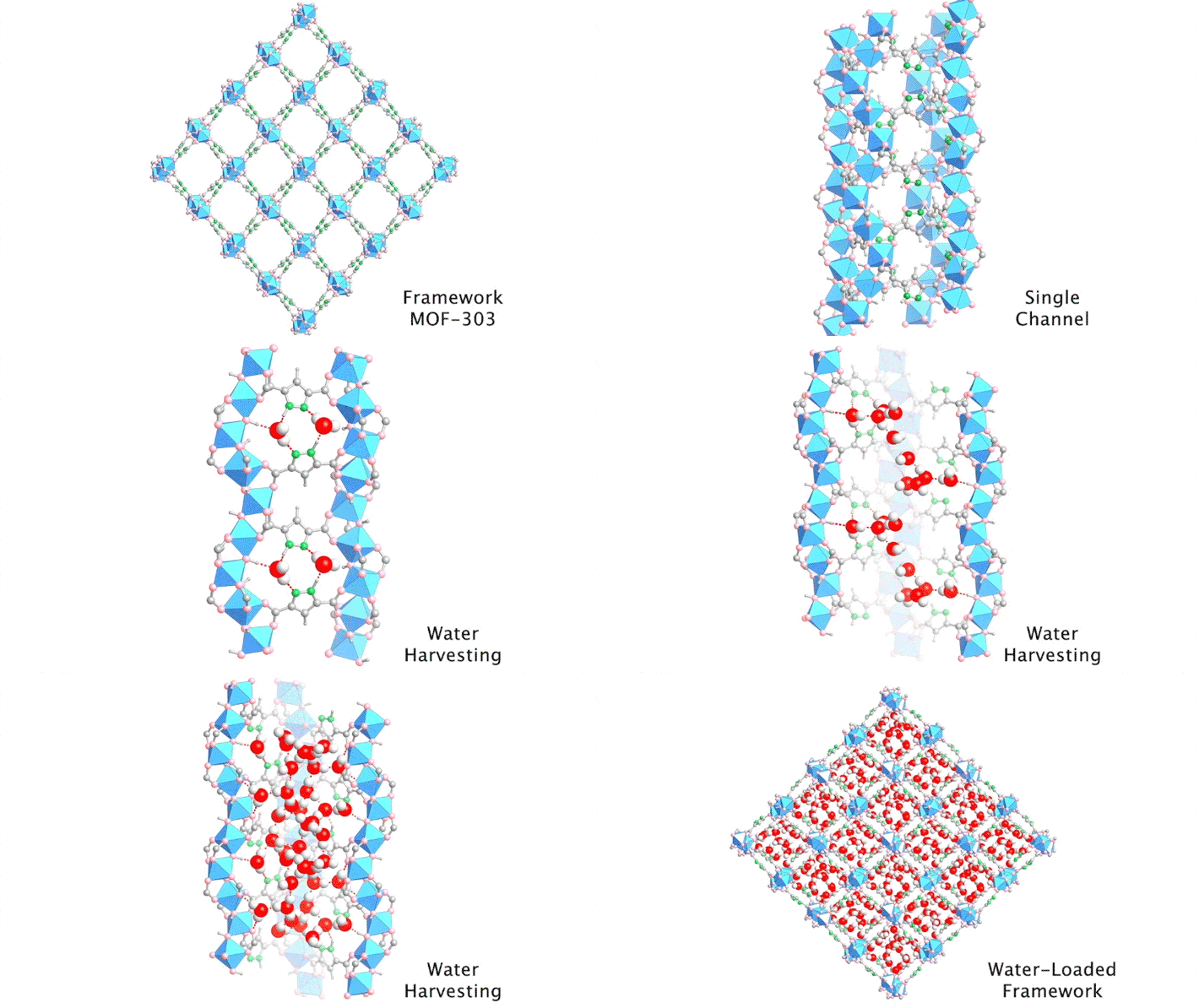
Researchers traced the step-by-step path of water-molecule uptake in a porous compound, then made pinpoint modifications to shape the material’s water-sorption behavior. The results led to improvements in the compound’s efficiency at harvesting water from the air, an important step toward alleviating water shortages in the future. Read more »
Interlayer Coupling Drives Mysterious Phase Transition
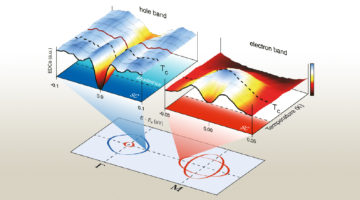
Researchers found that a mysterious phase transition in an iron-based superconductor is driven by interactions between the material’s 2D layers. The results counter the assumption that interlayer coupling is negligible in such materials, suggesting instead that the interactions can be an effective way to tune superconductivity. Read more »
Revealing Lithium Metal’s Electronic Structure

Spectroscopy at the ALS and theoretical calculations at the Molecular Foundry revealed the intrinsic spectroscopic signature of lithium metal and explained the origin of previous contradictory reports. The findings provide a benchmark for further studies of lithium compounds towards batteries with higher capacity and energy density. Read more »
Unexpected Transformations Reinforce Roman Architectural Concrete

Researchers used the ALS to study binding phases in Roman architectural concrete, revealing reactions and profound transformations that contribute to long-term cohesion and durability. The findings add to our growing understanding of cementing processes in Roman concretes, informing resilient materials of the future. Read more »
A Split-Screen View of Solar-Cell Crystallization

Researchers simultaneously monitored both the structure and function of a photovoltaic material as it crystallized from solution. The work raises the prospect of rationally tuning materials for optimal performance in photovoltaics and other light-manipulating devices, including light-emitting diodes, detectors, and lasers. Read more »
- « Previous Page
- 1
- …
- 5
- 6
- 7
- 8
- 9
- …
- 14
- Next Page »